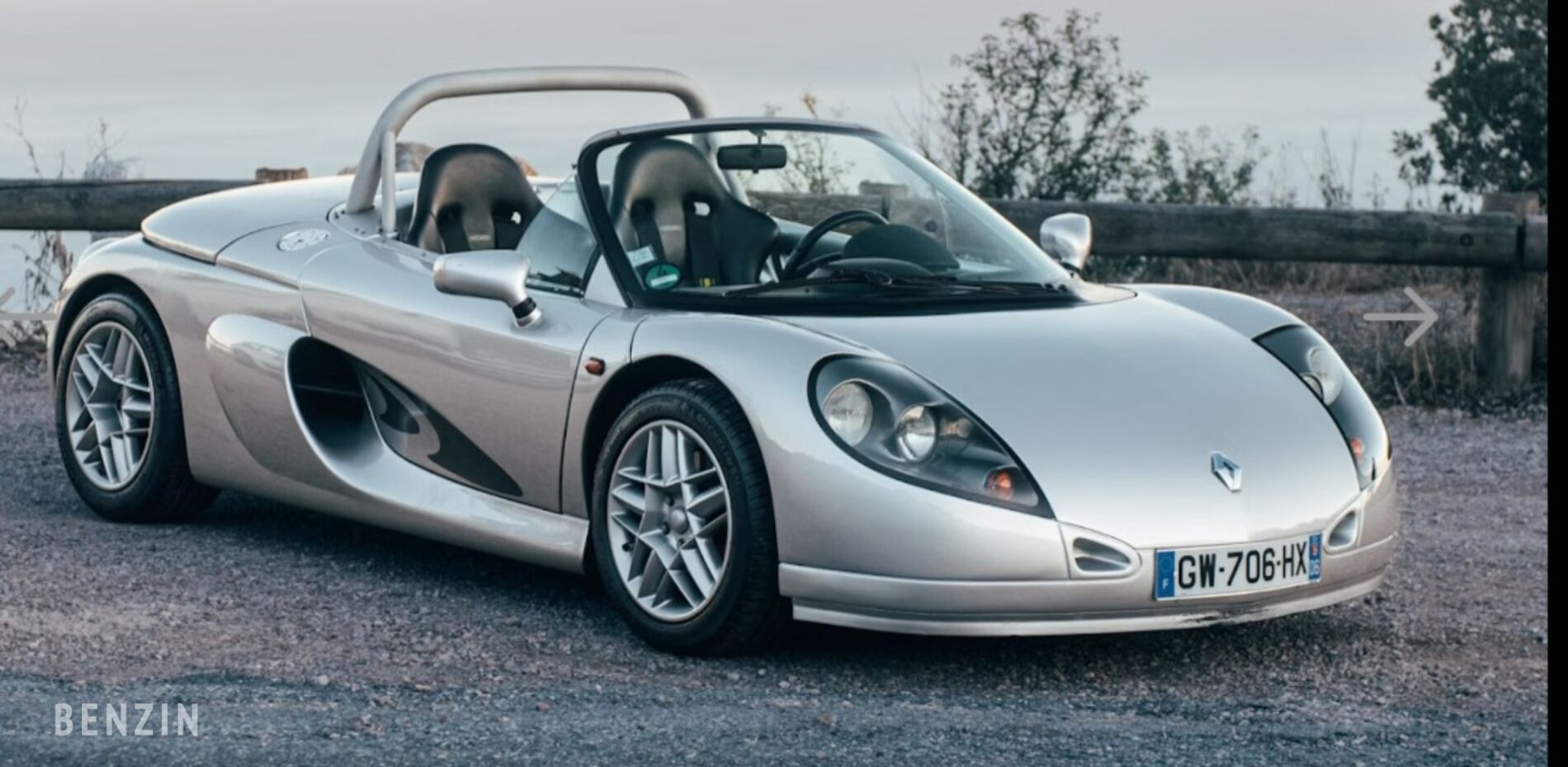
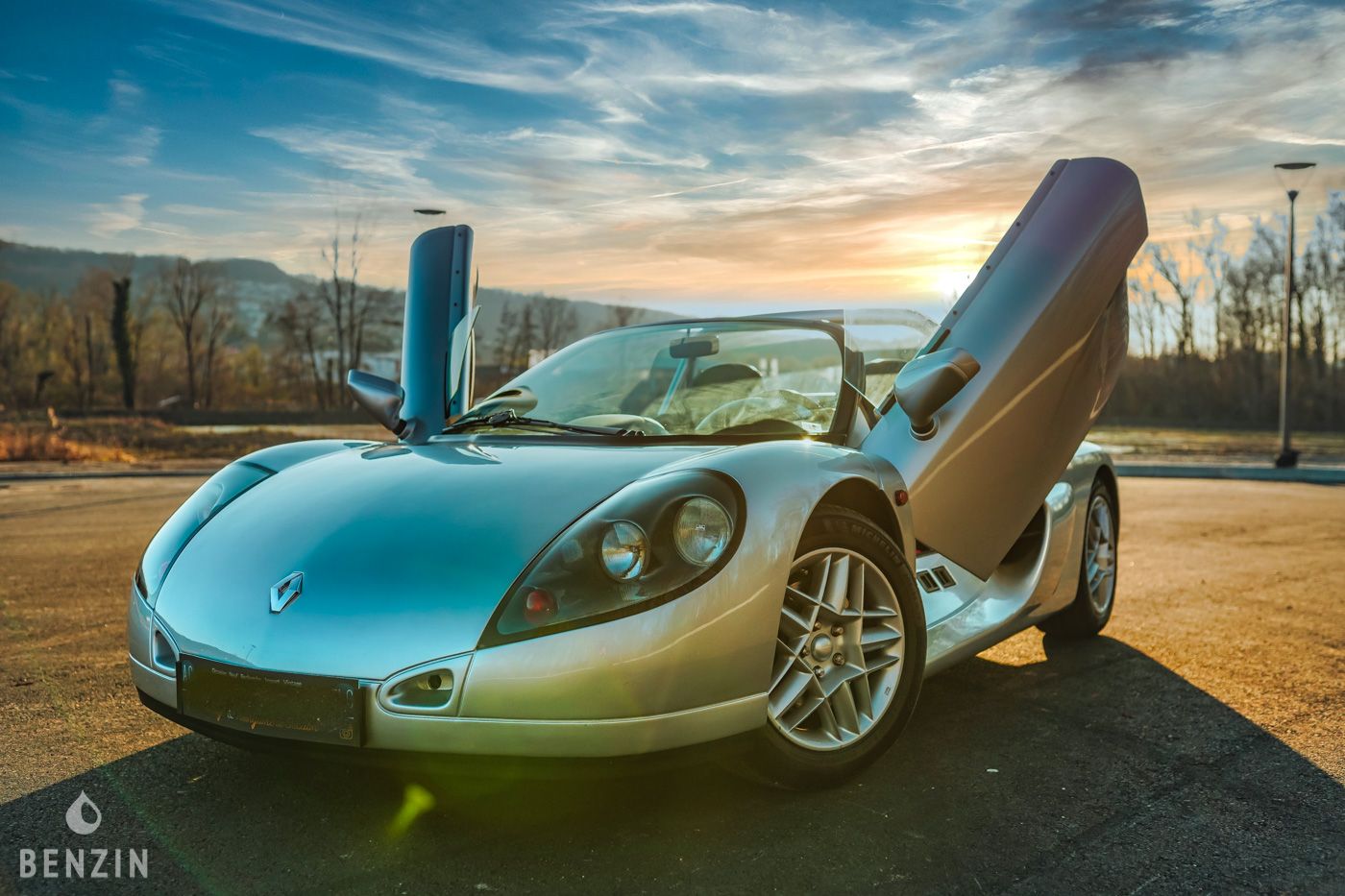
Introduced in the mid-1990s, the Renault Sport Spider is one of Renault’s most unusual projects: an ultra-light, uncompromising roadster developed by Renault Sport as a showcase of expertise and as an image bridge between road and racing. Its highly demonstrative styling, with fully exposed wheels, hollowed-out flanks and an aluminium cell, follows the tradition of lightweight barquettes more than that of conventional convertibles. The design is based on an aluminium chassis and composite bodywork, assembled in Dieppe at the Alpine site. At launch in 1995, the most radical version stood out for the complete absence of a windshield, replaced by a simple wind deflector, making it a very committed driver’s car. The chosen engine is the 2.0-litre 16-valve F7R four-cylinder, well known at Renault Sport, here mounted in a mid-rear position and paired with a five-speed manual gearbox.
The range remained simple, but the model evolved with the arrival of a version fitted with a windshield, intended to meet the expectations of part of the clientele and make road use easier. Power remained close to 150 hp depending on the market and regulations, while the spirit remained that of a light, very direct and unfiltered machine. The Spider also served as the basis for the Spider Trophy, a spectacular one-make series that greatly contributed to its reputation among track-day enthusiasts and Renault Sport fans. Its commercial career remained brief, until 1999, and total production remained limited, with just under 1,700 examples assembled. Today, the Spider occupies a special place in Renault production: too radical to have been a mass-market success, but highly regarded by enthusiasts for its purity of driving, rarity and status as a precursor in the modern history of Renault Sport.
Technical sheet
| Spider wind deflector | Spider windshield |
| Production years | 1995-1999 | 1997-1999 |
| Body style | 2-seat roadster | 2-seat roadster |
| Chassis | Aluminium, composite bodywork | Aluminium, composite bodywork |
| Engine(s) | 4-cylinder inline 2.0 16v F7R | 4-cylinder inline 2.0 16v F7R |
| Power | 150 hp | 150 hp |
| Transmission | Rear-wheel drive, 5-speed manual gearbox | Rear-wheel drive, 5-speed manual gearbox |
| Weight | around 930 kg | around 965 kg |
| 0-100 km/h | around 6.9 s | around 7.0 s |
| Top speed | around 215 km/h | around 215 km/h |
| Production | just under 1,700 examples in total |
Buyer’s guide
The most sought-after examples are generally the wind-deflector versions, truer to the original concept and rarer in this extreme configuration. For more road-oriented use, the Spider windshield version is often the best compromise, provided it is complete and true to its original configuration. It is best to be wary of incomplete cars, modified for track use or rebuilt with missing specific parts, as some Spider-specific items are difficult to find.
Points to watch
- Aluminium chassis and mountings : signs of impact, repair work or geometry that cannot be set correctly, on all versions; the suspension mounting points, floorpan, and the quality of any repairs after a track excursion or minor impact must be carefully inspected.
- Composite bodywork : cracks around the mountings, uneven panel gaps and chips on exposed areas, common on cars that have covered a lot of miles or been used on track; check the sills, wheel arch surrounds and front end, where a repair may look acceptable cosmetically but be mediocre structurally.
- Cooling system : overheating, temperamental fans or poor bleeding, a known issue on poorly maintained cars; check the front radiator, the long coolant pipes, the absence of mayonnaise, and invoices for hose replacement or head gasket work if the engine has overheated.
- F7R engine : overdue timing belt service, irregular idle or seepage, on all model years; ask for proof of replacement of the belt, tensioners and water pump, and check that it still runs strongly and smoothly without abnormal smoke.
- JC5 gearbox and controls : worn synchros, difficult engagement of 2nd gear or play in the linkage, especially on cars used hard; on a test drive, the gearbox must remain precise both hot and cold, without crunching on downshifts.
- Ball joints, pivots and running gear : knocks, imprecise front-end behavior or uneven tire wear, fairly common on this model that is very sensitive to alignment; the condition of the joints and shock absorbers must be checked, and it is worth asking whether a recent alignment was carried out by a workshop familiar with the Spider.
- Specific equipment : wind deflector, windshield, soft top, gullwing doors, covers, jack and original suitcase may be missing; on this model, the presence of the dedicated parts matters a great deal, as they are expensive or difficult to find.
At the time of purchase
On a Spider, it is important to note the chassis number, the manufacturer’s plate and, for an imported car, the original documents or the certificate confirming the correct version. A lift inspection is almost essential to examine the underside, the suspension mountings and any impact marks on the aluminium chassis. Timing, cooling and alignment invoices matter more here than a simple service book, and a test drive must absolutely include a fully warmed gearbox as well as monitoring of engine temperature.
1 of the 3 Renault Spider listed on Benzin found a buyer — 33 % of completed sales.
No Renault Spider is for sale at the moment. Follow the model to be notified as soon as a new one is listed.
Every vehicle comes with a detailed photo report, its history and the public exchanges between seller and community. You bid online; if you win, Benzin secures the payment and supports you through to delivery.
Follow the model from this page and you will get an e-mail as soon as a Renault Spider is listed on Benzin.
 English
 Français
 Español
 Italiano
 Deutsch
 Polski
 Magyar
