Renault Megane 2 RS
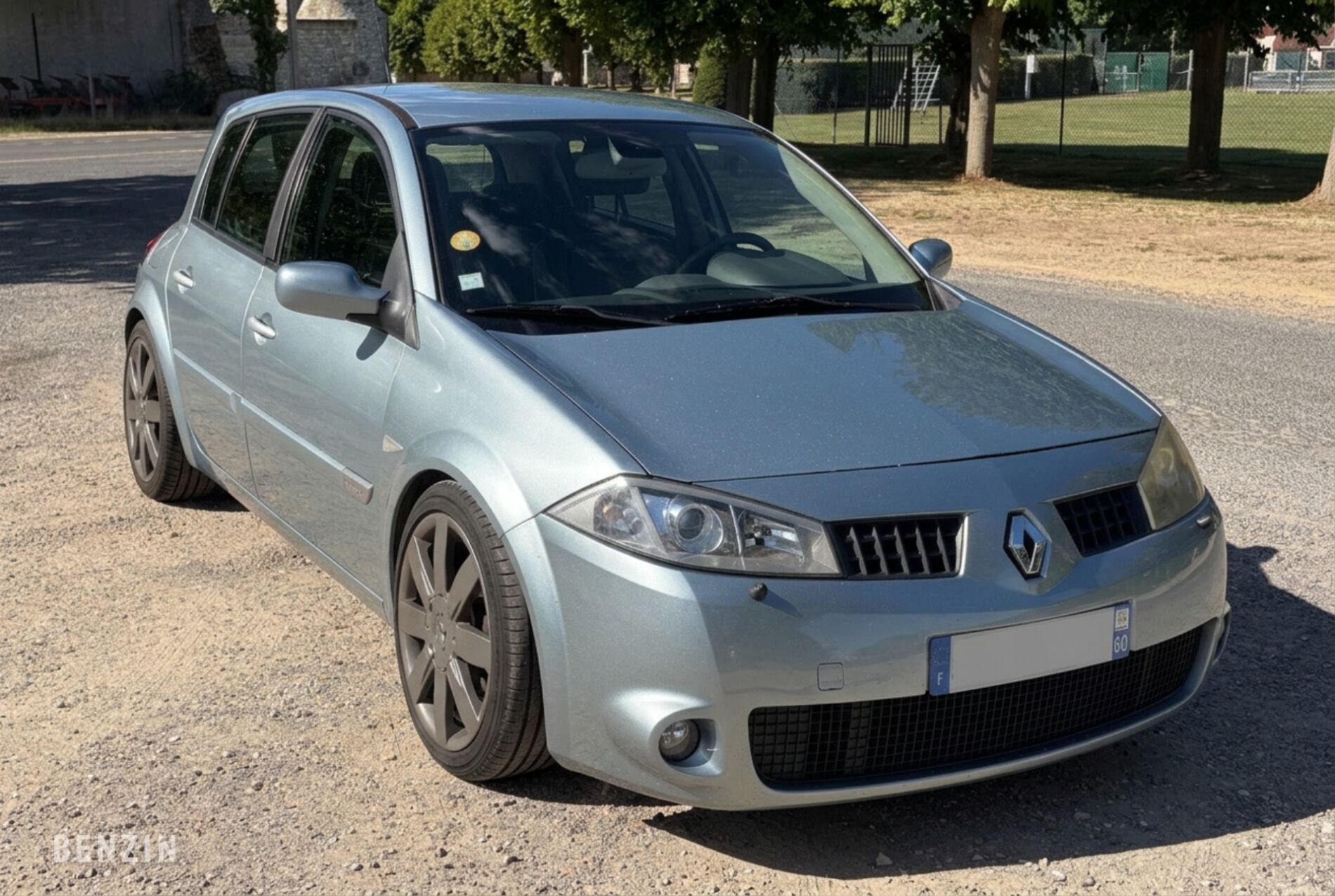
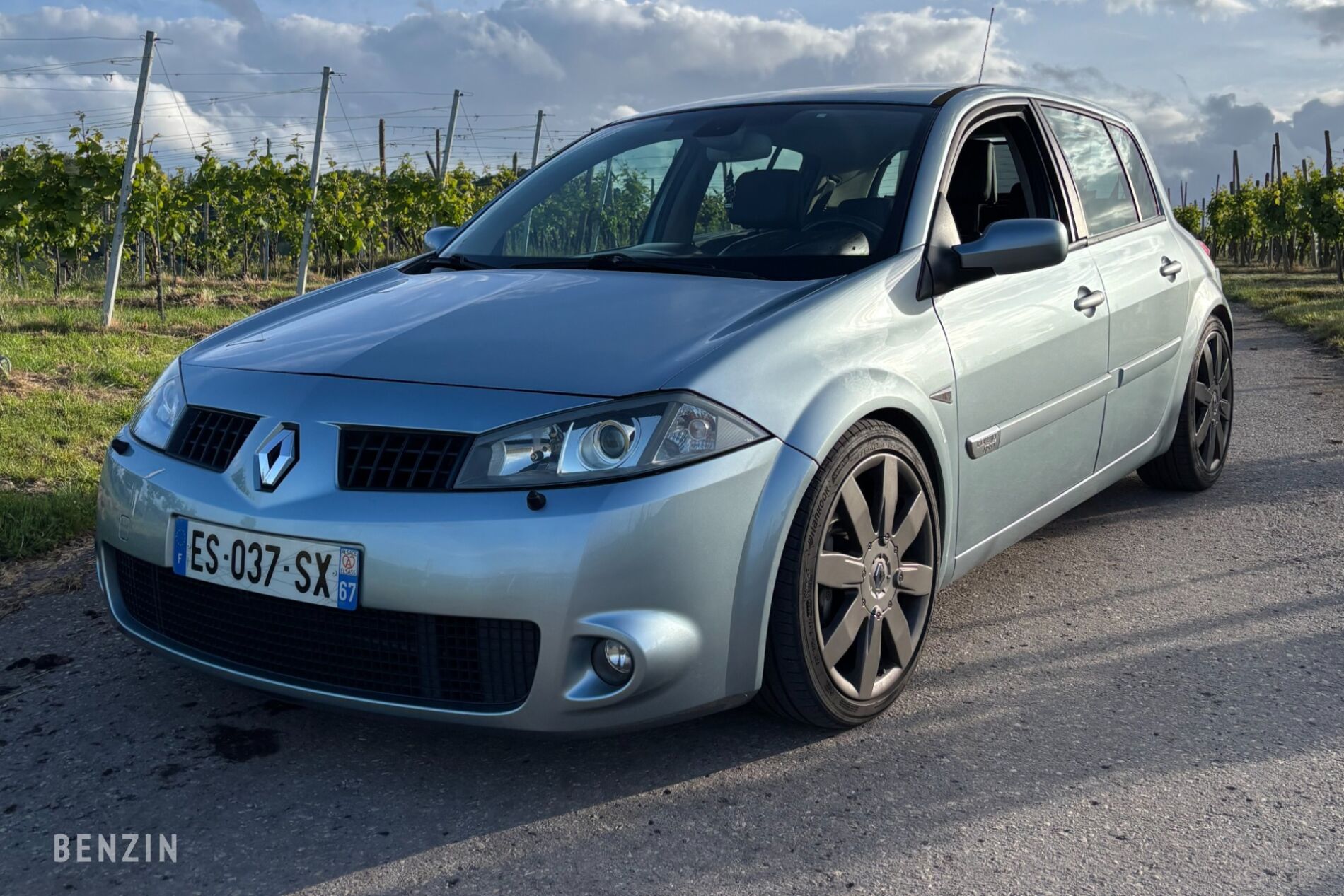
The Renault Mégane II Renault Sport appeared in autumn 2004 as the most radical version of the second-generation Mégane, developed by Renault Sport Technologies in Dieppe around the 3-door body shell, and more rarely as a 5-door in some markets. Its specific styling, due to the largely open front bumper, widened wings and independent pivot front end, clearly set it apart from the mainstream sporty hatchbacks of the time. Under the bonnet is the 2.0-liter turbocharged four-cylinder F4Rt in its 225 hp form, paired with a 6-speed manual gearbox. From launch, the model stood out for its highly sophisticated front end, Brembo braking and two chassis setups depending on market and year, Sport or Cup, the latter being firmer and sharper. The first series is often unofficially called “phase 1”, with its interior presentation and electronics specific to the early Mégane II. In 2006 came phase 2, recognizable by its light facelift, revised trim and several special editions that maintained the car’s very “F1” image.
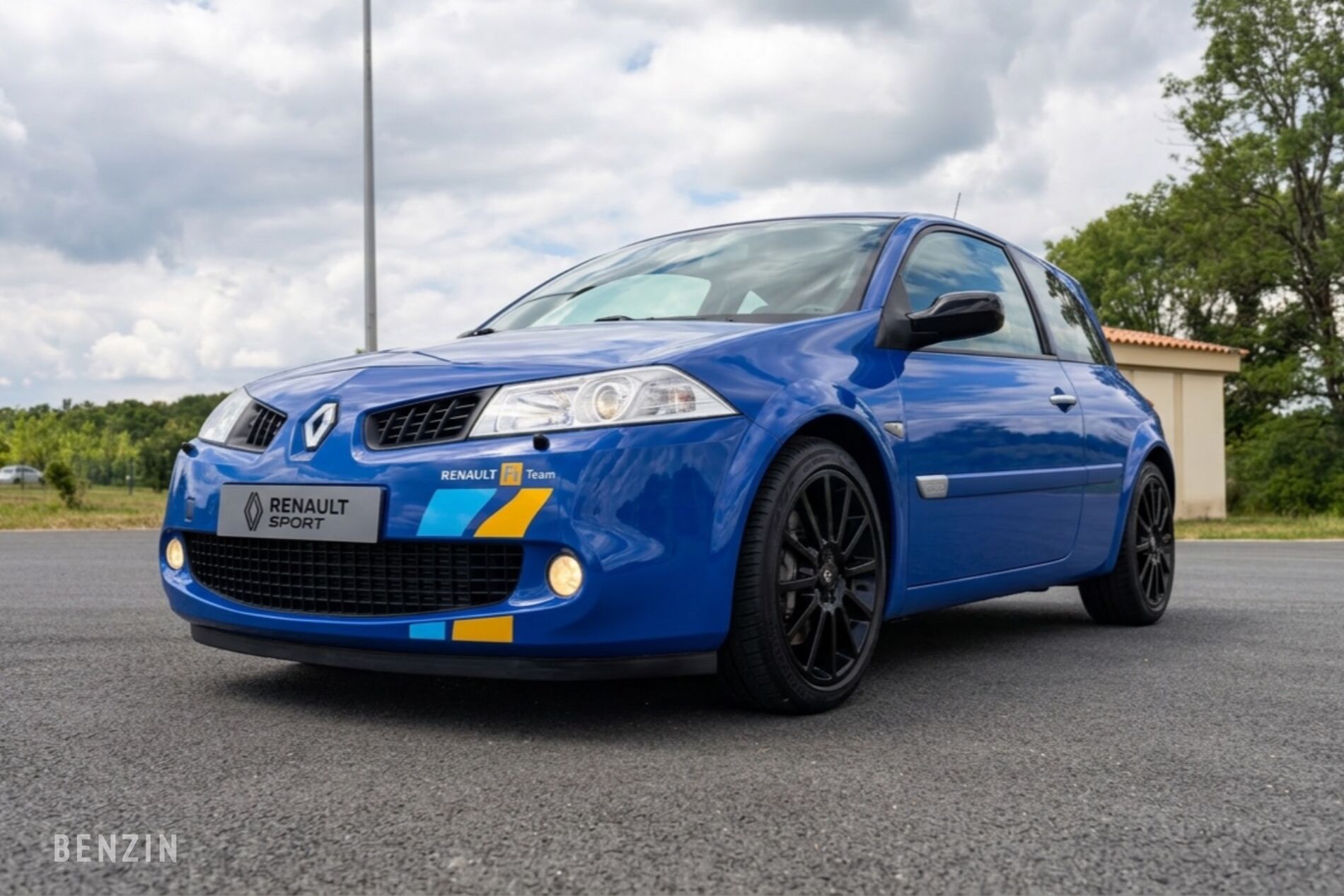
Among the notable versions are the 2005 Trophy series, produced in limited numbers, reduced in equipment and fitted with sought-after chassis upgrades, as well as the F1 Team and R25, whose naming is often a source of confusion on the used market because not all of them correspond to the same specifications depending on the country. In 2006, the Mégane R26 became the benchmark of the range with 230 hp, a mechanical limited-slip differential on the front axle and the Cup chassis as standard, making it the most balanced for sporty use. Renault Sport then launched a genuine image strategy around lap times, track days and the link with Formula 1, turning it into one of the most respected front-wheel drives of its era. Its behavior, both very incisive and surprisingly well filtered on fast roads, quickly earned it a benchmark reputation against contemporary Golf GTI, Civic Type R and Focus ST models. The car also fostered a strong tuning culture, with the F4Rt engine handling remaps and intake, exhaust and cooling upgrades well, which explains the presence of many modified examples.
The pinnacle of the range is the R26.R, launched in 2008, a stripped-down, radical lightweight version without a rear bench, which could receive Sabelt bucket seats and a carbon hood depending on the market. Produced in 450 examples, it immediately became a cult object after its record on the Nürburgring Nordschleife for a production front-wheel drive car. Across all Mégane II RS versions, production runs into several tens of thousands of units, but the most desirable versions remain significantly rarer than the “standard” 225s. Today, the Mégane II RS is considered one of the most important modern Renault Sport models, both for the effectiveness of its chassis and for the arrival of the differential on the R26 versions. Enthusiasts primarily seek cars that have remained close to original, with their exact configuration, their specific Renault Sport parts and clear identification of the limited editions, because conversions and fake “F1 Team” or “R26” trim are common.
Technical sheet
| Version | Mégane II RS 225 | Mégane II R26 | Mégane II R26.R |
|---|---|---|---|
| Production years | 2004-2008 | 2006-2008 | 2008-2009 |
| Body | 3-door hatchback, more rarely 5-door | 3-door hatchback | Lightweight 3-door hatchback |
| Engine | 4-cyl. turbo 1,998 cc F4Rt | 4-cyl. turbo 1,998 cc F4Rt | 4-cyl. turbo 1,998 cc F4Rt |
| Power | 225 hp | 230 hp | 230 hp |
| Torque | 300 Nm | 310 Nm | 310 Nm |
| Transmission | Front-wheel drive, 6-speed manual gearbox | Front-wheel drive, 6-speed manual gearbox, mechanical limited-slip differential | Front-wheel drive, 6-speed manual gearbox, mechanical limited-slip differential |
| Curb weight | approx. 1,355-1,430 kg depending on body style and equipment | approx. 1,375 kg | approx. 1,230 kg |
| 0-100 km/h | approx. 6.5 s | approx. 6.1 s | approx. 6.0 s |
| Top speed | approx. 236 km/h | approx. 240 km/h | approx. 240 km/h |
| Features | Independent pivot front end, Brembo brakes, Sport or Cup chassis depending on version | Standard Cup chassis, limited-slip differential, R26 trim | Extensive weight reduction, rear bench removed, reduced equipment |
| Production | several tens of thousands of examples across the RS 225 range | regular production series, much rarer than the 225 | 450 examples |
Buyer’s guide
For enthusiastic use, the R26 is generally the most recommendable version: it brings the limited-slip differential as standard and the best compromise between effectiveness, equipment and ease of maintenance. Original 225s, unmodified and well documented, remain excellent, while the Trophy and especially the R26.R are reserved for the informed enthusiast because of their rarity and the specificity of their parts. It is better to be wary of cars presented as F1 Team, R25 or R26 without matching VIN, equipment and original configuration details.
Points to watch
- Authentication of special editions : many confusions between 225 Cup, F1 Team, R25, R26 and “lookalike” cars; especially on 2005-2008 models. Check the VIN, any limited-edition plaque, the presence of the real limited-slip differential on R26, the correct seats, the correct wheels and consistency with the production date.
- Timing belt and water pump : the timing belt interval is essential on the F4Rt; delays are not uncommon on low-mileage cars. Ask for the detailed invoice with date, mileage and replacement of the water pump, not just a service note.
- PK4 gearbox and clutch : synchro crunching, especially 2nd and 3rd, stiff operation or a clutch at the end of its life on cars used hard or remapped. Check the quality of gear changes both cold and hot, and ask whether the clutch has already been replaced.
- Cup front end / pivots / wishbones : knocking, vague braking or uneven tire wear due to wishbone bushes, ball joints or front pivot components; very common on cars that have been driven on poor roads or on track. Examine the suspension invoices carefully, as the specific RS parts are not the same as those of a regular Mégane.
- Limited-slip differential : on R26 and R26.R, or on modified 225s, a worn limited-slip differential shows up as noises, inconsistent traction or abnormal behavior in tight maneuvers. Ask whether it is original or retrofitted, and by which specialist.
- Turbo and boost circuit : smoke when getting back on the throttle, excessive whistling, oily hoses or oil traces around the intake are not uncommon, especially on cars remapped to 260-300 hp. You need to check that the preparation matches the invoices, the cooling system and the condition of the clutch.
- Interior electronics : airbag warning light linked to the connectors under the seats, power windows, hands-free card reader, GPS/Cabasse radio screen and radio code often come up in owner reports. Check that all the specific equipment works, including cards if the car originally came with two.
- Braking and non-original parts : RSs are often fitted with discs, hoses, decat pipes, exhausts, coilovers or tinted windows, which can complicate the technical inspection and road use. Check for the presence of original parts if the car has been modified, especially the catalytic converter, exhaust, wheels and rear bench on cars that have been “trackified”.
When buying
On a Mégane II RS, you should first ask for the timing belt invoice, the history of front-end suspension work and, on the R26s, any document proving the authenticity of the original configuration. A check with Renault diagnostics or at a Renault Sport specialist is useful to verify stored faults, consistency of electronic mileage readings and any possible modified map. In the case of a prepared car, invoices for the parts and the tuning matter more than a simple stated power figure, and a full VIN helps avoid the very frequent naming errors on this model.
Renault Megane 2 RS — Live auctions
Renault Megane 2 RS — Sold
Frequently asked questions
How much does a Renault Megane 2 RS cost?
On Benzin a Renault Megane 2 RS has sold for 12 719 € on average, with a median price of 9 500 €. Based on the 13 sales completed on the platform.
What is a Renault Megane 2 RS worth?
The 13 Renault Megane 2 RS sold on Benzin changed hands for between 6 700 € and 25 500 €, depending on condition, mileage and version.
Do Renault Megane 2 RS sell well?
13 of the 26 Renault Megane 2 RS listed on Benzin found a buyer — 50 % of completed sales.
Is there a Renault Megane 2 RS for sale right now?
Yes, 1 Renault Megane 2 RS is currently for sale on Benzin.
How do I buy a Renault Megane 2 RS on Benzin?
Every vehicle comes with a detailed photo report, its history and the public exchanges between seller and community. You bid online; if you win, Benzin secures the payment and supports you through to delivery.
How do I hear about the next Renault Megane 2 RS?
Follow the model from this page and you will get an e-mail as soon as a Renault Megane 2 RS is listed on Benzin.
Welcome to Benzin, the French online auction platform dedicated to sports cars, classics and youngtimers.
Discover detailed listings, bidders verified by credit card and payment secured in escrow. Fees among the lowest on the market, capped at €3,900. Buying and selling your car becomes a pleasure: join Benzin.
 English
 Français
 Español
 Italiano
 Deutsch
 Polski
 Magyar
