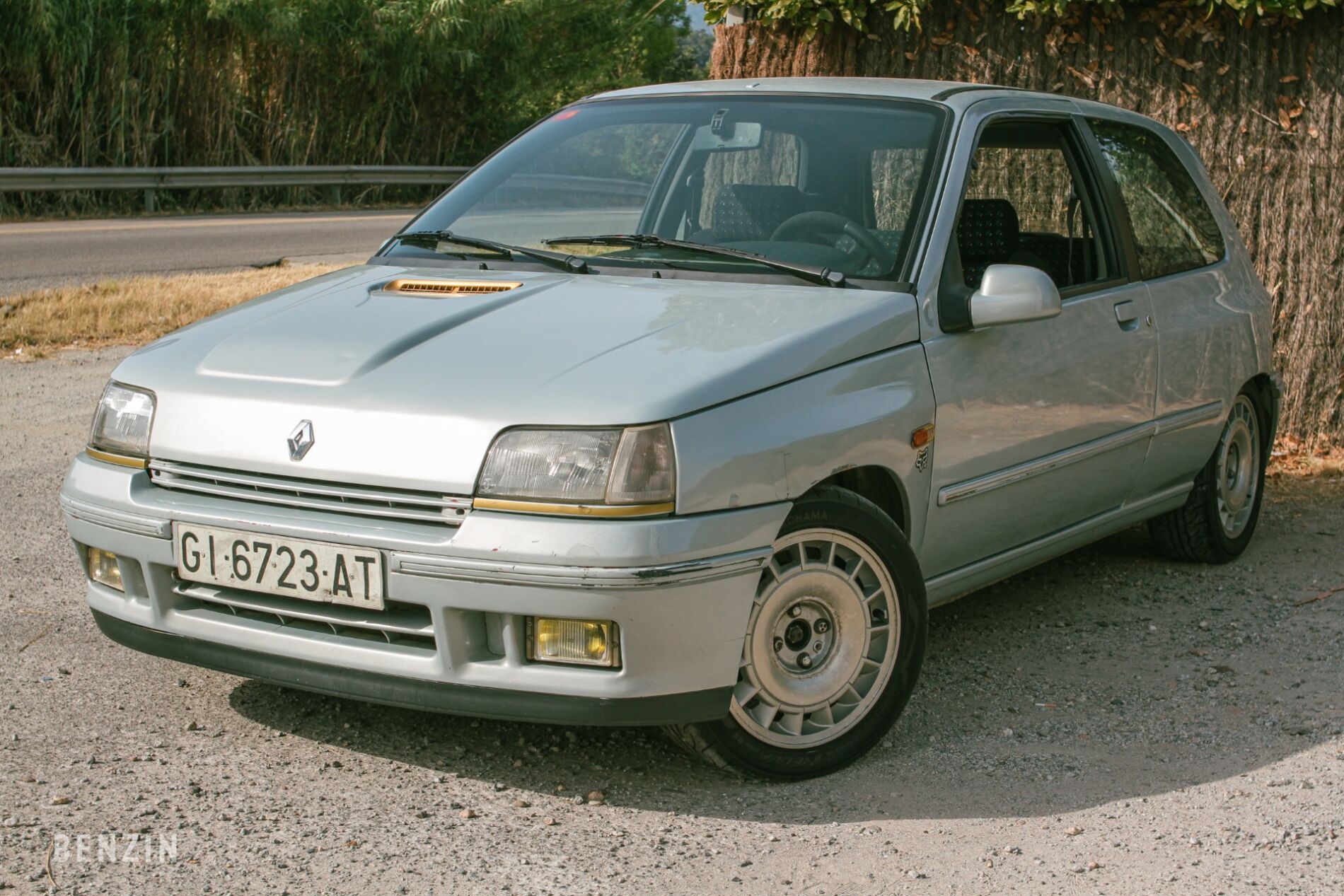
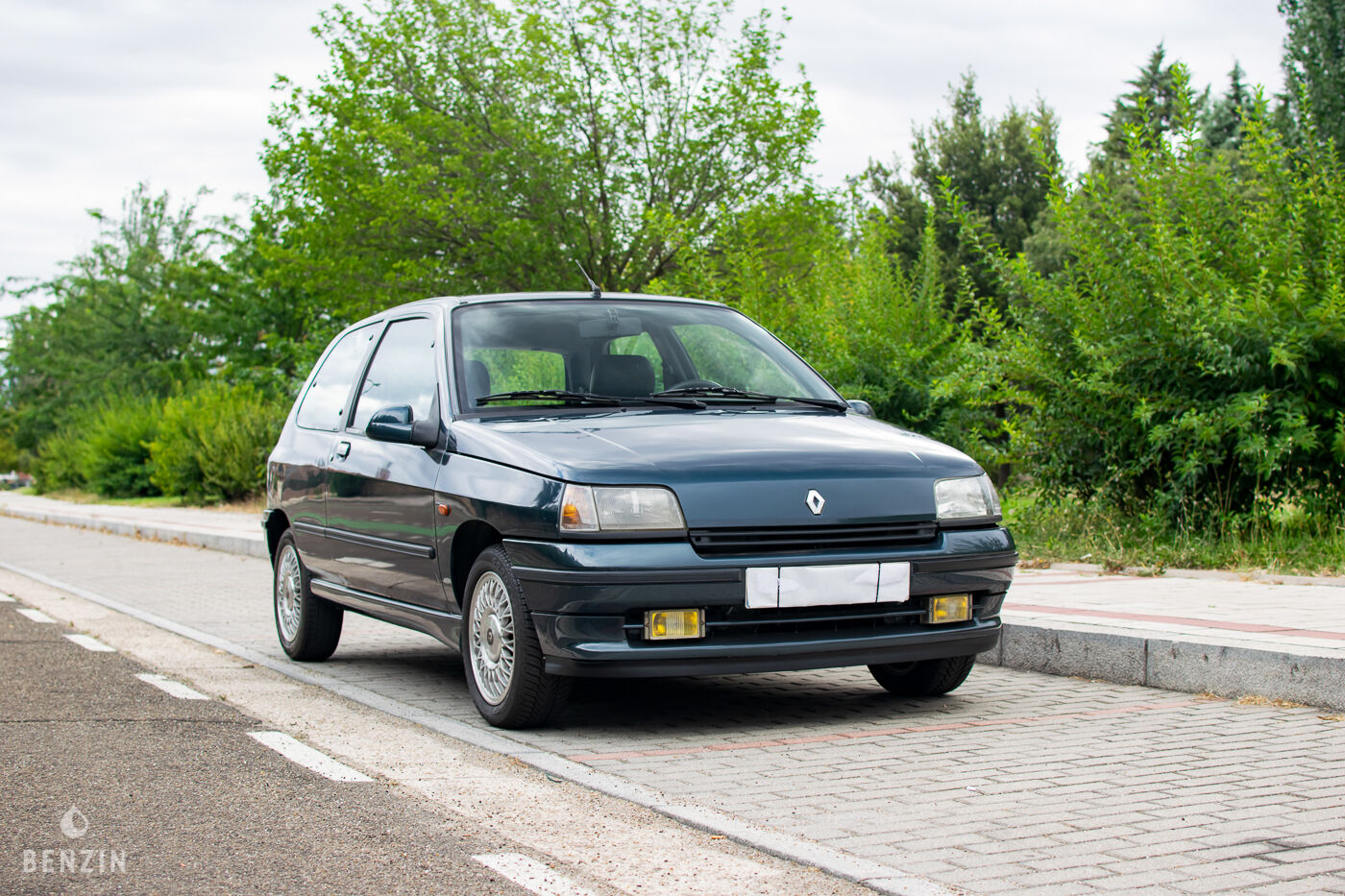
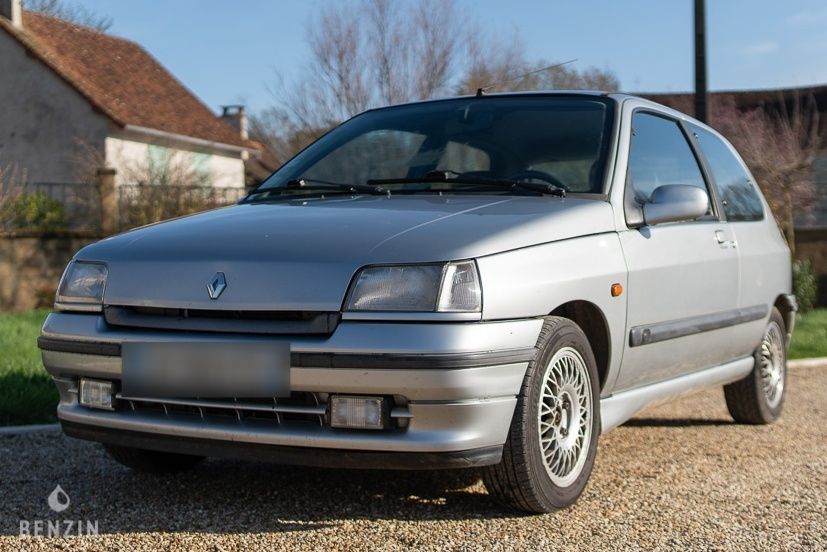
Unveiled at the 1990 Paris Motor Show to replace the Supercinq, the Renault Clio I marked a major turning point for the brand with a more modern, safer and noticeably better-finished city car. Its styling, developed by Renault’s design center, broke with the Supercinq through rounder shapes and a more upscale cabin, to the point of winning the 1991 European Car of the Year title. The range was initially built around 1.1, 1.2, 1.4 and 1.7 petrol engines, then 1.9 D diesels, with trim levels ranging from the very simple RL and RN versions to the more luxurious Baccara. In 1991 came the sporty 16S, quickly renamed 16V in some markets, with its 1.8-liter 16-valve engine, sharpened chassis and specific body kit. The Clio then evolved through successive updates rather than a full redesign, with a phase 2 in 1994 recognizable by its new grille, revised rear lights and various interior details, then a phase 3 in 1996 with more widespread airbags, richer equipment and new special editions. Renault also multiplied limited editions and special trims, including Be Bop, S, Chipie, MTV, Oasis, as well as the luxurious Baccara and then Initiale toward the end of its career.
The sporting pinnacle of the range remains the 1993 Clio Williams, developed for rally homologation, with its 2.0-liter 16-valve engine, widened tracks and iconic gold Speedline wheels. The Clio I also had a real competition career, in rallying as well as in one-make series, and strongly contributed to Renault’s sporting image in the 1990s. Production exceeded 4 million units across all versions, which explains the good availability of common mechanical parts, even if some trim pieces are becoming hard to find. Among collectors, the most sought-after are the 16V, Williams, certain very complete Baccaras and strictly original cars, with no engine swap or body modifications. The smaller 1.2 and 1.4 versions still have a real following for their simplicity, light weight and very 1990s feel, especially in well-preserved three-door form. Today, the Clio I is appreciated both as a popular youngtimer, as a light sporty base and as a very representative witness to the move upmarket of French city cars in the early 1990s.
Technical sheet
| Version | Clio 1.2 RL | Clio 1.4 Baccara | Clio 16V |
| Production years | 1990-1998 | 1991-1997 | 1991-1996 |
| Body | 3- or 5-door hatchback | 3- or 5-door hatchback | 3- or 5-door hatchback |
| Engine(s) | 4-cyl. petrol 1,172 cc | 4-cyl. petrol 1,390 cc Energy | 4-cyl. petrol 1,764 cc 16-valve |
| Power | approx. 55 hp | approx. 80 hp | 137 hp |
| Transmission | front-wheel drive, 5-speed manual gearbox | front-wheel drive, 5-speed manual gearbox | front-wheel drive, 5-speed manual gearbox |
| Curb weight | approx. 850 kg | approx. 900 kg | approx. 990 kg |
| 0-100 km/h | approx. 16 s | approx. 11.5 s | approx. 7.8 s |
| Top speed | approx. 155 km/h | approx. 175 km/h | approx. 205 km/h |
| Specific features | entry-level version, simple equipment | leather, wood trim, high-end equipment | widened arches, specific suspension, reinforced brakes |
Buyer’s guide
For collection and driving pleasure, original 16Vs and complete Baccaras are the most interesting, provided they conform to their factory configuration. For more relaxed use, a sound 1.2 or 1.4 with a healthy structure is often the best compromise. Modified cars, incomplete Baccaras or examples fitted with an engine or gearbox from another version should be examined with great caution.
Points to watch
- Floorpans and jacking points : corrosion or deformation around the sills, under the front footwells and at the jack points, especially on cars stored outside for a long time; you need to look underneath, under the carpets if possible, and read the technical inspection remarks carefully regarding the floorpan or underbody.
- Rear wheel arches and spare wheel well : rust appearing from the inside out, more common on cars exposed to moisture or with worn seals; check the wheel arch lips, the boot floor and signs of rough repairs.
- Energy 1.4 engines : many Baccara cars have been modified or re-engined; a non-original valve cover, air box or gearbox should raise concern, and the consistency between engine code, registration document and version equipment must be checked.
- JB/JC manual gearbox and linkage : synchro issues, especially in 2nd, vague gear selection or crunching when hot on high-mileage or hard-driven cars; check that the gears engage quickly and ask whether the clutch or shift linkages have already been replaced.
- Timing belt : on the 1.2, 1.4 and 1.8 16V, the absence of recent proof is a real point of attention; many Clio I cars are driven little and go past the deadline by time rather than mileage, so you need a dated invoice, not just a verbal statement.
- Interior trim : on phase 2 and phase 3, especially Baccara and Initiale, the door panels tend to yellow, peel off or warp under the effect of the sun and the original glue; check the consistency of all four panels and the presence of the specific trim elements.
- Baccara and Initiale equipment : air conditioning, central locking, electric windows, sunroof depending on version, parcel shelf cover or specific accessories are often missing; a car that looks nice but is incomplete loses much of its appeal if these parts are absent or not working.
- Front axle : knocking from the top mounts, control arms and silent blocks, wandering steering or uneven tire wear; this is common on Clio I and particularly noticeable on the 16V, whose chassis must remain precise and balanced.
When buying
On a Clio I, you should ask for the latest full technical inspection and check in detail any mention of the floorpan, underbody, rear brakes, or suspension imbalance. On a Baccara, an Initiale or a 16V, check that the presentation matches the original trim level: upholstery, wheels, body panels, engine code and, if possible, the Renault identification label. A recent timing belt invoice is more important than low indicated mileage, and a compression test may be relevant on a 16V or on a car that has been immobilized for a long time.
On Benzin a Renault Clio 1 has sold for 2 938 € on average, with a median price of 2 075 €. Based on the 8 sales completed on the platform.
The 8 Renault Clio 1 sold on Benzin changed hands for between 1 100 € and 7 850 €, depending on condition, mileage and version.
8 of the 11 Renault Clio 1 listed on Benzin found a buyer — 73 % of completed sales.
No Renault Clio 1 is for sale at the moment. Follow the model to be notified as soon as a new one is listed.
Every vehicle comes with a detailed photo report, its history and the public exchanges between seller and community. You bid online; if you win, Benzin secures the payment and supports you through to delivery.
Follow the model from this page and you will get an e-mail as soon as a Renault Clio 1 is listed on Benzin.
 English
 Français
 Español
 Italiano
 Deutsch
 Polski
 Magyar
