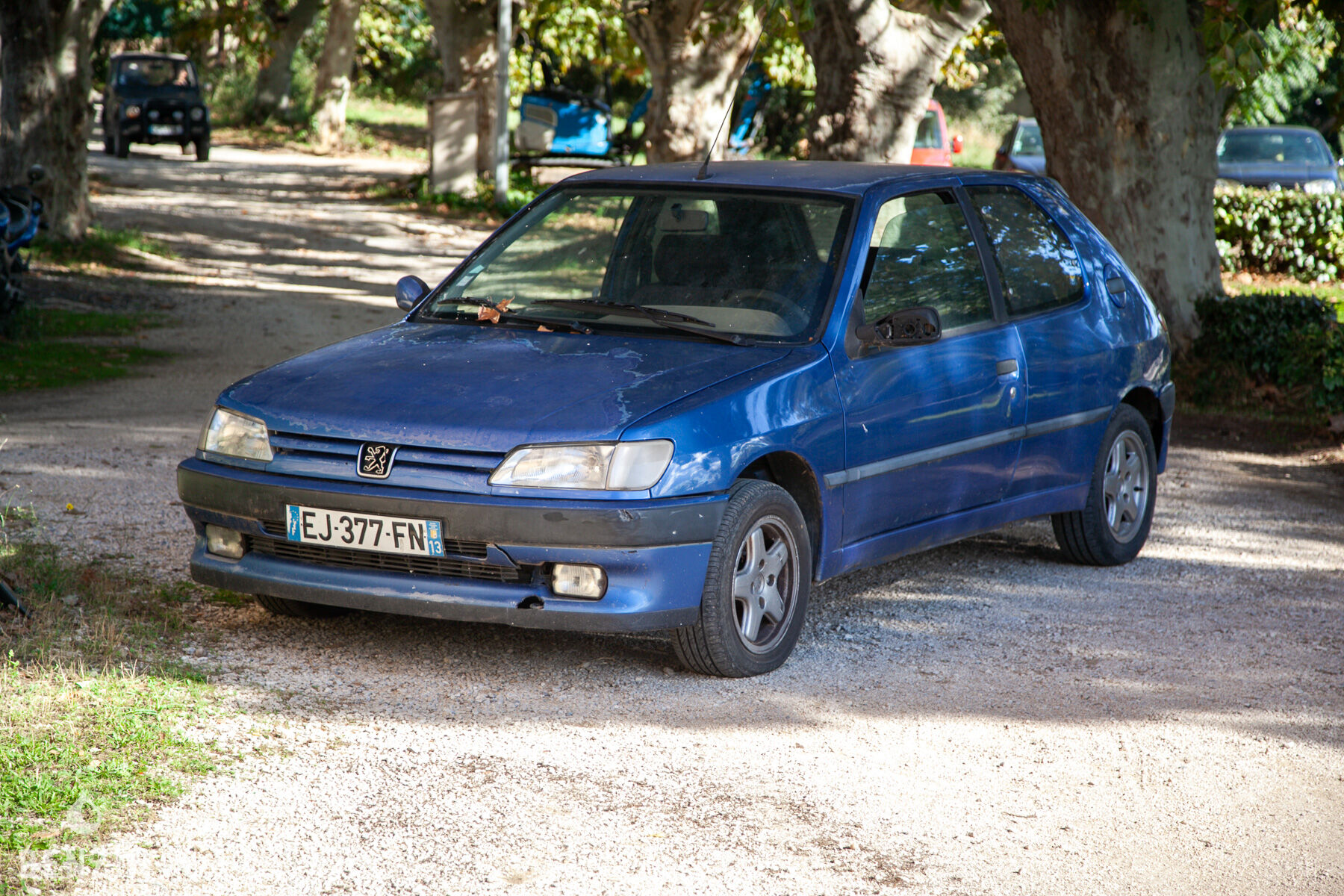
Introduced in spring 1993, the Peugeot 306 indirectly succeeded the 309 and slotted into the heart of the European compact segment, against the Renault 19, Volkswagen Golf III and Opel Astra. Its styling, smoother and more cohesive than that of its predecessor, was developed in-house at Peugeot, while the convertible was later bodied by Pininfarina and assembled in Italy. The range began with 3- and 5-door body styles, quickly supplemented by a 4-door saloon in some markets, an estate from 1997 and a convertible that became one of the most elegant variants in the family. From the outset, the 306 won people over with its chassis balance, with a precise front axle and self-steering rear axle that gave it road manners that became a benchmark in the class.
The 306’s career is divided into three major visible stages: phase 1 in 1993, phase 2 from 1997 with softened styling and a modernized presentation, then phase 3 in 1999 with detail updates and the wider arrival of HDi engines. The mechanical range covers a very broad spectrum, from small TU petrol units from 1.1 to 1.6 liters to 1.8 and 2.0-liter XU engines, not forgetting naturally aspirated and turbocharged XUD Diesels and then 2.0 HDi units. Notable versions include the sporty S16, which became GTI-6 with a 6-speed gearbox, the rare Rallye in some markets, the Pininfarina-designed convertible and widely sold special editions such as the Roland Garros, recognizable by its specific presentation, chosen colors and more upscale positioning. The Roland Garros existed on several body styles depending on the year and remains sought after when it has retained its original presentation elements.
In competition, the 306 does not have the official record of a 205, but the 306 Maxi made its mark on 1990s rallying with its fiery naturally aspirated engine, its effectiveness on asphalt and a silhouette that has become cult among front-wheel-drive enthusiasts. Produced in more than 2.8 million examples up to 2001-2002 depending on markets and versions, the 306 was a real commercial success in Europe. Today, enthusiasts clearly distinguish tired everyday cars, often worn out by long daily use, from beautiful preserved examples, highly appreciated for their still-relevant driving pleasure. Convertibles, GTI-6/S16 models and complete original special editions, including some Roland Garros, attract collectors, while the simpler versions still appeal to connoisseurs for their lightness and excellent handling.
Technical sheet
| 306 1.6 phase 1 | 306 Roland Garros 1.8i | 306 GTI-6 |
| Production years | 1993-1997 | Mid-1990s depending on series | 1996-2000 |
| Body | 3- or 5-door hatchback | Depending on series: hatchback or convertible | 3-door hatchback |
| Engine(s) | 4-cyl. TU5 petrol, 1,587 cc | 4-cyl. XU7 petrol, 1,761 cc | 4-cyl. XU10J4RS petrol, 1,998 cc |
| Power | 88 hp | 103 hp | 167 hp |
| Transmission | Front-wheel drive, 5-speed manual gearbox | Front-wheel drive, 5-speed manual gearbox | Front-wheel drive, 6-speed manual gearbox |
| Weight | Around 1,000 kg | Around 1,080 kg | Around 1,215 kg |
| 0-100 km/h | Around 11 s | Around 11.5 s | Around 8.5 s |
| Top speed | Around 180 km/h | Around 185-190 km/h | 220 km/h |
| Production | More than 2.8 million units across all versions |
Buyer’s guide
For reasonable leisure use, the 1.6 petrol, 1.9 D and 2.0 HDi are often the most sensible choices, while well-preserved convertibles and original complete Roland Garros cars have real collector appeal. For driving enthusiasts, the S16 and especially the GTI-6 are clearly superior, but they require more rigorous mechanical maintenance. It is better to be wary of modified cars, incomplete special editions and examples already showing signs of rear axle fatigue or overheating.
Points to watch
- Torsion-bar rear axle : this is the 306’s major weak point, with arm bearings developing play, rear wheels gaining negative camber, squeaks or a sagging stance; all versions are affected with age and mileage, and you should look for a full rebuild invoice rather than a simple greasing.
- Head gasket and cooling : overheating, hard hoses, mayonnaise-like sludge or coolant consumption are known warning signs on several TU and XU petrol engines, especially if the radiator, thermostat or fans have been neglected; if the cylinder head has been rebuilt, ask whether it has been pressure-tested and machined.
- MA and BE manual gearboxes : vague control feel, worn synchronizers, crunching in 2nd or 3rd and reluctant reverse gear often recur on high-mileage cars; this is found on small petrol engines as well as more powerful versions, and a cold test drive is essential.
- Comfort electrics : temperamental central locking, slow power windows, intermittent blower, erratic warning lights or poor door wiring contacts regularly appear on phases 1 and 2; everything must be tested, including air conditioning, ventilation and defrost.
- Body corrosion : the 306 generally resists corrosion fairly well, but weak points exist at the sills near the jacking points, the floors near the rear axle mountings, the lower edge of the doors and the tailgate; on a convertible, the lower rear wings and water drains should also be checked.
- Front axles : wishbone bushings, anti-roll bar links and shock absorber top mounts wear out and quickly degrade the precision that makes the model appealing; knocking over rough surfaces or uneven tire wear should raise concern.
- Roland Garros special series : many cars have lost over time their wheels, upholstery, badges or specific details; on these versions, the value of interest depends greatly on the authenticity of the presentation, which must be compared with the original equipment for the year concerned.
When buying
On a 306, the most important invoices are those for the rear axle, the cooling system and, on the engines concerned, any documented cylinder head overhaul. It is also necessary to check the fans when cold, the absence of abnormal pressure in the expansion tank and the quality of the gear changes. For a Roland Garros, identifying the special series by the chassis number, equipment codes, trim and original presentation elements matters almost as much as the mechanical condition.
2 of the 2 Peugeot 306 listed on Benzin found a buyer — 100 % of completed sales.
No Peugeot 306 is for sale at the moment. Follow the model to be notified as soon as a new one is listed.
Every vehicle comes with a detailed photo report, its history and the public exchanges between seller and community. You bid online; if you win, Benzin secures the payment and supports you through to delivery.
Follow the model from this page and you will get an e-mail as soon as a Peugeot 306 is listed on Benzin.

 English
 Français
 Español
 Italiano
 Deutsch
 Polski
 Magyar
