The Mitsubishi Pajero appeared in the early 1980s as the production version of a 4x4 program launched by Mitsubishi in the 1970s, after several prototypes and an initial concept shown in 1973. Styled in the spirit of Japanese leisure off-roaders but with global ambitions, it went on sale in 1982 in short-wheelbase form, then long-wheelbase, with hardtop, soft-top or wagon bodies depending on the market. Depending on the country, it was called Pajero, Montero or Shogun, but the basis remained the same: a true 4x4 with a separate chassis, transfer case and a range of petrol and diesel engines. The first generation established its reputation, notably with the 2.3 and 2.5 turbodiesels, petrol V6s and increasingly comfortable trim levels that moved it away from being a simple utility vehicle. In Europe, the short 2.5 TD versions like those from the late 1980s became the most emblematic of the classic Pajero, for their compact size and real off-road ability.
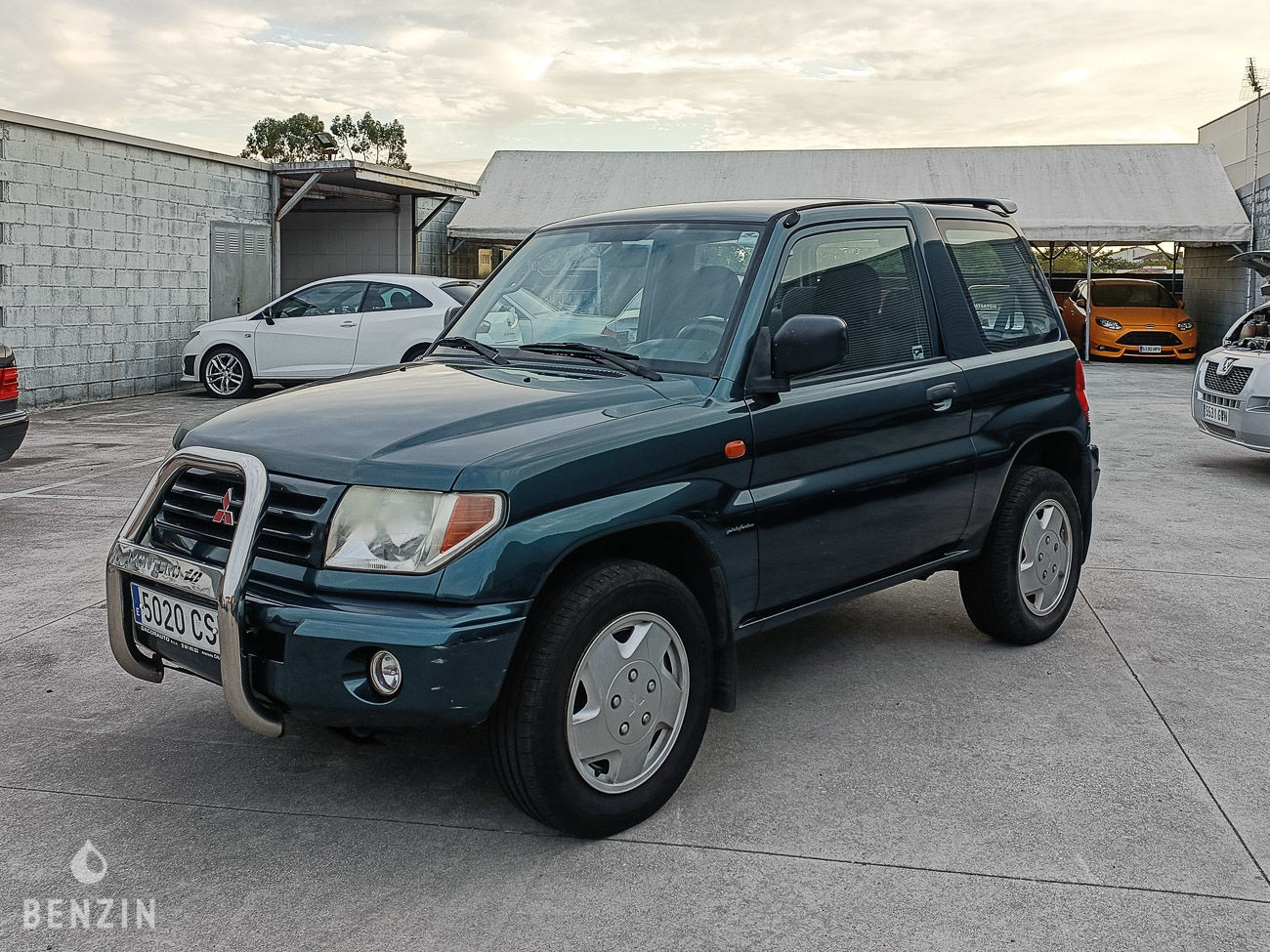
The second generation, launched in 1991, retained the separate chassis but gained road comfort, safety and sophistication with the Super Select transmission, highly appreciated because it allows, depending on the version, the use of four-wheel drive on grippy roads. It notably featured the 2.8 turbodiesel 4M40, smoother than the 2.5, as well as several V6 engines, before a third generation appeared in 1999 with a reinforced monocoque body, more advanced independent suspension and an even more family-oriented focus. Alongside the larger Pajero, Mitsubishi also developed the Pajero iO, known in Europe as the Pinin when it was assembled or styled for certain markets with Pininfarina: more compact, often fitted with a 1.8-liter GDI, it was aimed more at mixed road-and-trail use than serious rally-raid work. The model’s career continued with a fourth generation from 2006, a major evolution of the previous one, until its gradual discontinuation depending on the market during the 2020s.
The Pajero owes much of its legend to rally raid, and especially the Dakar, which it dominated many times, long reinforcing its image as a durable and effective 4x4. Special editions linked to rally raid, high-end equipment or certain markets marked its career, but it is above all the short-wheelbase configurations, mechanical diesels and well-maintained Super Select versions that attract enthusiasts today. Produced in the millions across all generations, it still benefits from a strong user community, a network of Japanese 4x4 specialists and abundant documentation. As a collector’s car and for leisure use, it is sought after for its overall robustness, while requiring a careful purchase because certain weak points are well known depending on the engines and generations.
Technical data
| Pajero I 2.5 TD SWB | Pajero II 2.8 TD | Pajero iO 1.8 GDI |
| Production years | mid-1980s - early 1990s | 1990s | late 1990s - mid-2000s |
| Body style | 3-door 4x4, short wheelbase | 4x4, 3 or 5 doors | Compact 4x4, 3 or 5 doors |
| Engine(s) | 2,476 cc 4-cylinder turbodiesel | 2,835 cc 4-cylinder turbodiesel | 1,834 cc 4-cylinder GDI petrol |
| Power | around 95 hp | around 125 hp | around 114 hp |
| Transmission | Part-time 4x4, manual gearbox, low range | 4x4 Super Select depending on version, manual or automatic gearbox, low range | 4x4 depending on version, manual or automatic gearbox |
| Weight | around 1,650 kg | around 1,950 kg | around 1,350 kg |
| 0-100 km/h | around 18 s | around 15 s | around 12.5 s |
| Top speed | around 145 km/h | around 155 km/h | around 165 km/h |
Buyer’s guide
For collection and leisure use, short-wheelbase diesel Pajero I and II remain the most desirable, with a frequent preference for the 2.8 TD Super Select when road use matters as much as off-road. The early 2.5 TD appeals for its simplicity, but you need to be stricter about cooling and timing-belt maintenance; as for the iO, the 1.8 GDI is interesting as a versatile car provided you accept a mechanical setup that is more sensitive to clogging and to the quality of the refurbishment.
Points to watch
- Chassis and body : corrosion on the rear frame rails, crossmembers, suspension mounts, sills and rear floor, especially on Pajero I and II that have lived in humid climates, on trails or with towing use; visually inspect underneath, around the body mounts and near the fuel tank.
- 4D56 2.5 TD engine : overheating, cracked cylinder head or worn head gasket on poorly cooled examples; check cold starting, pressure in the system, absence of mayonnaise, abnormal smoke, and ask what has been done to the radiator, viscous fan coupling, water pump and cylinder head.
- Balance belt and timing belt : on 2.5 TDs, the small balance shaft belt is a point often highlighted by specialists because its failure can cause major indirect damage; insist on a dated invoice clearly mentioning both belts, the idler pulleys and ideally the water pump.
- Super Select or part-time 4x4 transmission : 4-wheel-drive warning light flashing, difficult switching between modes, front hubs or vacuum-operated control acting up, especially on Pajero II and III; try all modes 2H, 4H, 4HLc and 4LLc, and check that the actuators and solenoids have already been repaired if needed.
- Manual gearbox and clutch : worn synchronizers, crunching when cold or a stiff clutch on vehicles that have towed or done a lot of off-road driving; on a short-wheelbase 2.5 TD, ask whether the clutch has already been replaced and check for slipping under load.
- GDI injection on the Pajero iO : unstable idle, hesitation on acceleration, hard starting and high fuel consumption linked to intake clogging, the high-pressure pump or sensors; prefer a car with detailed invoices for intake cleaning, pump, injectors and ignition work.
- Front axle : play in the ball joints, bushings, wheel bearings and sometimes wear in the front shafts on vehicles used off-road with large tires; check for wandering under braking, vibrations and uneven tire wear, which are common on high-mileage Pajero I and II.
When buying
On a diesel Pajero, the timing belt invoices detailing the main belt, balance belt and water pump matter more than a simple service stamp. You also need to check the actual operation of the transfer case and the various 4x4 modes, not just the absence of a warning light on the dashboard. On a Pajero iO 1.8 GDI, a diagnostic scan, a cold and hot test drive, and proof of work on the intake or high-pressure pump are particularly useful.
0 of the 2 Mitsubishi Pajero listed on Benzin found a buyer — 0 % of completed sales.
No Mitsubishi Pajero is for sale at the moment. Follow the model to be notified as soon as a new one is listed.
Every vehicle comes with a detailed photo report, its history and the public exchanges between seller and community. You bid online; if you win, Benzin secures the payment and supports you through to delivery.
Follow the model from this page and you will get an e-mail as soon as a Mitsubishi Pajero is listed on Benzin.

 English
 Français
 Español
 Italiano
 Deutsch
 Polski
 Magyar
