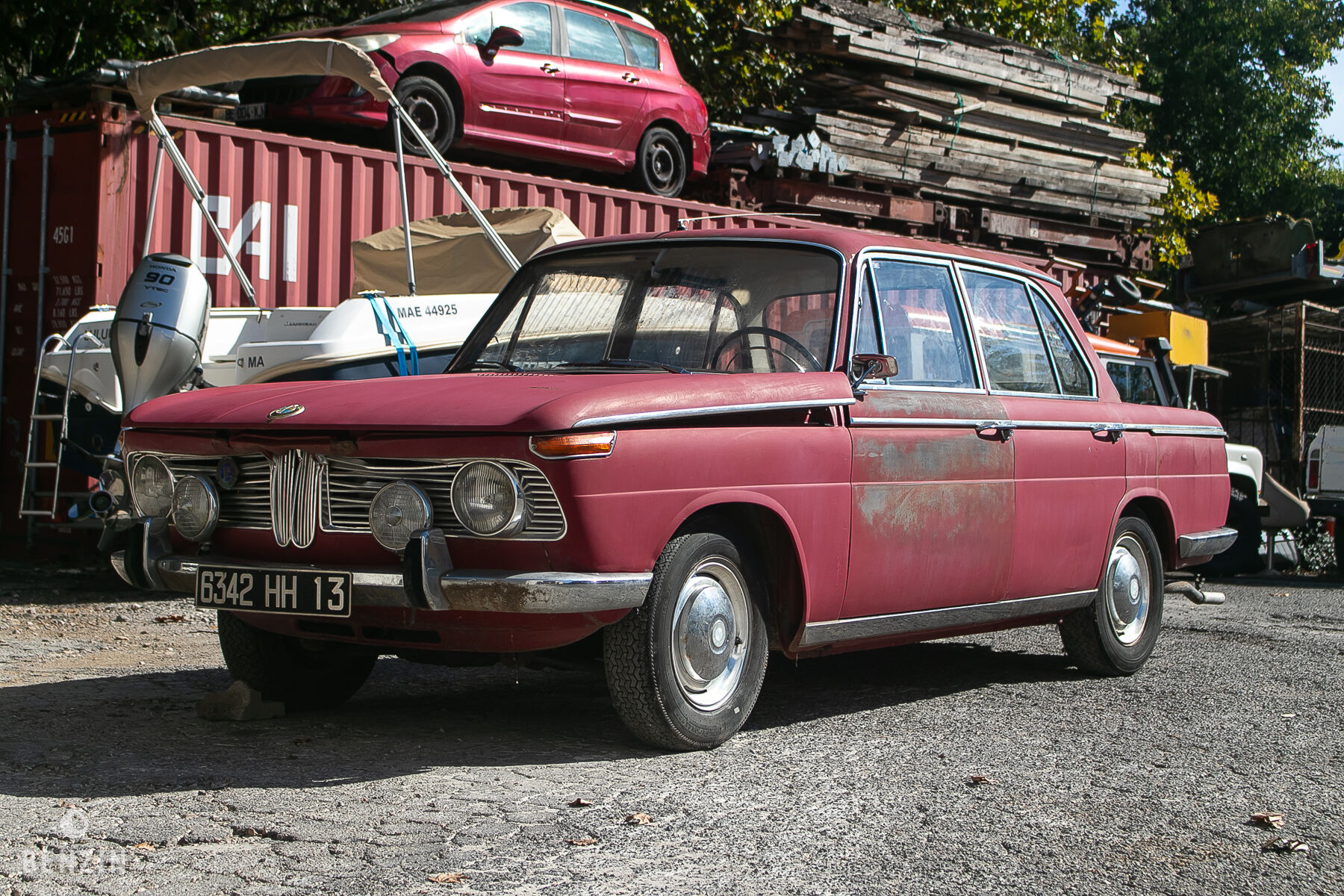
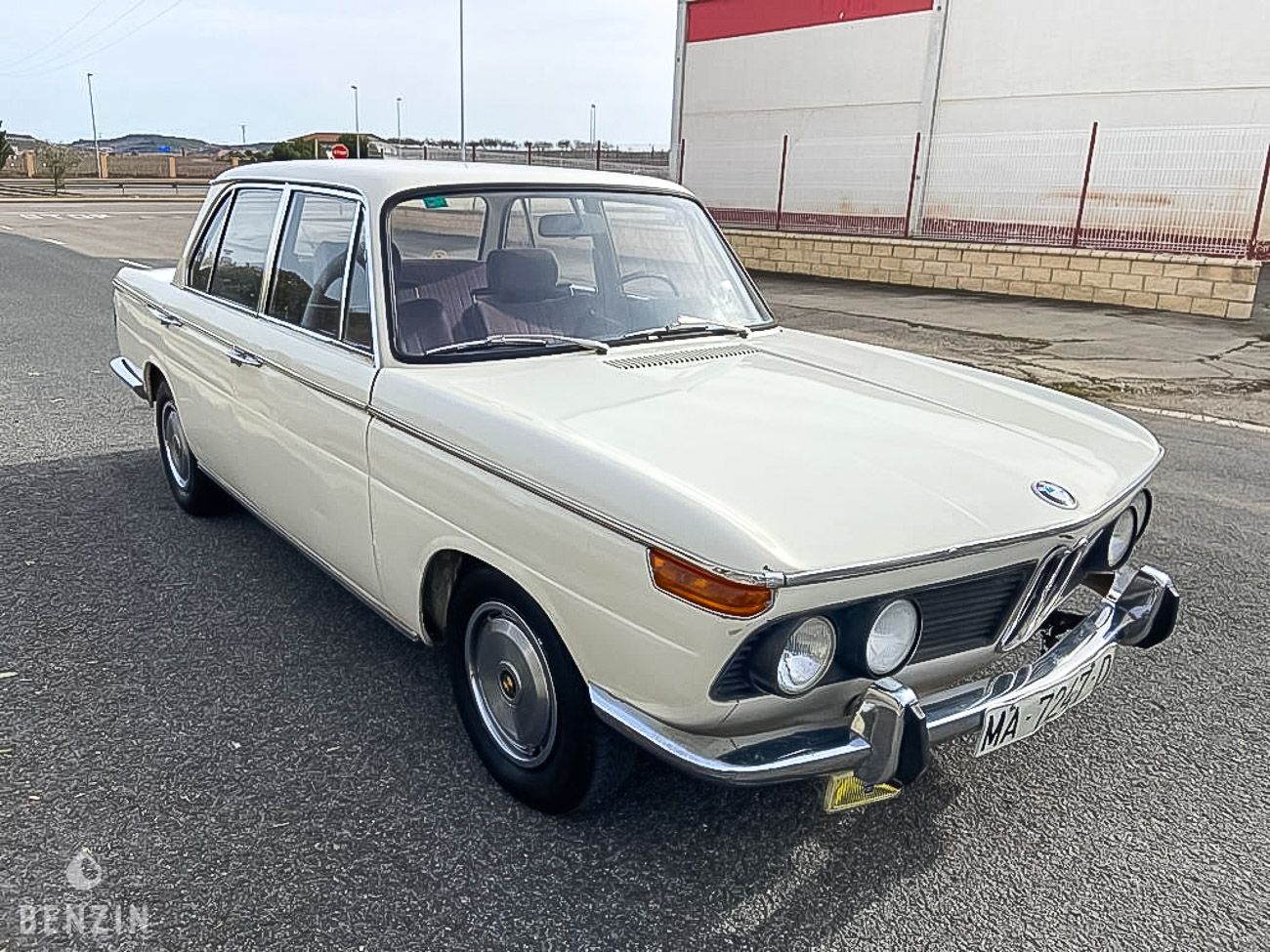
The BMW Neue Klasse refers to the family of sedans that revived the brand in the early 1960s, at a time when BMW was looking for a modern model positioned between the postwar microcars and the expensive in-house V8s. Introduced as the 1500 at the 1961 Frankfurt Motor Show and sold from 1962 onward, it inaugurated an architecture that would become fundamental for BMW: monocoque body, four doors, McPherson front suspension, independent rear wheels and the M10 four-cylinder overhead-cam engine. Its sober, taut design is generally attributed to BMW’s in-house team around Wilhelm Hofmeister, with an influence often noted from Giovanni Michelotti in the early studies. The 1500 was quickly followed by the 1800, 1600, then 2000, each refining the compromise between family sedan and sporting character. This lineage also laid the foundations of modern BMW identity, with a low driving position, precise front end and engines that were very eager for the time.
The range then evolved in steps rather than through true generations, with single- or twin-carburetor variants, then more powerful versions such as the 1800 TI, 1800 TI/SA, 2000 TI and especially the 2000 tii with Kugelfischer mechanical injection. Depending on the market, there are different trim, equipment and lighting details, as well as changes to the gearbox, differential and braking system over the model years. The 2000 C and 2000 CS coupés, then the E9 coupés, derive from this technical base but are not part of the Neue Klasse sedan proper. In competition, the 1800 TI and 2000 TI played a major role in European touring car racing in the 1960s, and the M10 engine from this family would go on to have an exceptional career, right through the BMW 2002 and far beyond. The Neue Klasse is therefore both a pivotal car in BMW’s industrial history and a true technical template for the brand.
Production of the four-door Neue Klasse sedans continued into the early 1970s, before being succeeded by the BMW 5 Series E12 in the upper segment, while the 1600/2002 took over in the compact class. In total, the Neue Klasse sedan family was produced in more than 300,000 examples, making it a decisive success for BMW. Today, the 1800 and 2000 remain appreciated for their very pure styling, simple and expressive mechanics, and surprisingly modern driving feel. The TI and tii versions are the most sought after, but the “normal” 1800 and 2000 still enjoy real esteem among fans of 1960s sporty sedans. Their main issue as collectibles is not the availability of mechanical parts, which is generally good thanks to the M10 engine, but the structural condition of the body and the authenticity of the original configurations.
Technical data
| Version | BMW 1800 | BMW 2000 | BMW 2000 tii |
| Production years | 1963-1971 | 1966-1972 | 1969-1972 |
| Body | 4-door sedan | 4-door sedan | 4-door sedan |
| Engine | Inline 4-cylinder M10, 1,773 cc, carburetor | Inline 4-cylinder M10, 1,990 cc, carburetor | Inline 4-cylinder M10, 1,990 cc, Kugelfischer mechanical injection |
| Power | approx. 90 hp | approx. 100 hp | approx. 130 hp |
| Transmission | Rear-wheel drive, 4-speed manual gearbox | Rear-wheel drive, 4-speed manual gearbox | Rear-wheel drive, 4- or 5-speed manual gearbox depending on version/market |
| Brakes | Front discs, rear drums | Front discs, rear drums | Front discs, rear drums |
| Curb weight | approx. 1,050 kg | approx. 1,100 kg | approx. 1,120 kg |
| 0-100 km/h | approx. 13 s | approx. 12 s | approx. 9.5 s |
| Top speed | approx. 160 km/h | approx. 170 km/h | approx. 190 km/h |
| Production | included in a total of more than 300,000 Neue Klasse sedans | included in a total of more than 300,000 Neue Klasse sedans | included in a total of more than 300,000 Neue Klasse sedans |
Buyer’s guide
For road use, the carbureted 1800 and 2000 are often the most interesting: they retain the charm and balance of the Neue Klasse with simpler mechanics that are better understood by M10 specialists. The 2000 tii are the most desirable for their performance and historical importance, but it is better to choose a complete, correct and properly tuned example rather than a modified or incomplete car. Cars converted into “TI” or “tii” without coherent original components should be viewed with caution.
Points to watch
- Sills and jacking points : corrosion often structural on sedans that were only superficially restored or stored for a long time; 1800 and 2000 are particularly exposed; check whether the sills are original, properly rebuilt in several sections, and ask for photos before paint.
- Front strut towers and inner fenders : possible perforating rust around the suspension mounting points and in the front wheel arches; a known issue on older Neue Klasse bodies; inspect from the engine bay and inside the wing, as thick underseal can hide major repairs.
- Floors, bulkhead and windshield frame : water ingress and corrosion in the front footwells, under the carpets and at the base of the pillars; common on cars left outside; the mats must be lifted, the drains checked and signs of persistent dampness sought.
- M10 engine : robust, but sensitive to overheating; on 1800 and 2000, a tired head gasket or a cracked cylinder head after overheating shows up as mayonnaise, pressure in the cooling system and unstable temperature; ask whether the radiator, water pump and thermostat have been renewed.
- Solex/Zenith carburetors : unstable idle, hesitation on acceleration and excessive fuel consumption on carbureted versions when the shafts develop play or the settings are improvised; the exact type of carburetor fitted must be checked, as well as evidence of a documented rebuild, not just a “tune-up”.
- Kugelfischer injection : on 2000 tii, difficult hot starts, lean or irregular running if the pump, linkage or injectors are badly adjusted; it is an effective but expensive system to restore; ask who adjusted the injection and with which parts.
- Manual gearbox and synchros : crunching in 2nd, hesitant engagement or a vague shifter on high-mileage cars; a classic weakness of gearboxes that have been abused on more powerful versions; check shifts both cold and hot, and the absence of bearing noise on deceleration.
- Rear axle and steering box : vague steering on the road, unwanted feedback and uneven tire wear when the silent blocks, rear joints or steering box develop play; owners often report a car that “floats” rather than a clear noise; ask whether the alignment was done after replacing suspension components.
When buying
On a Neue Klasse, a lift inspection is essential to assess the structure: sills, suspension mounting points, floors, spare wheel well and the lower windshield frame should be seen bare or with a serious photo record of restoration. A compression test is relevant on the M10, and on a 2000 tii it is particularly useful to obtain precise invoices for the Kugelfischer pump, injectors and linkage. For sporty versions or those presented as such, the consistency of the engine numbers and specific equipment must also be checked, as many cars have been reconfigured over the decades.
1 of the 2 BMW Neue Klasse listed on Benzin found a buyer — 50 % of completed sales.
No BMW Neue Klasse is for sale at the moment. Follow the model to be notified as soon as a new one is listed.
Every vehicle comes with a detailed photo report, its history and the public exchanges between seller and community. You bid online; if you win, Benzin secures the payment and supports you through to delivery.
Follow the model from this page and you will get an e-mail as soon as a BMW Neue Klasse is listed on Benzin.
 English
 Français
 Español
 Italiano
 Deutsch
 Polski
 Magyar
