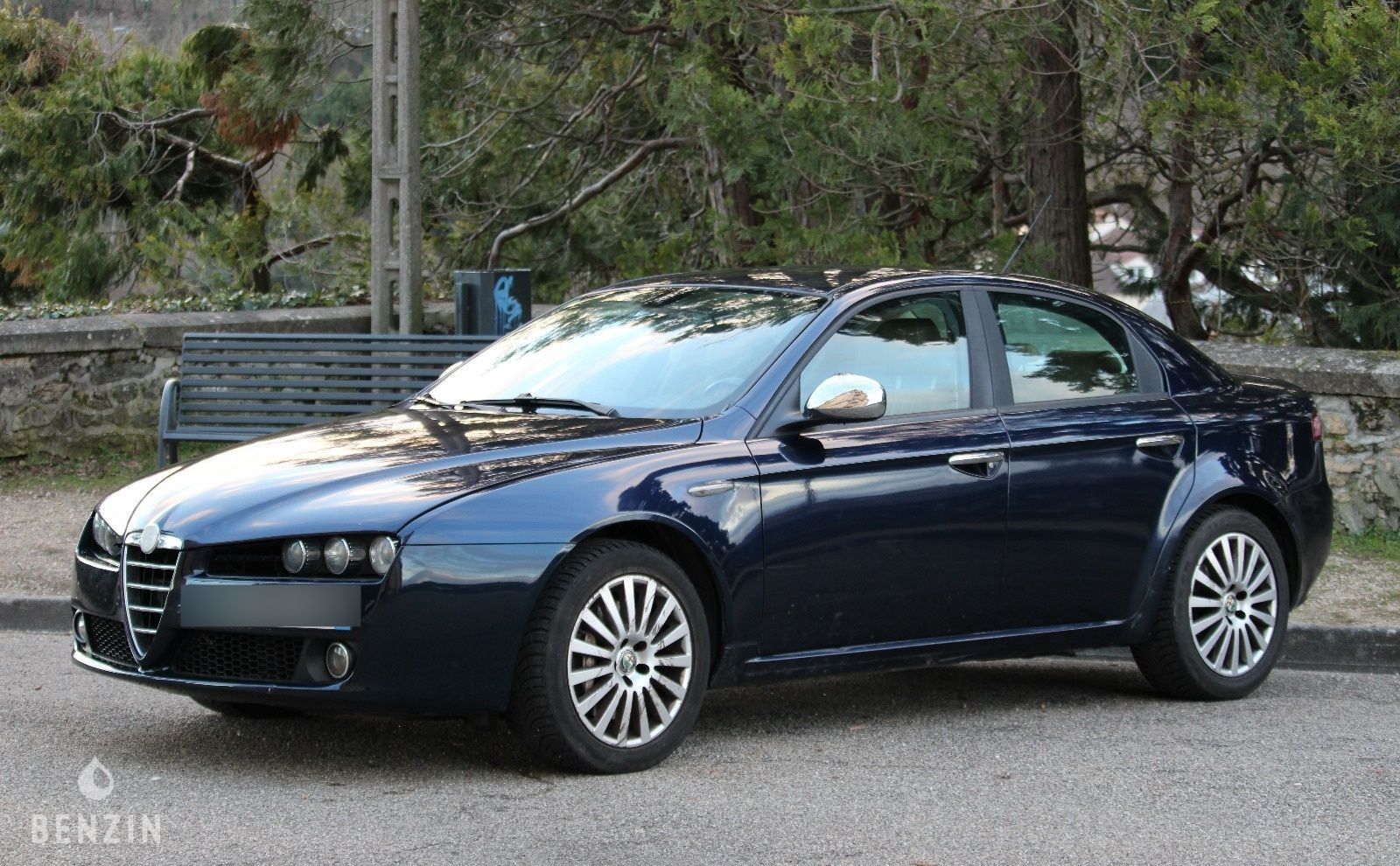
The Alfa Romeo 159 replaced the 156 in spring 2005 and marked a real step upmarket for the brand, both in presentation and structure. Its design, by Giorgetto Giugiaro with the Centro Stile Alfa Romeo, almost directly translated the style of the Brera coupé shown as a concept, with a three-headlamp front end that remains one of the strongest visual signatures of Italian sedans from the 2000s. The so-called Premium technical base came from a joint Fiat-GM development, but Alfa extensively reworked it to achieve high rigidity and more serious handling than the 156. The range began with the sedan, then the Sportwagon estate arrived in 2006, with launch engines including the 1.9, 2.2 and 3.2 V6 JTS petrol units, as well as 1.9 and 2.4 JTDm diesels.
Over the course of its life, the 159 evolved in small steps rather than through very visible facelifts. In 2008, Alfa Romeo lightened several versions and improved certain settings, while the Ti trims, with firmer suspension and a sportier appearance, became the most sought after by enthusiasts. In 2009, the range gained the highly convincing 1750 TBi 200 hp, often considered the best petrol engine in the line for its balance of performance, refinement and running costs, as well as a more modern 2.0 JTDm on the diesel side. The top-end 3.2 V6 Q4, with all-wheel drive, occupies a special place: noble on paper, very reassuring, rare today, but penalized by high weight that makes it less incisive than hoped.
The 159 did not have a notable official motorsport career, but it mattered a great deal to Alfa Romeo’s image by restoring prestige to the brand in the sporty family-car segment. Production ended in 2011, after a total run of around 240,000 examples including sedans and Sportwagon models. Long underestimated because of its weight and the shadow cast by the 156, it is now appreciated for its build quality, very distinctive styling and road manners, with a fairly clear enthusiast hierarchy: 1750 TBi and 2.0 JTDm for everyday use, 3.2 V6 Q4 and Ti for collecting and character.
Technical data
| Version | 159 1.75 TBi | 159 2.4 JTDm 20v | 159 3.2 V6 Q4 |
| Production years | 2009-2011 | 2005-2011 | 2005-2011 |
| Body | 4-door sedan, 5-door Sportwagon | 4-door sedan, 5-door Sportwagon | 4-door sedan, 5-door Sportwagon |
| Engine(s) | 4-cylinder turbo petrol, 1,742 cc | 5-cylinder turbo diesel, 2,387 cc | Direct-injection petrol V6, 3,195 cc |
| Power | 200 hp | 200 to 210 hp depending on model year | 260 hp |
| Transmission | Front-wheel drive, 6-speed manual gearbox | Front-wheel drive, manual or automatic gearbox depending on version | Q4 all-wheel drive, 6-speed manual gearbox |
| Weight | approx. 1,500 kg | approx. 1,650 kg | approx. 1,740 kg |
| 0-100 km/h | approx. 7.7 s | approx. 8.4 s | approx. 7.0 s |
| Top speed | approx. 235 km/h | approx. 228 km/h | approx. 240 km/h |
| Production | Around 240,000 examples for the entire 159 sedan and Sportwagon range |
Buyer’s guide
For regular driving, the most recommended versions are generally the 1750 TBi and 2.0 JTDm, more accomplished late in the model run and better balanced than the early JTS engines. The 3.2 V6 Q4 is the enthusiast’s version, rare and appealing on paper, but it should be bought for its actual condition and all-wheel-drive maintenance rather than for the prestige of the V6 alone. The early 1.9 and 2.2 JTS engines require greater caution because of their chain-driven timing and an overall refinement considered disappointing given the car’s weight.
Points to watch
- Timing chain : chain stretch, cold-start noise or camshaft/crankshaft correlation faults on JTS petrol engines, especially 1.9 and 2.2, but the 3.2 also deserves a careful reading of timing values in diagnostics; ask whether a precise check has already been carried out and whether any timing-related fault codes are stored.
- M32 gearbox : whining in 5th/6th, play in the bearings or less precise shifting on some 4-cylinder 159s, notably 1.9 JTDm and several 2.2 JTSs; check whether the gearbox has already been opened or strengthened, as this issue often comes up among specialists.
- Q4 transmission and rear axle : on 3.2 V6 Q4s, the absence of proof of fluid changes for the Torsen center differential, transfer case and rear axle is a real warning sign; listen for droning at steady speed and jerking during maneuvers.
- 1.9/2.4 JTDm diesel intake : swirl flaps and the intake manifold can clog or develop play, causing limp mode, smoke or engine faults; ask whether the manifold has already been replaced or cleaned and whether the actuator works properly.
- EGR valve and DPF : especially on JTDm engines used in town, clogging, incomplete regenerations and engine warning lights are common; a diagnostic scan should confirm the filter saturation level and the absence of any clumsy deactivation.
- Front suspension : upper wishbones, bushings and links suffer from the weight of the 159, especially on 2.4, 3.2 and Ti trims with large wheels; knocking over rough surfaces, inner tire wear and difficult alignment to maintain should be checked.
- Body electronics and Blue&Me : a flashing odometer, Bluetooth/USB failures or disrupted communication on the CAN network are common; check that all onboard functions respond normally and that no proxy alignment is pending.
- Front structure and underbody : the 159 has a low nose and a front crossmember that can take a hit; if this is mentioned on the inspection report or if there are front-end alignment discrepancies, inspect the side members, crossmembers, radiator mounts and the quality of the repairs.
At the time of purchase
On a 159, a thorough electronic diagnostic is particularly useful: it should allow reading engine faults, cam timing values on the JTS, the DPF status on diesel models and, on a Q4, the absence of anomalies related to the transmission. The most important invoices are those documenting work on the timing chain, a repair to the M32 gearbox, a clutch/flywheel replacement and fluid changes for the gearbox, rear axle and differential on 3.2 Q4. The front-end alignment and the condition of the lower crossmember should also be checked carefully, as minor structural remarks or poorly repaired small impacts are not uncommon on this model.
2 of the 3 Alfa Romeo 159 listed on Benzin found a buyer — 67 % of completed sales.
No Alfa Romeo 159 is for sale at the moment. Follow the model to be notified as soon as a new one is listed.
Every vehicle comes with a detailed photo report, its history and the public exchanges between seller and community. You bid online; if you win, Benzin secures the payment and supports you through to delivery.
Follow the model from this page and you will get an e-mail as soon as a Alfa Romeo 159 is listed on Benzin.

 English
 Français
 Español
 Italiano
 Deutsch
 Polski
 Magyar