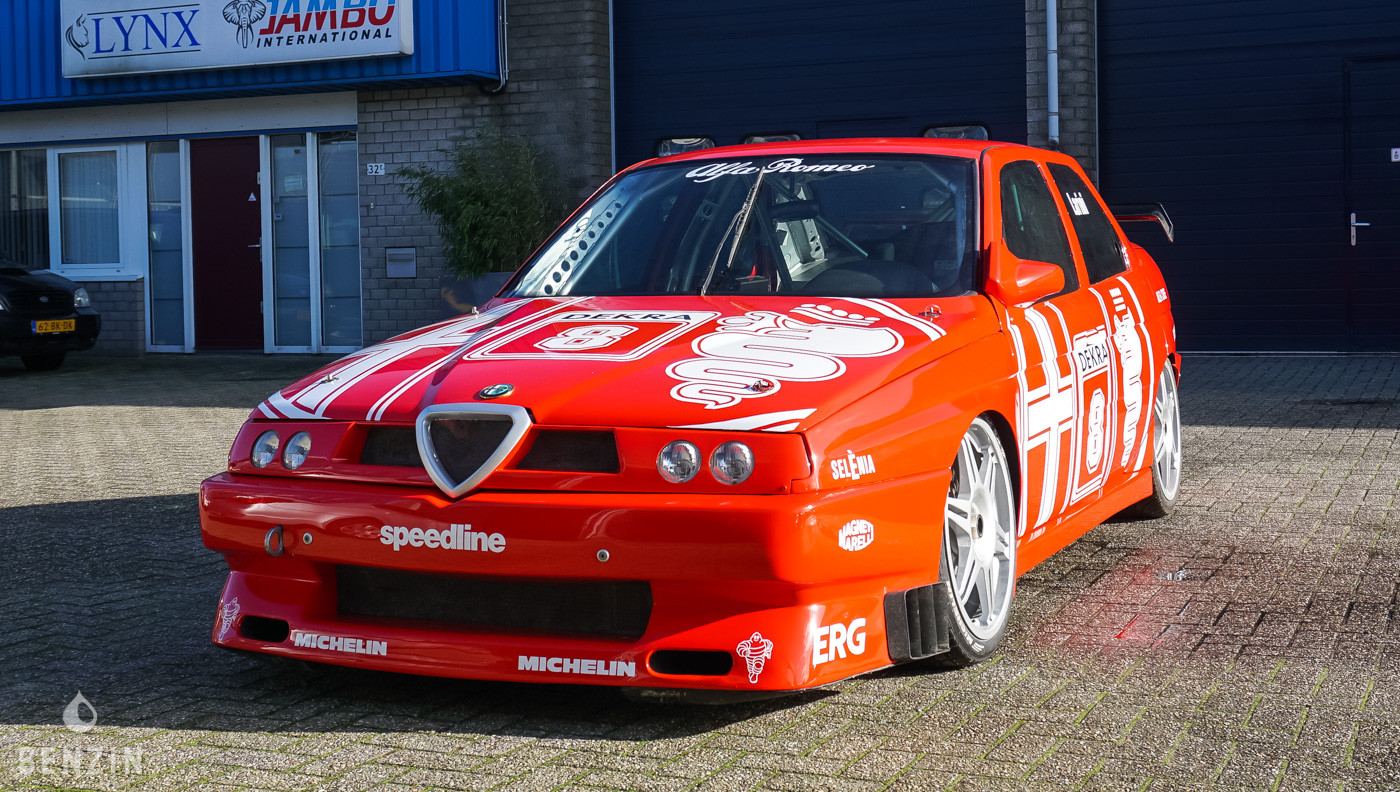
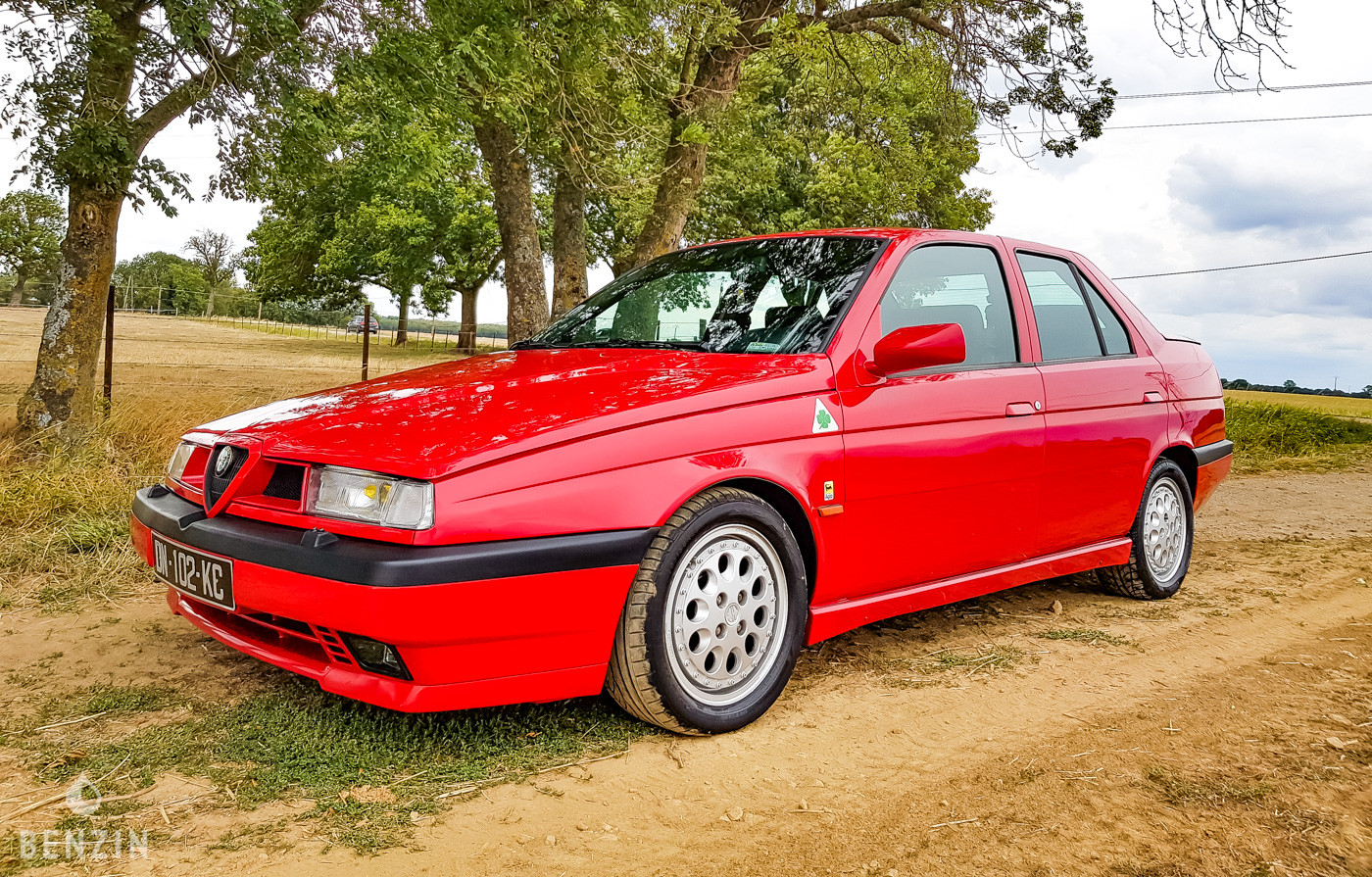
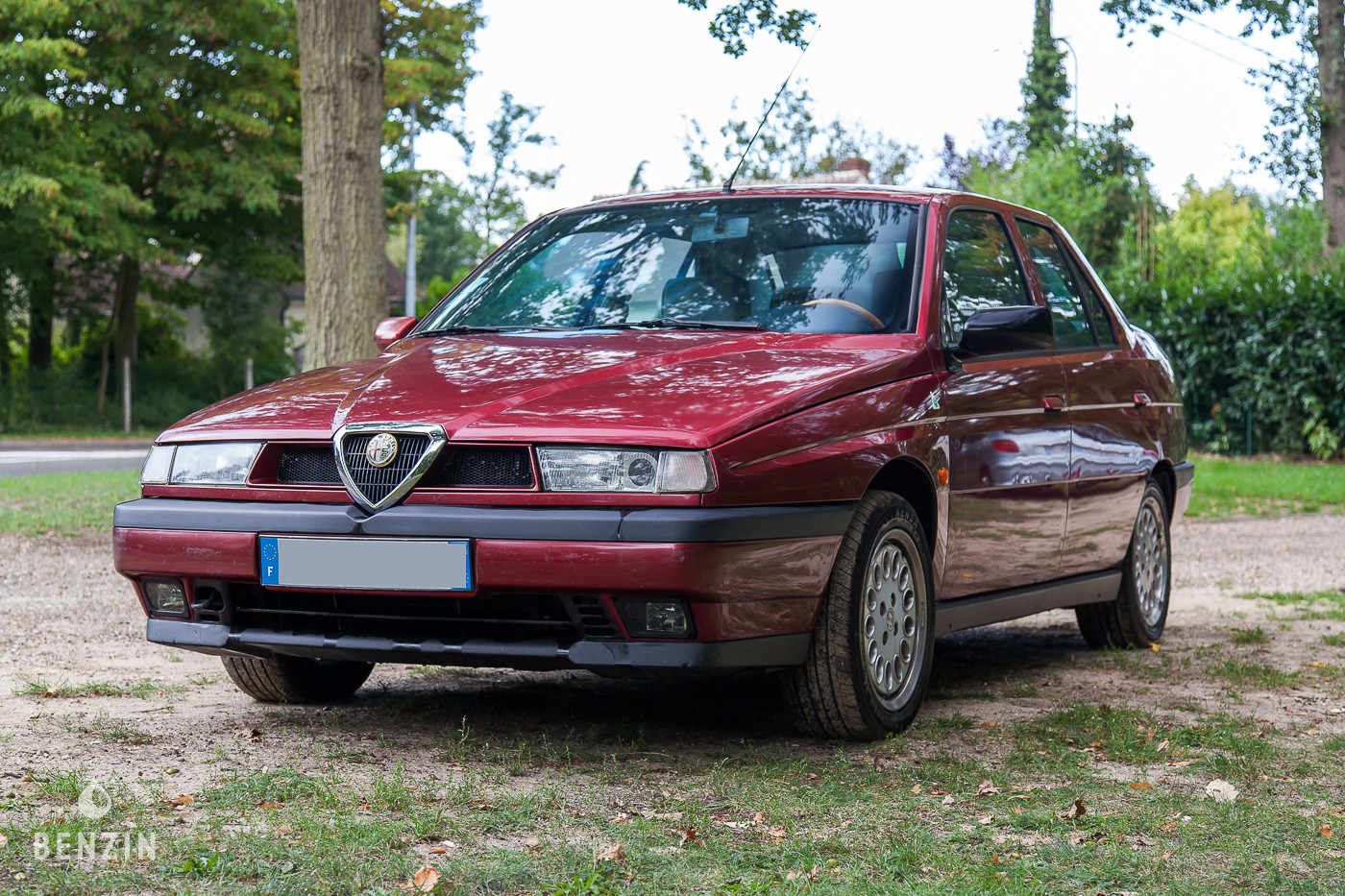
The Alfa Romeo 155 appeared at the beginning of 1992 to replace the 75 and accompany the brand’s shift to a transverse-engine, front-wheel-drive layout already seen on the 164, the Fiat Tipo and the Lancia Dedra. Styled by the I.DE.A Institute under the direction of Ercole Spada, with final Alfa-specific tuning in the treatment of the front end and the side crease, it clearly breaks with the rear-wheel drive it replaces through an angular, restrained and aerodynamic three-box sedan. At launch, the range centered on the 1.7 Twin Spark, 1.8 and 2.0 Twin Spark 8-valve, the 2.5 V6 Busso, the 2.5 VM Diesel and then 2.5 turbodiesel, and above all the 155 Q4. The latter takes over most of the drivetrain from the Lancia Delta Integrale, with permanent all-wheel drive and a 2-liter turbo 16-valve engine, making it the most distinctive and sought-after road-going 155. In 1995, the 155 received a major chassis and body facelift, with a wider track, revised running gear, modernized presentation and the arrival of 1.6, 1.8 and 2.0-liter Twin Spark 16-valve engines, which were clearly more convincing than the early 8-valve units in terms of refinement.
The 155 also built up a considerable reputation in competition, far beyond its commercial career. The 155 V6 TI dominated the DTM and ITC from 1993 with Nicola Larini, while the Supertourisme 155s shone in Italy, Great Britain, Spain and especially Germany with the two-liter STW versions. These successes largely shaped the car’s image among enthusiasts, far more than its road presence, which remained discreet compared with the BMW 3 Series, Audi 80 and Mercedes 190 and then C-Class. Special editions existed depending on the market, but it is above all the Super trims, the second-phase Twin Spark 16V and the rare Q4 that now shape collector interest. Total production remained below 200,000 units between 1992 and 1997, before the 156 took over. Long underestimated, the 155 is now appreciated for its very 1990s styling, its still expressive Alfa engines and its direct link with the DTM and STW programs, with a clear hierarchy among enthusiasts between well-preserved Twin Spark 16V cars, V6s for their engine, and the Q4 for its technical kinship with the Delta Integrale.
Technical data
| Version | 155 1.8 TS 16V | 155 Q4 | 155 2.5 V6 |
| Production years | 1995-1997 | 1992-1995 | 1992-1997 |
| Body | 4-door sedan | 4-door sedan | 4-door sedan |
| Engine(s) | Inline 4-cylinder, 1773 cc, Twin Spark 16V | Inline 4-cylinder turbo, 1995 cc, 16V | 60° V6, 2492 cc, 12V |
| Power | 140 hp | 186 hp | 165 hp |
| Transmission | Front-wheel drive, 5-speed manual | All-wheel drive, 5-speed manual | Front-wheel drive, 5-speed manual |
| Curb weight | around 1,250 kg | around 1,390 kg | around 1,300 kg |
| 0-100 km/h | around 9.0 s | around 7.0 s | around 8.4 s |
| Top speed | around 205 km/h | around 225 km/h | around 215 km/h |
| Distinctive feature | Phase 2 with widened track, more modern engine | Drivetrain derived from the Delta Integrale | Busso engine, the most noble road-going version outside Q4 |
Buyer’s guide
For road use and maintenance that is still reasonable, the 1.8 and 2.0 Twin Spark 16V from 1995-1997 are the most coherent, with a clearly improved chassis and a more pleasant engine than the early 8-valve cars. The Q4 is the most desirable for its historical and technical interest, but also the most demanding to buy because its specific parts are so rare; the V6s appeal thanks to the Busso, at the cost of a more heavily loaded front end and sometimes neglected maintenance. Heavily modified, lowered or converted cars with non-compliant parts should be examined with greater caution, especially on Q4.
Points to watch
- Sills and lifting points : deformation then localized corrosion behind the front wheels and under the plastic covers, often due to improper lifting points; this is a regularly reported issue on 155s of all phases, to be inspected with the car lifted, covers removed if possible.
- Twin Spark timing belt and phase variator : diesel-like noise at startup, less smooth idle or a flat engine at low revs on 1.8 and 2.0 TS 16V; ask whether the variator was replaced at the same time as the belt, as it is often deferred even though the labor overlaps.
- Oil consumption of Twin Spark 16V : oil level dropping quickly or smoke on acceleration on the 1.8/2.0; these engines do not like overly long intervals or low oil, and a history showing monitored top-ups is preferable.
- Q4 transmission : transmission noises, vibrations under load, leaks from the gearbox, rear differential or transfer case; the specific components derived from the Delta Integrale are expensive and not always easy to find, and you must check that the four tires are the same size and wear level and that the oil changes have been done.
- Phase 2 front suspension : knocking, wandering or uneven tire wear due to the wishbones, bushings and top mounts, particularly noticeable on cars fitted with wide tires; the 155 drives very well when its geometry is correct, much less so when the front end is worn.
- Interior electrics and air conditioning : temperamental displays, automatic climate control that no longer regulates properly, outside temperature sensor or controls that do not work; this is not uncommon on the later, well-equipped 155s, and the full operation must be checked, not just whether the console lights up.
- Upholstery and seat mechanisms : play in the seatback, faulty cable or tilt/adjustment control, especially on the front seats of heavily used cars; the fault is often minor but revealing of the condition of the interior and sometimes annoying to restore perfectly to original.
When buying
On Twin Spark, the timing belt invoice, which also details the possible replacement of the phase variator, matters more than a simple note of routine maintenance. On Q4, it is ideally best to inspect the car on a lift, note any transmission leaks and check the consistency of the part references for the specific transmission and braking components, as many cars have been repaired with makeshift solutions. Photos of the underside, the inspection report and, on TS engines, a cold start followed by a compression test if the running is not perfect, are particularly useful on this model.
2 of the 4 Alfa Romeo 155 listed on Benzin found a buyer — 50 % of completed sales.
No Alfa Romeo 155 is for sale at the moment. Follow the model to be notified as soon as a new one is listed.
Every vehicle comes with a detailed photo report, its history and the public exchanges between seller and community. You bid online; if you win, Benzin secures the payment and supports you through to delivery.
Follow the model from this page and you will get an e-mail as soon as a Alfa Romeo 155 is listed on Benzin.

 English
 Français
 Español
 Italiano
 Deutsch
 Polski
 Magyar