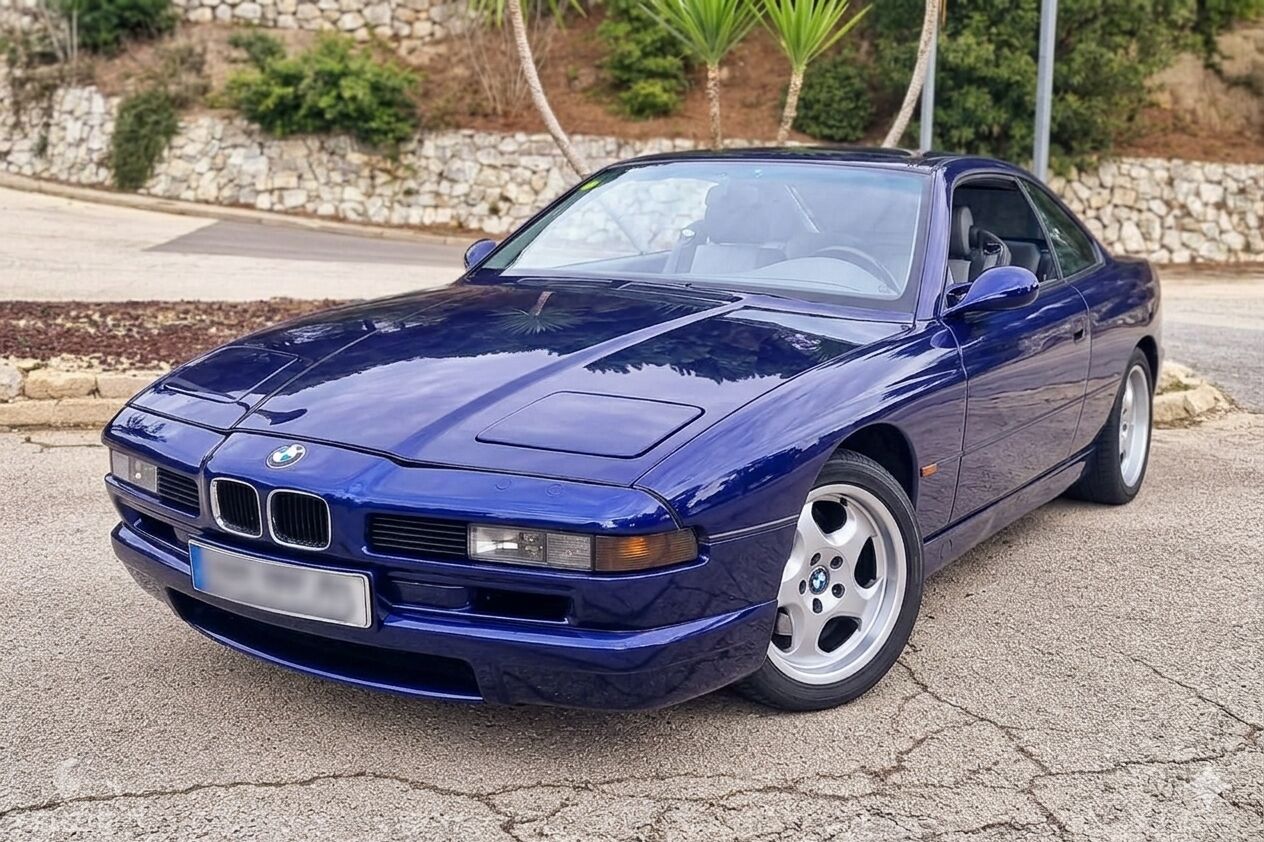
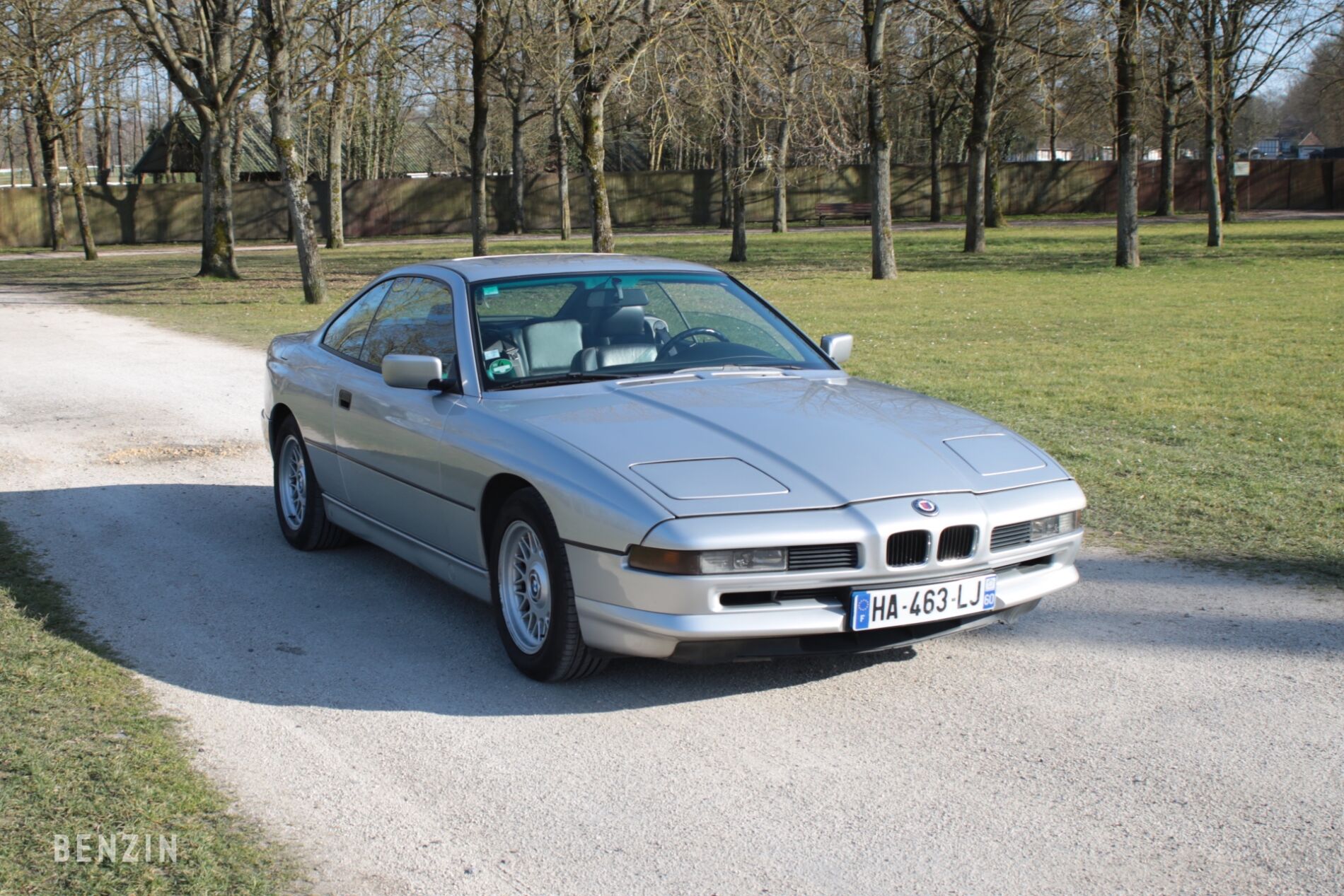
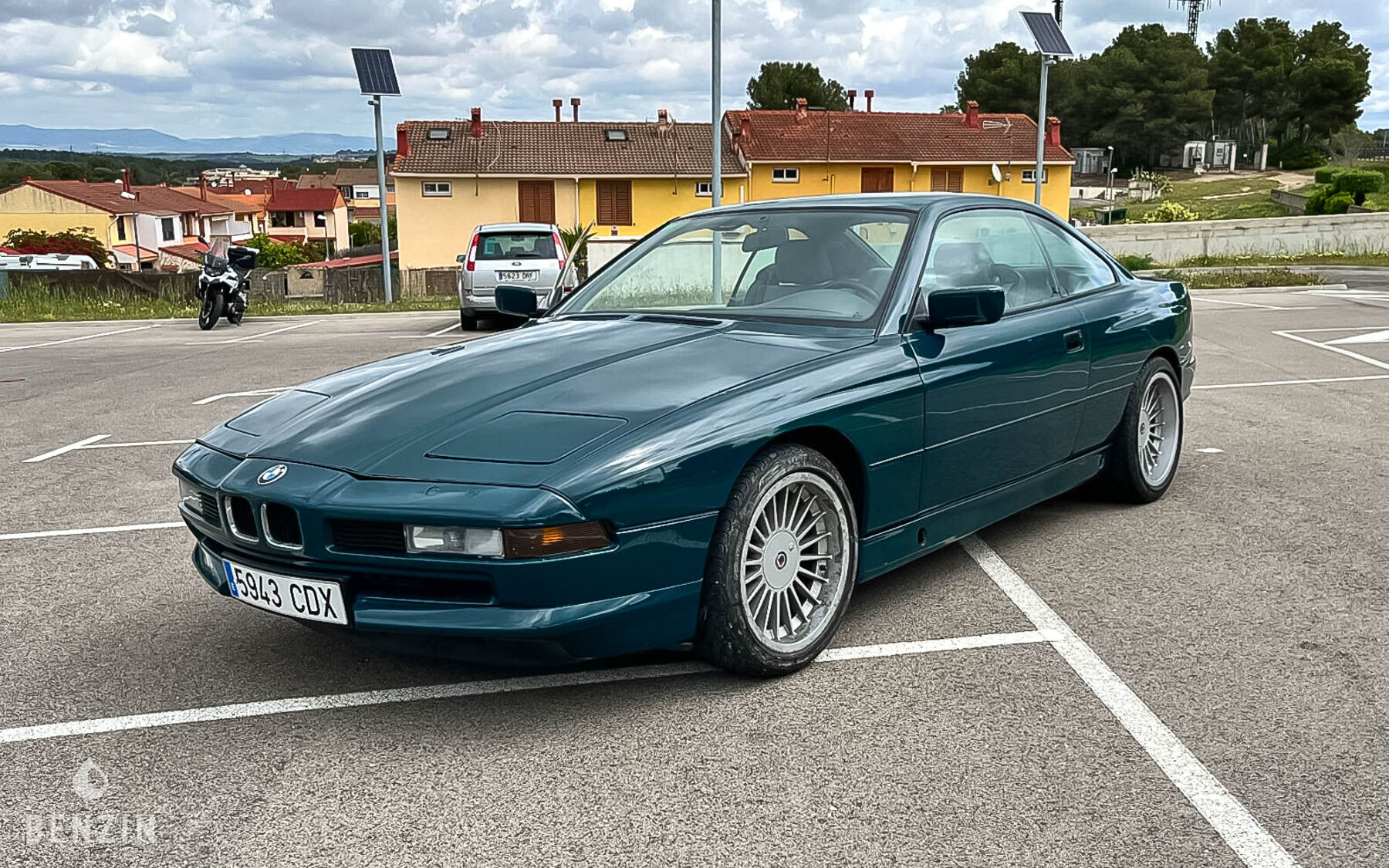
The BMW 8 Series E31 appeared at the 1989 Frankfurt Motor Show as the grand prestige coupé intended to indirectly succeed the 6 Series E24, but with a much higher technical ambition. Designed under the direction of Claus Luthe, developed with extensive use of CAD and refined at length in the wind tunnel, it stands out for its very low profile, pop-up headlights, frameless windows and sophisticated chassis with a multi-link rear axle. The commercial launch began with the 850i, powered by the 5.0-liter 300 hp M70 V12, offered with an automatic transmission or, much more rarely, a 6-speed manual gearbox. This version defines the E31’s image: a fast, quiet and very complex GT, designed more to devour miles than to play the role of a raw sports car. In 1993 came the 840Ci, first with the 286 hp 4.0-liter M60 V8, then with the M62 4.4-liter of comparable power depending on market and year. The V12 range then evolved into the 850Ci, first still with the 5.0-liter depending on model year, then with the 326 hp 5.4-liter M73.
The top of the range is the 850CSi, launched in 1992, developed by BMW Motorsport with the 5.6-liter S70 V12 and 380 hp, a 6-speed manual gearbox, a stiffer chassis, a limited-slip differential, specific suspension and a subtly more aggressive appearance. It never officially wore the M8 badge, but its link to the M program is central to the E31 legend, just like the M8 prototype that never reached production. The E31 8 Series career continued until 1999, without a true facelift but with many detail changes in electronics, equipment and engines. Total production was just over 30,000 units, making it a relatively rare mass-produced BMW, and the 850CSi accounts for only a small fraction of that. Today, enthusiasts mainly seek original cars that have been well maintained electrically and hydraulically, with a marked preference for manual 850i cars, later and easier-to-live-with 840Ci models, and of course the very exclusive 850CSi.
Technical specifications
| Feature | 840Ci | 850i / 850Ci V12 | 850CSi |
| Production years | 1993-1999 | 1990-1999 | 1992-1996 |
| Body style | 2+2 coupé | 2+2 coupé | 2+2 coupé |
| Engine(s) | naturally aspirated 4.0 then 4.4-liter V8 | naturally aspirated 5.0 then 5.4-liter V12 | naturally aspirated 5.6-liter V12 |
| Power | 286 hp | 300 to 326 hp depending on version | 380 hp |
| Transmission | rear-wheel drive, 5-speed automatic or more rarely 6-speed manual | rear-wheel drive, 4/5-speed automatic or more rarely 6-speed manual | rear-wheel drive, 6-speed manual |
| Curb weight | about 1,800 kg | about 1,850 to 1,950 kg | about 1,900 kg |
| 0-100 km/h | about 6.8 to 7.0 s | about 6.3 to 6.8 s | about 6.0 s |
| Top speed | 250 km/h | 250 km/h | 250 km/h |
| Production | included in the E31 total of 30,621 units | included in the E31 total of 30,621 units | 1,510 units |
Buyer’s guide
The 850CSi is the most desirable version for its Motorsport engine, manual gearbox and specific chassis, but it is also one of the most expensive to bring up to standard. For more peace of mind, late 840Ci cars are generally the easiest to live with, while an original manual 850i is highly sought after for its rarity. It is better to be wary of early V12s that have been left unused for a long time or cars that are incomplete in terms of electronics and hydraulics, because restoring them quickly consumes the budget.
Points to watch
- Motorized throttles and EML management : on the M70/M73 V12s, jerks, unstable idle or limp mode often come from the DK units, the EML or aging wiring looms; check cold starting, idle stability and the absence of persistent warnings in the instrument cluster.
- Pentosin hydraulic circuit : power steering, brake assist and, depending on equipment, certain suspension functions share a circuit that is sensitive to seepage; on the E31, the hoses, reservoir, hydraulic brake booster and pressure accumulator deserve careful inspection, especially if the car leaves marks after being parked.
- Cooling system : radiator, water pump, viscous fan coupling, expansion tank and hoses must be impeccable on both V8 and V12 cars; an E31 that runs hot in traffic or fans abnormally may hide an incomplete refresh, which is problematic on engines packed tightly under the hood.
- M60 V8 and Nikasil wear : early 840Ci 4.0-liter cars may be affected by Nikasil cylinder wear, especially older cars that never received a replacement block; look for rough idle, hot-start difficulties and ask whether the engine was checked or replaced at the time.
- AHK active rear axle and EDC damping : especially on the 850CSi and well-optioned cars, a warning light, erratic behavior or leaks can reveal expensive components; the operation of the systems, the presence of the correct parts and any specialist repairs must be confirmed.
- On-board electrics and power supply : the E31 does not cope well with a weak battery or long periods of inactivity, leading to Check Control faults, slow power windows, and temperamental seats or steering column; on V12s in particular, the condition and age of the batteries, charging and parasitic draw must be checked carefully.
- Pop-up headlights and sunroof : motors, relays, gears and guides can wear over time; the headlights should be opened several times and the full sunroof cycle should be tested, because noisy, misaligned or hand-assisted operation is a classic fault on a car that has been left unused.
- Gearboxes and version identification : manual gearboxes are rare and highly sought after, but many listings confuse manual and automatic transmissions; check the VIN code, the gearbox label and the exact match between chassis number, engine type and transmission, especially on early 850i cars.
When buying
On an E31, the most useful check is a scan with a BMW diagnostic computer or by a specialist who really knows the model, in order to read EML, ABS/ASC, EDC, AHK and body module faults. You should also insist on a cold start test with all electrical consumers switched on, check the operation of the pop-up headlights, sunroof and Check Control, then examine the invoices for cooling-system and hydraulic-circuit upgrades. On the 840Ci 4.0, a compression test or at least a clear history of the engine block is relevant, and on the 850CSi the VIN-engine-gearbox-specific-equipment match deserves a thorough verification.
On Benzin a BMW Serie 8 e31 has sold for 19 521 € on average, with a median price of 20 000 €. Based on the 7 sales completed on the platform.
The 7 BMW Serie 8 e31 sold on Benzin changed hands for between 13 600 € and 26 700 €, depending on condition, mileage and version.
7 of the 20 BMW Serie 8 e31 listed on Benzin found a buyer — 35 % of completed sales.
No BMW Serie 8 e31 is for sale at the moment. Follow the model to be notified as soon as a new one is listed.
Every vehicle comes with a detailed photo report, its history and the public exchanges between seller and community. You bid online; if you win, Benzin secures the payment and supports you through to delivery.
Follow the model from this page and you will get an e-mail as soon as a BMW Serie 8 e31 is listed on Benzin.
 English
 Français
 Español
 Italiano
 Deutsch
 Polski
 Magyar
