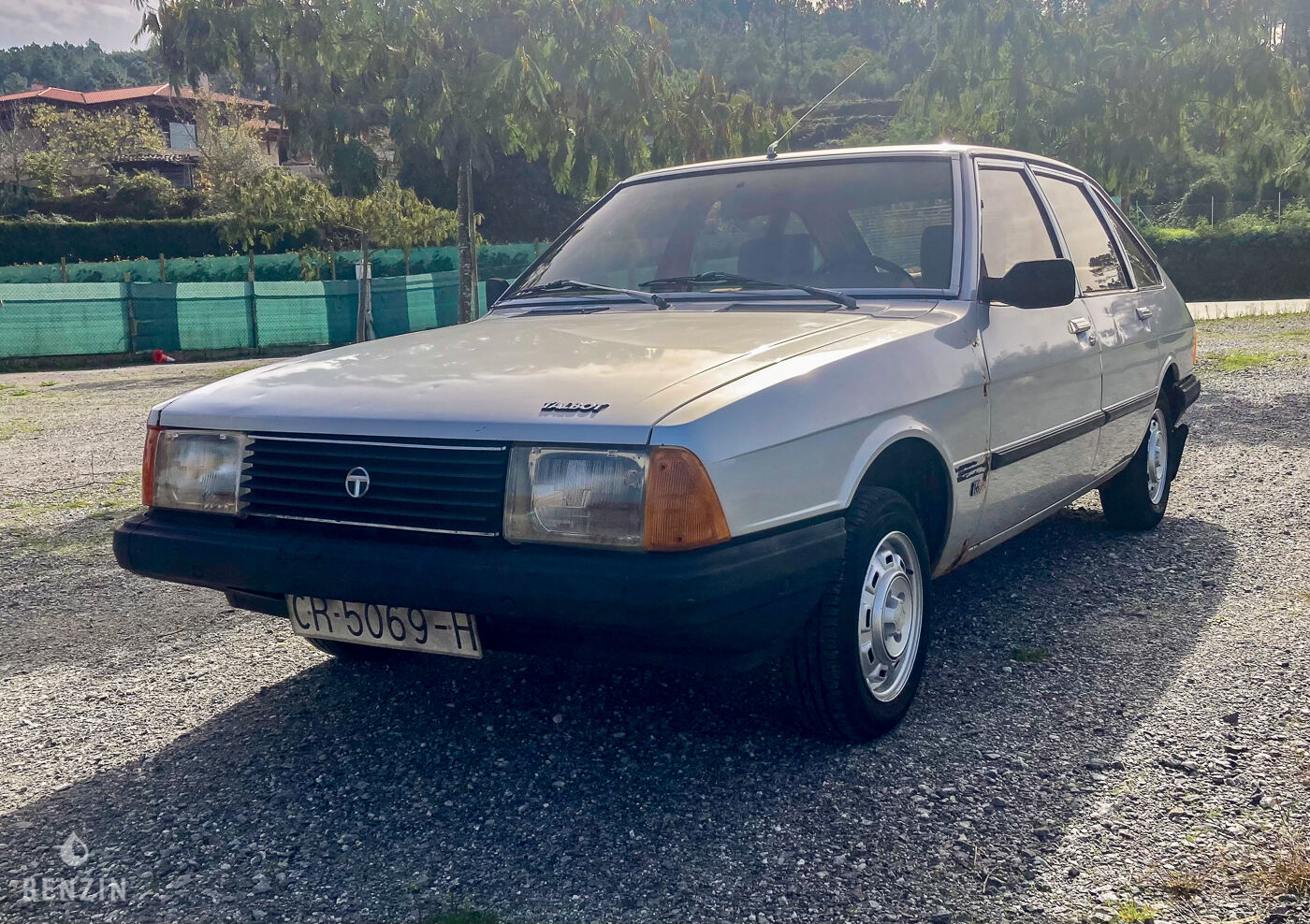
In Spain, the Talbot 150 mainly refers to the local version of the large front-wheel-drive car from the Simca-Chrysler family born in the mid-1970s, the one known in France as the Simca 1307, 1308, 1309 and then 1510, and in the United Kingdom as the Chrysler Alpine. Its modern architecture for the time — transverse engine, hatchback, roomy cabin and very safe handling — came from the program developed by Simca under Chrysler Europe, with a two-box design very close to the original 1307. The technical basis is well known to marque enthusiasts: McPherson front suspension, trailing-arm rear suspension and “Poissy” engines of 1.3, 1.4 and 1.6 liters depending on market and year. In Spain, the model continued its career under Chrysler then Talbot badging after PSA took over Chrysler Europe, with GL and GLS trims and, depending on country or series, more upscale variants. The 1983 model year corresponds to the Talbot period, when the car was already an established family model in the range, between the compact Horizon and the future Solara with a trunk.
Compared with the early Simca 1307/1308, late Talbot 150s benefit from simplified trim, revised equipment and detail updates rather than a mechanical revolution. The most common engines remain the Simca overhead-valve four-cylinders, generally carbureted, paired with a four- or five-speed manual gearbox depending on version and market. The 150 was above all notable for its practicality, visibility and ride comfort, qualities that explain its strong sales at the time under its various European names, with several hundred thousand built if the whole 1307/1510/Alpine/150 family is counted. It did not leave the sporting mark of a Sunbeam Lotus or the prestige of a Tagora, but it holds an important place in Talbot’s industrial history as one of the last major family cars directly descended from the Simca-Chrysler era.
Today, the Talbot 150 has become rare, especially in original Spanish-spec form, as many have disappeared through corrosion or been cannibalized for their mechanical parts shared with other Simca-Talbot models. Collectors value it for its very “end of Simca” authenticity, its relaxed driving feel and the relative ease of finding some mechanical wear parts, far more than specific body or upholstery items. The most sought-after examples are complete, unmodified cars with their period-correct presentation, because restoring an incomplete 150 is often more difficult than rebuilding its mechanicals.
Technical sheet
| Feature | Talbot 150 GL | Talbot 150 GLS / 150 GT |
| Production years | Early 1980s | Early 1980s |
| Body style | 5-door hatchback sedan | 5-door hatchback sedan |
| Engine | 4-cylinder in-line gasoline “Poissy”, carburetor | 4-cylinder in-line gasoline “Poissy”, carburetor |
| Displacement | 1,442 cc | 1,592 cc |
| Power | Around 80 hp depending on market | Around 85 to 90 hp depending on version |
| Transmission | Front-wheel drive, 4- or 5-speed manual gearbox depending on version | Front-wheel drive, 5-speed manual gearbox |
| Suspension | McPherson front, trailing arms rear | McPherson front, trailing arms rear |
| Brakes | Front discs, rear drums | Front discs, rear drums |
| Curb weight | Around 950 to 1,020 kg | Around 980 to 1,050 kg |
| Top speed | Around 155 km/h | Around 165 km/h |
Buyer’s guide
For relaxed classic use, well-preserved 150 GL and GLS models are the most sensible choice: they retain the spirit of the model without the complications of hard-to-find accessories on some very well-equipped versions. The cars to favor are those that have kept their original Poissy mechanicals and their specific Talbot presentation; examples that have been bodged together with mixed interiors, modified wiring or body parts from other variants often require far more work than it first appears.
Points to watch
- Body corrosion : sills, door bottoms, rear wheel arches, windshield scuttle and lower tailgate edge are classic trouble spots on the 1307/1510/150 family; check panel alignment and look for old repairs hidden by thick underseal.
- Front strut towers : rust can attack the metal around the strut towers on cars left outside for a long time; inspect from the engine bay and under the wheel arches, as a light repair does not hold up well.
- Cooling system : the 1.4 and 1.6 do not tolerate a clogged radiator or an erratic fan; overheating in town, mayonnaise in the expansion tank or very hard hoses mean the radiator, thermoswitch, water pump and any head gasket replacement must be checked.
- Solex/Weber carburetor : unstable idle, flat spots on acceleration and hard starting are common after immobilization; ask whether the carburetor has been properly rebuilt and whether air leaks at the base or on the vacuum hoses have been addressed.
- Manual gearbox : crunching in 2nd or 3rd, vague shifting and seepage at the differential outputs often recur on high-mileage cars; on 5-speed versions, the gear selection should be tested when hot and it should be checked that no gear jumps out on deceleration.
- Front suspension : control arm bushings, ball joints and top mounts wear out and cause a vague front end or knocking on rough roads; on this model, poorly addressed wear quickly degrades the car’s otherwise sound handling.
- Rear brakes and compensator : after long storage, wheel cylinders, drums and the brake proportioning valve can seize; an uneven pedal or a car pulling under braking should prompt a full inspection rather than just replacing the linings.
- Talbot 150 specific items : headlights, taillights, hubcaps, interior trim and certain moldings are much harder to find than mechanical parts; check that the car is complete, especially on a 1983 GL, as sourcing often relies on handmade reproduction or used parts.
When buying
On this model, it is important to confirm the car’s exact identity, as the names vary by country and many examples have been mixed with parts from Simca 1307/1510 or other Talbot. The most useful invoices are those relating to the cooling system, carburetor, clutch and structural bodywork repairs. A compression test and a lift inspection of the corrosion-prone areas are often worth more than a recent cosmetic restoration.
1 of the 1 Talbot 150 listed on Benzin found a buyer — 100 % of completed sales.
No Talbot 150 is for sale at the moment. Follow the model to be notified as soon as a new one is listed.
Every vehicle comes with a detailed photo report, its history and the public exchanges between seller and community. You bid online; if you win, Benzin secures the payment and supports you through to delivery.
Follow the model from this page and you will get an e-mail as soon as a Talbot 150 is listed on Benzin.
 English
 Français
 Español
 Italiano
 Deutsch
 Polski
 Magyar
