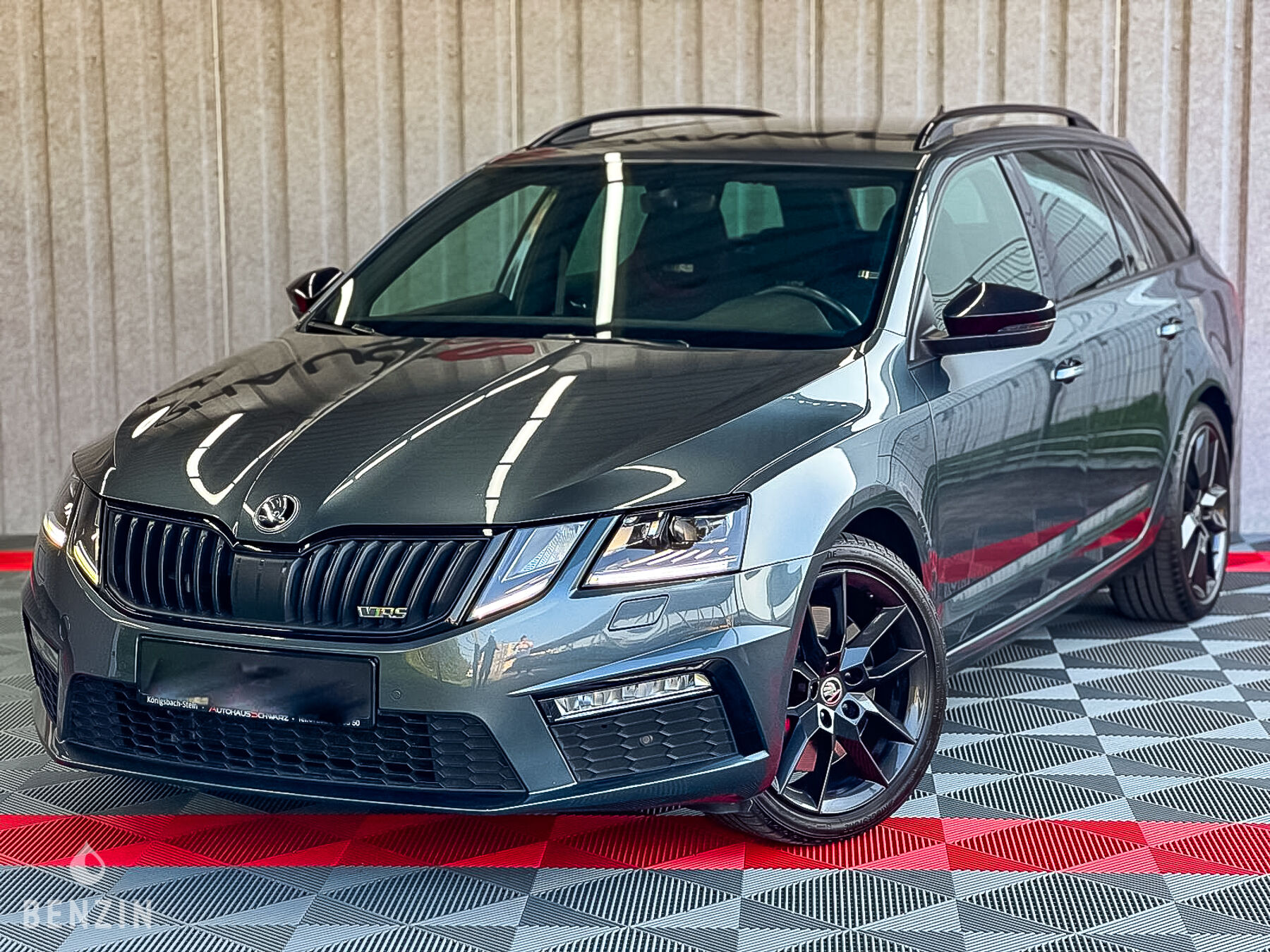
Relaunched in 1996 on Volkswagen Group underpinnings, the modern Skoda Octavia quickly took a central place in the Czech brand’s range thanks to a simple and highly effective recipe: a compact family car with a huge trunk, technically close to mainstream Volkswagen models, but more understated in appearance and often better equipped for the same budget. The third-generation Octavia, coded 5E and launched at the end of 2012, marked a real leap in interior space and perceived quality thanks to the MQB modular platform, while the 2017 facelift, often called “phase 2,” significantly revised the front end with its split headlights. It is this later evolution that most interests fans of recent versions, especially in RS form, with a range spanning the 1.0 TSI and 1.5 TSI to the 2.0 TDI, not forgetting the G-TEC natural-gas variants in some markets. The body style is available as a 5-door sedan and as a Combi estate, always with remarkable practicality, which explains its wide spread across Europe.
The RS version remains the most sought after by enthusiasts: after the RS 2.0 TSI and TDI already known before the facelift, the Octavia phase 2 notably received the RS 230 and RS 245, derived from the 2.0 TSI EA888, with manual or DSG gearbox depending on version and market. The RS 230, particularly common in 2017-2018, is identified by its 230 hp and its controlled front VAQ differential, while the RS 245 pushes the formula a little further with 245 hp, a sharper calibration, and, with DSG, the newer 7-speed gearbox. Alongside it, the RS TDI 184 hp retains its fans for its torque and long-distance use, even if driving enthusiasts generally prefer petrol. Produced in the millions across all versions over the entire modern Octavia line, the 5E established itself as a rational family car, and the RS as one of the most accomplished discreet sports cars of its era.
Today, the Octavia RS phase 2 enjoys a strong reputation among clubs and VAG specialists: capable, spacious, relatively easy to maintain outside the dealer network, and less ostentatious than a Golf GTI or its technically related Leon Cupra cousin. Collectors do not yet consider it a classic, but attractive original cars, lightly modified and properly maintained, are already the ones sought after by connoisseurs. Imported examples are numerous, which means the exact configuration must be checked carefully, especially between RS 230 DSG6, RS 245 DSG7, sedan or Combi, as well as the CO2 homologation standard, which can vary depending on the model year.
Technical specifications
| Feature | Octavia RS 230 TSI DSG6 | Octavia RS 245 TSI DSG7 | Octavia RS TDI DSG6 |
| Production years | 2017-2020 | 2017-2020 | 2017-2020 |
| Body style | 5-door sedan or Combi | 5-door sedan or Combi | 5-door sedan or Combi |
| Engine | 4-cyl. 2.0 l turbo TSI (EA888) | 4-cyl. 2.0 l turbo TSI (EA888) | 4-cyl. 2.0 l turbo TDI |
| Power | 230 hp | 245 hp | 184 hp |
| Torque | 350 Nm | 370 Nm | 380 Nm |
| Transmission | Front-wheel drive, DSG6 | Front-wheel drive, DSG7 | Front-wheel drive, DSG6 |
| Curb weight | approx. 1,430 kg | approx. 1,450 kg | approx. 1,470 kg |
| 0-100 km/h | approx. 6.8 s | approx. 6.6 s | approx. 7.8 s |
| Top speed | 250 km/h | 250 km/h | approx. 232 km/h |
Buyer’s guide
For a good balance between driving pleasure, perceived reliability, and ease of resale, the RS 230 with the 2.0 TSI is often the most coherent choice, especially if its DSG gearbox and VAQ differential maintenance is perfectly documented. The RS 245 appeals to those who want the most accomplished version, but you need to be more vigilant with modified or reprogrammed cars. The TDI models suit high-mileage drivers well, but enthusiasts generally prefer petrol and avoid examples maintained under “LongLife” servicing without close follow-up.
Points to watch
- DSG gearbox : jerks at low speed, wheelspin on takeoff, or hesitant gear changes, especially if the oil has not been changed at the prescribed intervals; on RS 230 with DSG6 as on RS 245 with DSG7, ask for precise gearbox service invoices and check for any diagnostic faults.
- VAQ differential : clunks during maneuvers, inconsistent traction, or warning messages on the RS 230 and 245; this controlled differential has its own maintenance, often forgotten, and the specific fluid change as well as the absence of noise under hard acceleration must be confirmed.
- Water pump and thermostat housing : coolant seepage or a slow drop in level on the 2.0 TSI EA888; this is a known issue in the VAG world, to be checked visually around the cooling module and through replacement invoices if it has already been done.
- 2.0 TSI engine : abnormal oil consumption, cold misfires, or irregular running on reprogrammed or poorly maintained cars; check the condition of the coils and spark plugs, and make sure the car has not been driven for long with an undeclared map.
- Columbus/Bolero infotainment : screen rebooting, finicky touchscreen, unstable GPS or connectivity on some phase 2 cars; check all functions, menu language, updates, and the absence of a replacement with a poorly coded used module.
- Front axle and bushings : knocking on rough roads, uneven tire wear, or the car pulling to one side, especially on RS models often running on large-diameter wheels; inspect the top mounts, link rods, and alignment condition, as these cars sometimes hide a poorly repaired minor impact.
- Front radar and driver-assistance systems : Front Assist/ACC messages or incorrect calibration after bumper or windshield replacement; on an imported or accident-repaired car, the correct calibration of the sensors and the absence of stored faults must be confirmed.
- Panoramic sunroof on Combi : noises, leaks, or blocked drains; this is not systematic, but it is an issue reported by owners, to be checked during a static inspection and after spraying with water.
When buying
On an RS, a scan with the VAG diagnostic tool is very useful to read fault codes, check the consistency of the mileage stored in the control units, and confirm the exact equipment. Ask for invoices for DSG oil changes and, where applicable, for the VAQ differential: their absence should raise suspicion. On imported cars, it is also important to verify the exact version by chassis number, the gearbox fitted from new, the approved emissions level, and the options list, because the RS 230 and 245 are often confused in listings.
1 of the 1 Skoda Octavia 2 listed on Benzin found a buyer — 100 % of completed sales.
No Skoda Octavia 2 is for sale at the moment. Follow the model to be notified as soon as a new one is listed.
Every vehicle comes with a detailed photo report, its history and the public exchanges between seller and community. You bid online; if you win, Benzin secures the payment and supports you through to delivery.
Follow the model from this page and you will get an e-mail as soon as a Skoda Octavia 2 is listed on Benzin.
 English
 Français
 Español
 Italiano
 Deutsch
 Polski
 Magyar
