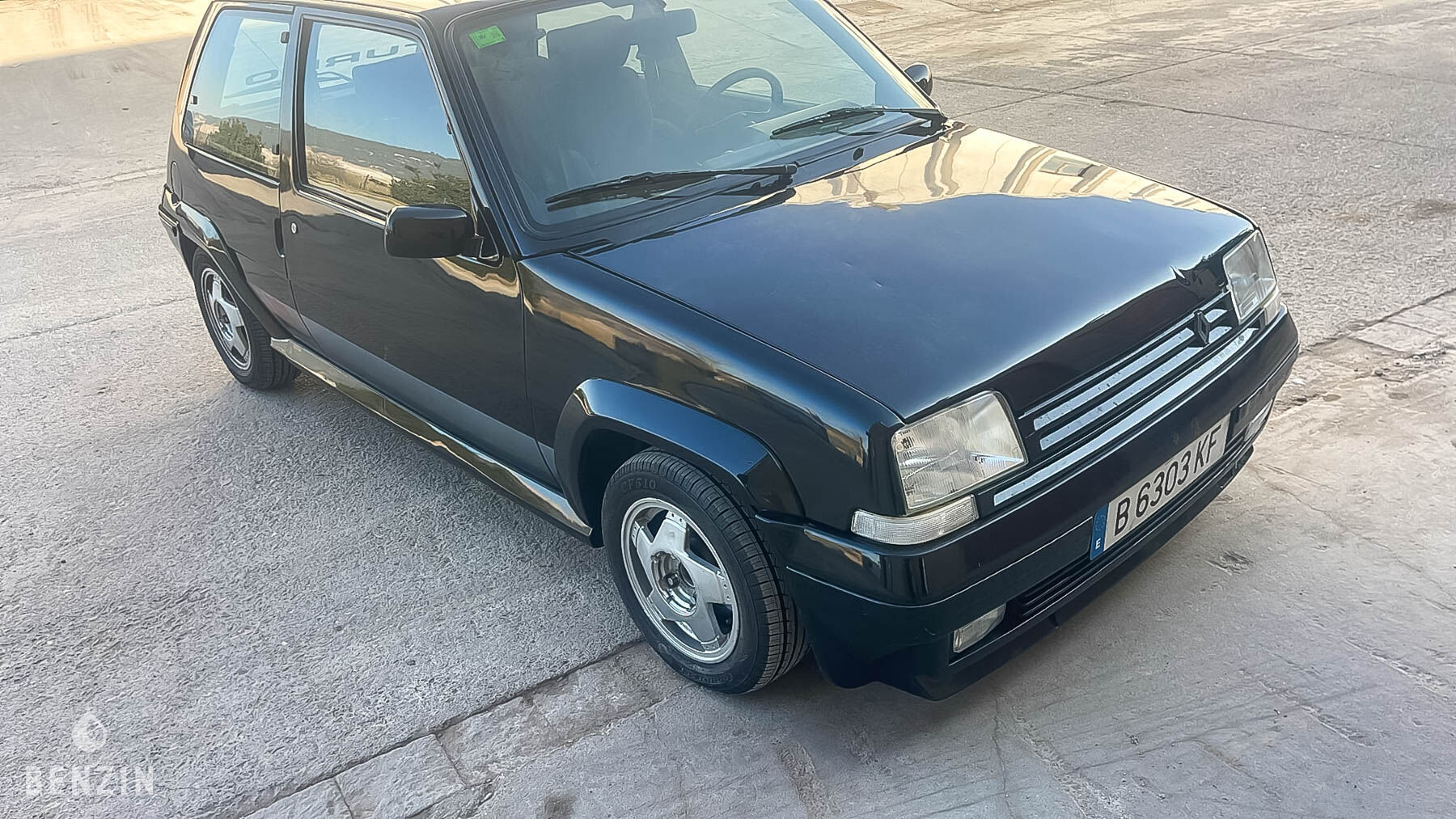
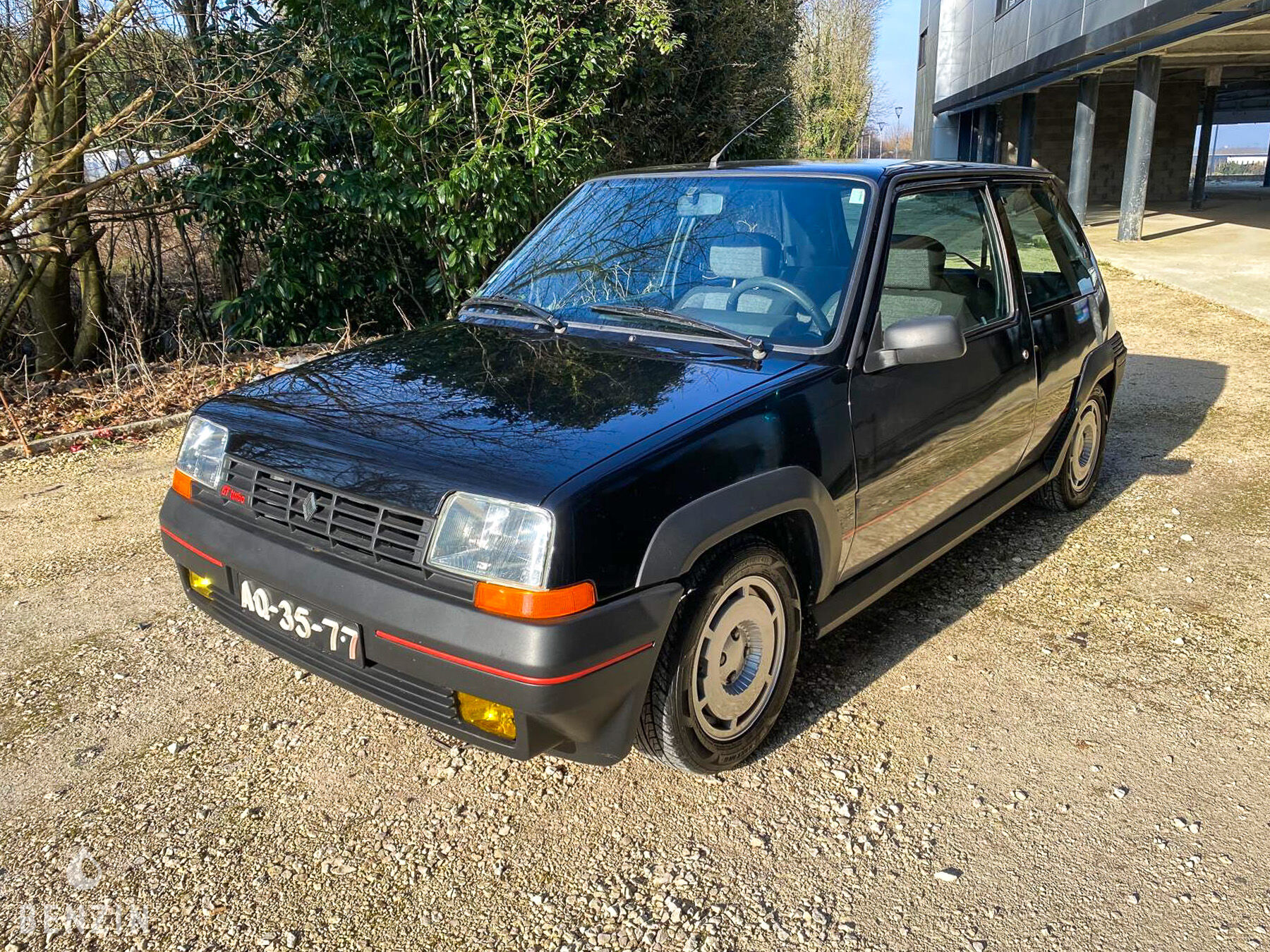
Introduced in autumn 1985, the Renault Super 5 GT Turbo took up the recipe of the small turbocharged sports car that Renault had popularized with the R5 Alpine Turbo, but on the basis of the Supercinq styled under the direction of Marcello Gandini for the exterior design. Instead of adopting modern fuel injection, Renault chose to develop the robust 1,397 cc “Cléon-Fonte” four-cylinder with a Garrett T2 turbocharger and a blow-through carburetor, a simple, light and very effective solution. The first phase, sold for the 1985 model year, is recognized by its specific interior, its original alloy wheels and its 115 hp output. Very lively, light and demanding, it quickly established itself as one of the benchmarks among French turbo GTIs, with a more brutal character than many of its naturally aspirated rivals. From the outset, Renault placed it in a strong sporting universe, between promotional one-make series, national rallies and the image of an 1980s boulevard “bomb.” The so-called “Copa” versions seen today refer either to cars linked to export markets, or to configurations evoking the one-make cup, with equipment or wheels that do not always exactly match the factory specification of a standard GT Turbo.
In 1987 came phase 2, extensively revised in detail: bumpers, dashboard, suspension, cooling and overall tuning were updated, while power rose to 120 hp. This evolution is generally considered the most accomplished for road use, without losing the model’s very distinctive character. The career continued until 1991, with several limited editions depending on the country, while rarer derivatives such as the EBS convertibles used the GT Turbo’s mechanical base in a conversion carried out outside Renault’s factory. The GT Turbo also enjoyed a considerable second cultural life, between tuning, engine swaps, track builds and sometimes approximate restorations, which makes strictly original cars particularly sought after. Total production amounts to just over 47,000 examples, a modest figure given its reputation. Today, it holds a special place among French youngtimer enthusiasts: an iconic car, very fast for its size, but one whose purchase requires careful distinction between originality, structural condition and the quality of the restoration work.
Technical sheet
| Version | GT Turbo phase 1 | GT Turbo phase 2 | EBS GT Turbo |
| Production years | 1985-1987 | 1987-1991 | late 1980s-early 1990s |
| Body style | 3-door hatchback | 3-door hatchback | 2-door convertible converted by EBS |
| Engine | inline 4-cylinder, 1,397 cc, Garrett T2 turbo, blow-through carburetor | inline 4-cylinder, 1,397 cc, Garrett T2 turbo, blow-through carburetor | inline 4-cylinder, 1,397 cc, Garrett T2 turbo, blow-through carburetor |
| Power | 115 hp | 120 hp | 120 hp depending on the source used |
| Torque | approx. 165 Nm | approx. 165 Nm | approx. 165 Nm |
| Transmission | front-wheel drive, 5-speed manual gearbox | front-wheel drive, 5-speed manual gearbox | front-wheel drive, 5-speed manual gearbox |
| Curb weight | approx. 850 kg | approx. 850 kg | higher than the hatchback |
| 0-100 km/h | approx. 7.5 s | approx. 7.7 s | slightly slower than the hatchback |
| Top speed | approx. 200 km/h | approx. 204 km/h | close to the hatchback depending on configuration |
| Production | just over 47,000 standard GT Turbo cars in total; EBS: very small-series conversion |
Buyer’s guide
For regular use, phase 2 is generally the most recommendable thanks to its tuning and cooling improvements, provided it has remained close to original. Phase 1 is the most sought after by purists for its style and character, but it deserves extra vigilance regarding the authenticity of the components and the quality of repairs. Very modified cars, phase 1/phase 2 mixes and poorly documented conversions should be approached with caution.
Points to watch
- Cooling / head gasket : temperature rise, hard hoses, traces of mayonnaise or coolant pushing back into the expansion tank, especially on poorly maintained or modified cars; ask what has been done to the radiator, thermostat, fan sender/fan switch and head gasket.
- Garrett T2 turbo : blue smoke after deceleration or prolonged idling, abnormal whistling, shaft play and oil leaks on feed/return lines; a rebuild documented by a specialist is a real plus on this model.
- Pressurized carburetor and boost system : flat spots on acceleration, unstable idle, lean running under boost or inconsistent turbo pressure; check the condition of the Solex, the diaphragms, the pressure hoses and the absence of makeshift fuel-mixture or wastegate modifications.
- Gearbox : worn synchros, crunching in 2nd/3rd, bearing noise and drivetrain strain on cars driven hard; also check the clutch, often original on low-mileage cars but not necessarily in good condition.
- Body corrosion : windscreen scuttle under the seal, battery tray, cowl feet, sills, boot floor and rear wheel arches; these are areas regularly mentioned by owners, sometimes hidden by a resprayed finish.
- Front axle / steering : split and greasy steering rack boots, play in the control arms and strut tops, vague braking feel; on a healthy GT Turbo, the front end should remain precise despite the torque and should not feel floaty.
- Authenticity of the phase and specific parts : upholstery, panels, wheels, bumpers, grille, spoiler and instruments are often mixed between phase 1, phase 2 and Coupe parts; you need to check that the stated configuration really matches the year and type of the car.
- Modifications and homologation : side exhaust, aftermarket sunroof, roll cage, engine swap, increased turbo pressure or convertible conversion; on this model, which is often modified, you need to distinguish between a reversible preparation and a car that has become difficult to register or return to compliance.
When buying
The most useful documents are the old MOT certificates to cross-check the mileage, invoices for turbo, head gasket and cooling system rebuilds, as well as any proof of work on the gearbox or clutch. Check that the chassis number matches the registration document, and on a car presented as “matching,” also verify that the engine is consistent with its period. A test drive should confirm normal boost pressure, stable temperature rise and no smoke; on a restored or modified car, a compression test and an inspection on a lift are particularly relevant. For an EBS or an imported car, you also need to make sure the conversion and identification are correctly recorded in the paperwork.
On Benzin a Renault Super 5 GT Turbo has sold for 14 671 € on average, with a median price of 13 750 €. Based on the 16 sales completed on the platform.
The 16 Renault Super 5 GT Turbo sold on Benzin changed hands for between 8 300 € and 30 000 €, depending on condition, mileage and version.
16 of the 29 Renault Super 5 GT Turbo listed on Benzin found a buyer — 55 % of completed sales.
No Renault Super 5 GT Turbo is for sale at the moment. Follow the model to be notified as soon as a new one is listed.
Every vehicle comes with a detailed photo report, its history and the public exchanges between seller and community. You bid online; if you win, Benzin secures the payment and supports you through to delivery.
Follow the model from this page and you will get an e-mail as soon as a Renault Super 5 GT Turbo is listed on Benzin.
 English
 Français
 Español
 Italiano
 Deutsch
 Polski
 Magyar
