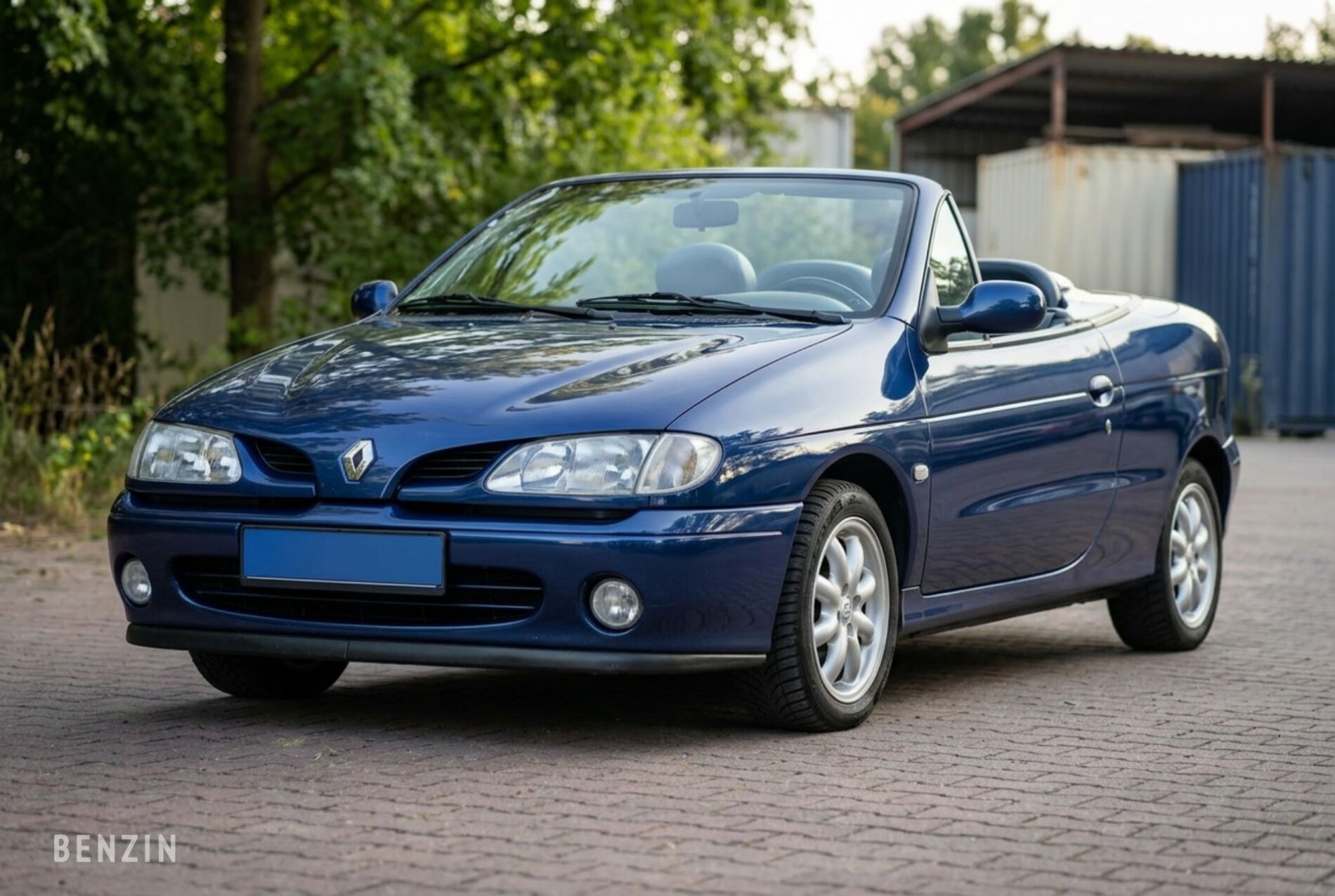
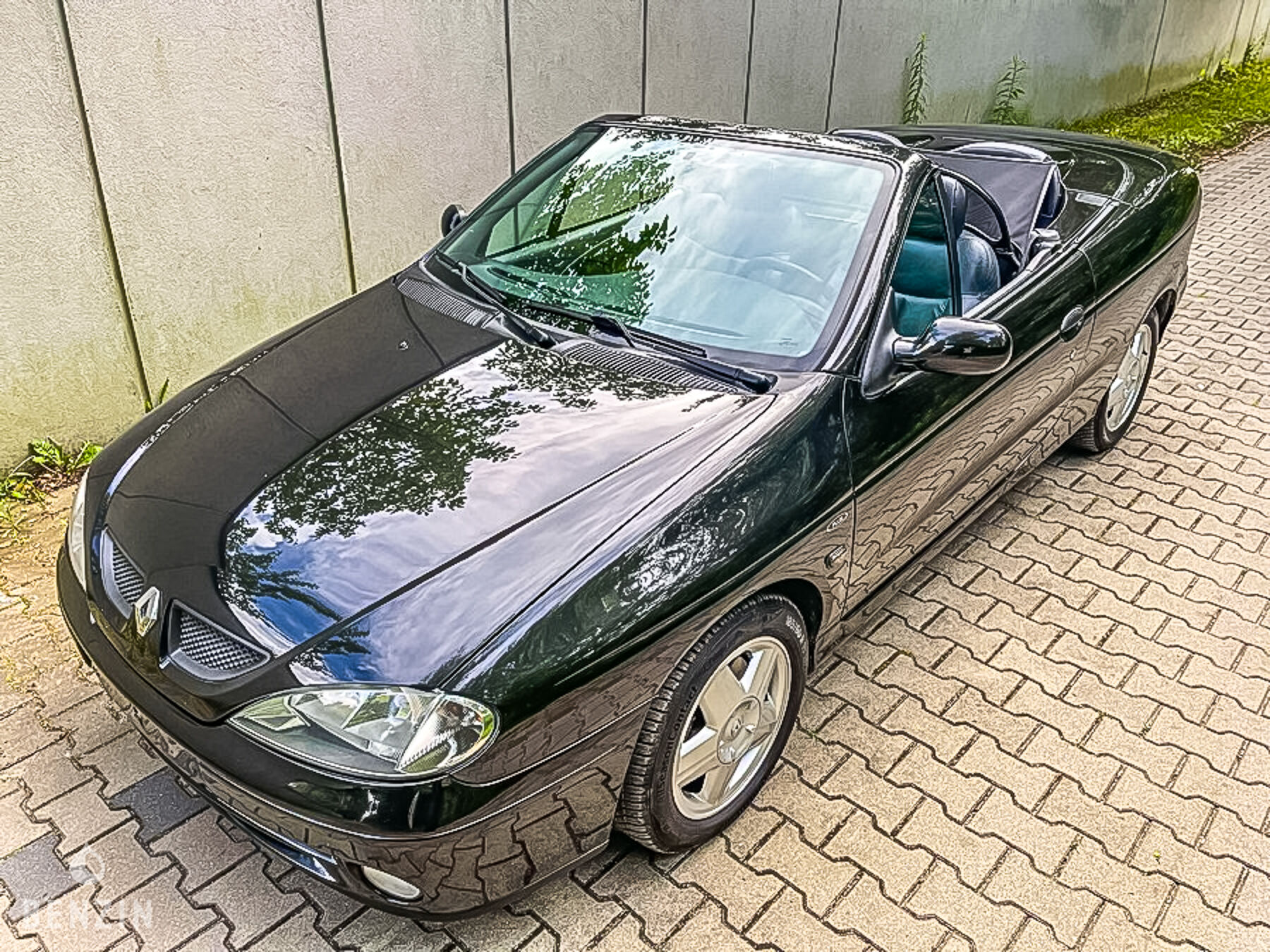
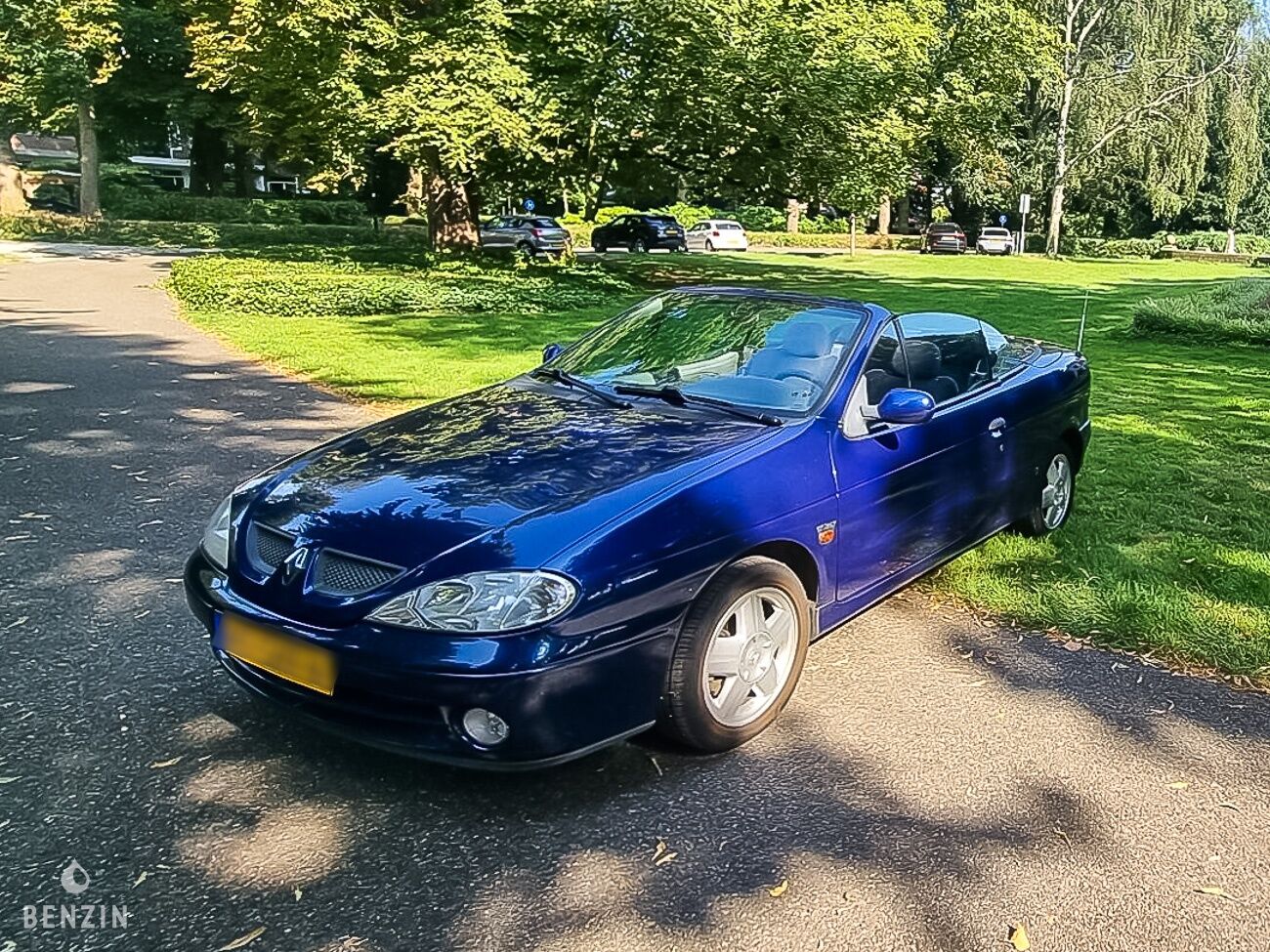
The Renault Mégane Cabriolet was born in the wake of the replacement of the R19 by the Mégane family, launched from 1995 under the styling direction of Patrick Le Quément. Presented in 1996 and sold from 1997, it uses the Mégane I technical base but with an open-top body offering four real seats, an electrically assisted fabric soft top depending on version, and specific body reinforcements. Its design retains the very recognizable face of the Mégane phase 1, with its oval headlights, then adopted the 1999 facelift known as phase 2, smoother and more modern. The range is built around well-known Renault petrol engines, from the 1.6 8-valve to the 1.6 16-valve, up to the 2.0 16-valve which is the most powerful version. Diesel versions also existed in some markets, but it is clearly the petrol versions that dominate today among enthusiasts. Without aiming for the radicalism of a roadster, the Mégane Cabriolet offered a very French formula for a compact convertible usable every day, with a decent trunk for the class and genuine comfort for four.
This first generation remained in the catalog until the early 2000s, before being replaced in 2003 by the Mégane II CC with a retractable hardtop, then by the Mégane III CC in 2010. These two CC generations changed the model’s philosophy, focusing more on coupe-cabriolet versatility than on the lightness and simplicity of the fabric-top version. Even so, in the collector and leisure market, it is the Mégane I Cabriolet that appeals to those looking for the cleanest lines, the lowest weight and simple mechanics to maintain. The 2.0 16v is the most sought-after variant among enthusiasts, while the 1.6 16v versions are often considered the best compromise between performance and running costs. Long underestimated, it is now enjoying renewed interest as an accessible 1990s convertible, provided you can find an example with sound structure and, above all, impeccable soft-top operation and sealing.
Like many Renault convertibles of this era, its reputation depends less on engine durability than on the condition of the body peripherals and comfort electrics. Clubs and specialists therefore advise choosing complete, unmodified cars, with the soft top, glazing, cover and trim perfectly fitted, because these elements are harder to set right than an ordinary mechanical issue. A well-kept car remains pleasant, lively enough in 1.6 16v and genuinely convincing in 2.0 16v, while retaining the discreet charm of compact open-top cars from the late 1990s.
Technical data
| Version | 1.6e Cabriolet | 1.6 16v Cabriolet | 2.0 16v Cabriolet |
| Production years | 1997-2000 | 1999-2003 | 1999-2003 |
| Body | 2-door convertible, 4 seats, fabric soft top | 2-door convertible, 4 seats, fabric soft top | 2-door convertible, 4 seats, fabric soft top |
| Engine | 4-cylinder inline petrol, 1598 cc, 8 valves | 4-cylinder inline petrol, 1598 cc, 16 valves | 4-cylinder inline petrol, 1998 cc, 16 valves |
| Power | 90 hp | 110 hp | 145 to 150 hp depending on year |
| Transmission | Front-wheel drive, 5-speed manual gearbox | Front-wheel drive, 5-speed manual gearbox | Front-wheel drive, 5-speed manual gearbox |
| Curb weight | About 1180 to 1220 kg | About 1200 to 1240 kg | About 1230 to 1270 kg |
| 0-100 km/h | About 12 s | About 10.5 s | About 9 s |
| Top speed | About 180 km/h | About 190 km/h | About 205 km/h |
Buyer’s guide
The most desirable version is the 2.0 16v, rarer and best suited to the extra weight of the convertible. For more peace of mind, the 1.6 16v phase 2 is often the best choice thanks to its better refinement than the 1.6 8-valve without excessive complexity. Cars with a temperamental soft top, poorly adjusted windows or a body that “moves” should be avoided, because putting them right is quickly more troublesome than fixing the mechanicals.
Points to watch
- Electro-hydraulic soft top : cycle that stops, soft top that strains, or cover that does not lock, especially on cars that are rarely used; check several full opening and closing cycles when hot and cold, without manual assistance.
- Micro-switches and soft-top mechanism : warning light on, trunk lid that refuses to open, or a sequence that gets stuck halfway through; common on aging Mégane Cabriolets, you need to check the alignment of the hooks, the presence of the covers and the absence of any bodged wiring.
- Soft-top sealing and drains : dampness in the cabin, wet carpet behind the seats or water in the trunk; check the condition of the seals, the rear window, the drains, and ask whether the car is kept outside or not.
- Frameless windows : poor fit, wind noise, leaks around the quarter windows or upper seals; on this model, a simple window adjustment can make it seem like the soft top is worn out, so you need to check the raising, lowering and sealing of the glass with the door closed.
- Body structure and alignment : doors that close poorly, body creaks on rough roads, abnormal play around the windshield; on an older convertible, this can reveal a poorly repaired impact or repeated lifting at the wrong jacking points.
- Coils and ignition on the 1.6 16v and 2.0 16v : misfires, unstable idle, engine running on three cylinders; this is a classic Renault issue from the period, ask whether the coils have already been replaced and check for any ignition fault under load.
- Variable valve timing pulley on 1.6 16v phase 2 : diesel-like noise at cold start; on the cars concerned, you should listen to a start-up after the car has been parked and look for a replacement invoice if the noise has already been addressed.
- Convertible-specific upholstery and trim : loose panels, soft-top cover plastics, missing mechanism covers or rear deck trim; these are not just details, because some convertible-specific trim parts are harder to find than mechanical components.
When buying
On a Mégane Cabriolet, the test drive must absolutely include the full operation of the soft top, checking the carpets and the trunk, as well as the alignment of the windows with the seals. For the 1.6 16v and 2.0 16v, a diagnostic scan can reveal intermittent ignition or sensor faults, and a recent invoice for coils or timing belt work is particularly useful. If the car comes from abroad, you also need to make sure the certificate of conformity or a complete registration file is present, as these convertibles often circulated outside France.
On Benzin a Renault Megane CC / Cabriolet has sold for 833 € on average, with a median price of 650 €. Based on the 3 sales completed on the platform.
The 3 Renault Megane CC / Cabriolet sold on Benzin changed hands for between 600 € and 1 250 €, depending on condition, mileage and version.
3 of the 7 Renault Megane CC / Cabriolet listed on Benzin found a buyer — 43 % of completed sales.
No Renault Megane CC / Cabriolet is for sale at the moment. Follow the model to be notified as soon as a new one is listed.
Every vehicle comes with a detailed photo report, its history and the public exchanges between seller and community. You bid online; if you win, Benzin secures the payment and supports you through to delivery.
Follow the model from this page and you will get an e-mail as soon as a Renault Megane CC / Cabriolet is listed on Benzin.
 English
 Français
 Español
 Italiano
 Deutsch
 Polski
 Magyar
