Unveiled in autumn 2008 and sold from the end of that same year, the Renault Mégane III succeeded a Mégane II with a very broad career and had to bring the model back to the heart of the European C-segment. Its styling, overseen at the end of the Patrick Le Quément era, broke with the exuberance of the previous generation in favor of sharper lines and a finish perceived as a clear improvement. The range was immediately conceived as a complete family, with a 5-door sedan, 3-door coupé, Estate wagon and coupé-cabriolet, soon joined by GT, GT Line and especially Renault Sport variants. The engine lineup was very broad, from 1.5, 1.6, 1.9 and then 2.0 dCi diesels to naturally aspirated and turbo petrol engines, with direct-injection TCe engines arriving over the course of the model’s life.
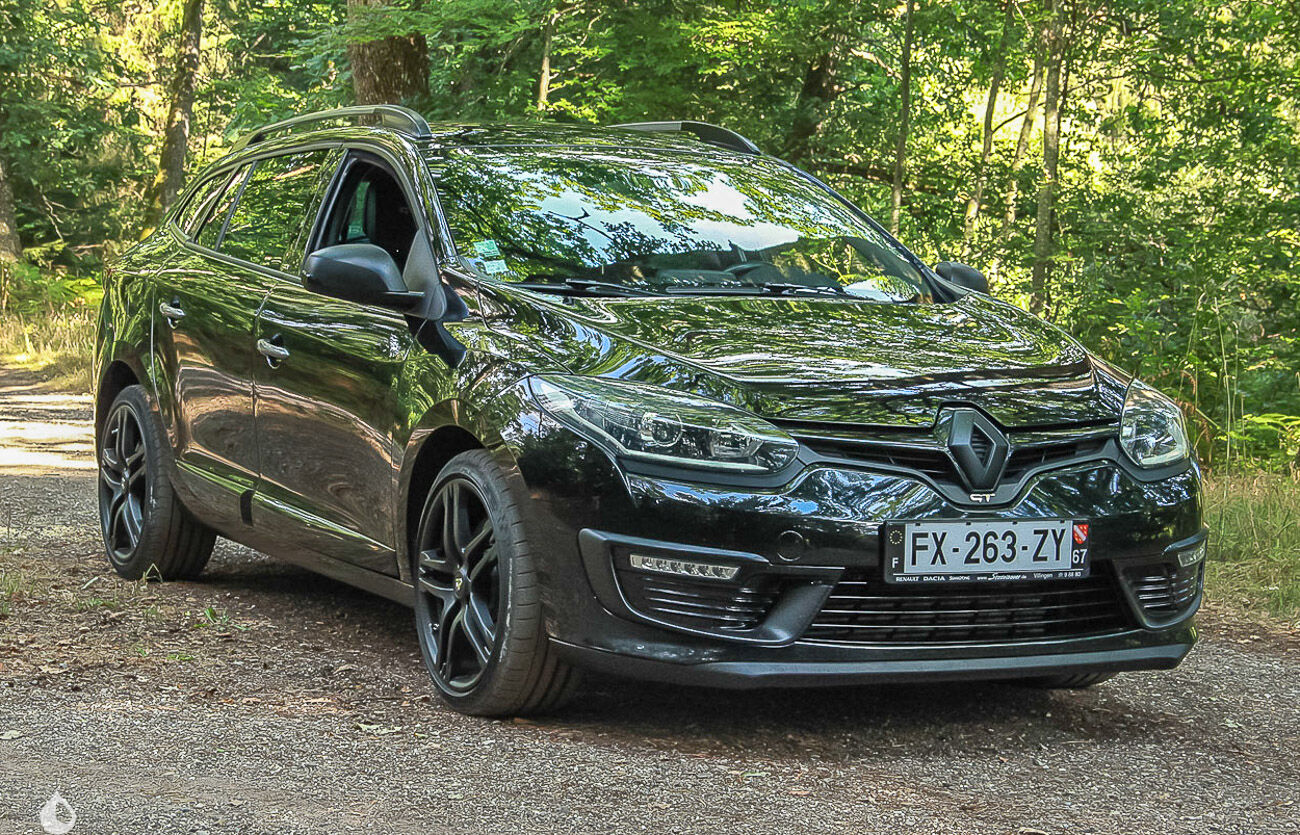
The Mégane III evolved in successive steps rather than through a clean break, with a first facelift in 2012 and a second update in 2014, recognizable by the new Renault front end. The sporty Mégane RS, first with 250 hp then 265 and 275 hp, became one of the benchmark front-wheel-drive cars of its generation thanks to its front axle, its differential on Cup versions and its Nordschleife records. Alongside it, discreet buyers look for the GT models with the 2.0 TCe engine, and especially the rare Estate GT 220 that appeared at the end of the model’s life, a very capable estate using the RS’s 2-liter turbo in a softened 220 hp tune. This version stands out for its “sleeper” character, its manual gearbox and a more serious technical base than the small turbo petrol engines at the bottom of the range. In customer racing, the Mégane name is also linked to the various Mégane Trophy cars, which has helped maintain the sporty image of the line well beyond the road-going compact alone.
Today, the Mégane III is appreciated for its balance of driving pleasure, chassis precision and still-reasonable running costs, with a clear hierarchy between versions. The RS models are already well identified by modern youngtimer collectors, while the GT coupés and especially the Estate GT 220 are gaining the respect of enthusiasts. Conversely, some small-displacement TCe petrol versions require more caution, which makes engine choice particularly important on this model.
Technical sheet
| Version | Mégane III Estate GT 220 | Mégane III RS 265 | Mégane III 1.5 dCi 110 |
| Production years | 2013-2016 | 2012-2014 | 2008-2016 |
| Body style | 5-door estate | 3-door coupé | 5-door sedan / estate depending on version |
| Engine | 4-cyl. 2.0 turbo petrol F4Rt | 4-cyl. 2.0 turbo petrol F4Rt | 4-cyl. 1.5 turbo diesel K9K |
| Power | 220 hp | 265 hp | 110 hp |
| Torque | 340 Nm | 360 Nm | 240 Nm |
| Transmission | Front-wheel drive, 6-speed manual gearbox | Front-wheel drive, 6-speed manual gearbox | Front-wheel drive, 6-speed manual gearbox or EDC depending on year |
| Curb weight | around 1,430 kg | around 1,380 kg | around 1,250 to 1,320 kg |
| 0 to 100 km/h | around 7.6 s | around 6.0 s | around 11.7 s |
| Top speed | around 240 km/h | around 254 km/h | around 190 km/h |
| Specific features | GT chassis, RS-derived mechanics, discreet estate | Cup chassis possible, limited-slip differential depending on version | production version, frugality and running costs |
Buyer’s guide
For enthusiast use, the most interesting versions are the RS and, as a more discreet and very well-balanced alternative, the rare Estate GT 220 with the 2.0 TCe engine, far more reassuring than the small TCe engines from the end of the model’s life. For daily use, the well-maintained 1.5 dCi 110 and 1.6 dCi remain the most rational choices. The 1.2 TCe versions are the ones that inspire the most caution because of their reputation for oil consumption and internal problems.
Points to watch
- 1.2 TCe H5Ft : excessive oil consumption, misfires, loss of compression or even premature engine wear on some cars from 2012 to 2016; ask specifically about the oil consumption observed, any campaigns or replacements, and avoid any example that smokes or rattles when cold.
- 2.0 TCe F4Rt (GT 220 and RS) : generally robust base, but modified or remapped cars can suffer from overheating, tired turbochargers or leaks in the boost circuit; check whether the map is original, the condition of the hoses, boost pressure stability and the absence of smoke when accelerating again.
- PK4/TL4 manual gearbox : synchro crunching, especially 3rd and 4th, heavy clutch or slipping on powerful and/or hard-driven cars; during the test drive, check gear changes both hot and cold and ask whether the clutch or flywheel have already been replaced.
- Front axle on the GT and RS : play in the pivots, link rods, ball joints and sometimes rapid tire wear if the alignment has shifted after sporty use; check for perfectly even tire wear, no knocking on rough roads and stable steering under braking.
- Timing belt on belt-driven engines : on the 2.0 TCe F4Rt as on the K9K diesels, the timing belt interval is a crucial point; insist on a dated invoice rather than a simple mention, because many cars are driven little and reach age before mileage.
- 1.5 dCi / 1.6 dCi diesel : EGR valve, DPF and injection peripherals can cause problems on cars used almost exclusively in the city; check invoices, the absence of limp mode, hesitation under acceleration and recurring emissions warnings.
- Electric parking brake and comfort electronics : on Mégane III, breakdowns are less frequent than on some earlier Renaults but are still known, with dashboard messages, temperamental keyless entry cards or faulty window lifts/switches; systematically test every function and ask whether a diagnostic scan has already revealed stored faults.
When buying
On a GT 220 or an RS, a Renault diagnostic scan is very useful to read stored faults, check boost parameters and spot any remap or the disabling of certain functions. You should also ask for proof of the timing belt service when the engine depends on it, as well as invoices for the clutch, brakes and tires on the more powerful versions. On diesels, checking injector corrections and the DPF load status is worthwhile; on a 1.2 TCe, the oil consumption history and, if there is any doubt, a compression test make sense.
1 of the 1 Renault Megane 3 listed on Benzin found a buyer — 100 % of completed sales.
No Renault Megane 3 is for sale at the moment. Follow the model to be notified as soon as a new one is listed.
Every vehicle comes with a detailed photo report, its history and the public exchanges between seller and community. You bid online; if you win, Benzin secures the payment and supports you through to delivery.
Follow the model from this page and you will get an e-mail as soon as a Renault Megane 3 is listed on Benzin.
 English
 Français
 Español
 Italiano
 Deutsch
 Polski
 Magyar
