The Renault Mégane II appeared in autumn 2002 to replace the long-running Mégane I, with the ambition of moving Renault upmarket in the compact segment. Its styling, developed under Patrick Le Quément, clearly differed from the previous generation, especially on the hatchback with its very upright rear, while the car was based on the Renault-Nissan Alliance common platform. The range quickly expanded with 3-door, 5-door and Estate versions, then the Coupé-Cabriolet with a retractable hardtop launched in 2003, not to mention the four-door sedan intended for certain markets. The Mégane II also made an impression with its equipment level, its hands-free card on certain trims and its excellent Euro NCAP crash-test result, with Renault strongly emphasizing safety at the time. Engines ranged from naturally aspirated petrol units 1.4 16v, 1.6 16v and 2.0 16v to 1.5, 1.9 and 2.0 dCi diesels, with a very broad offering depending on body style and country.
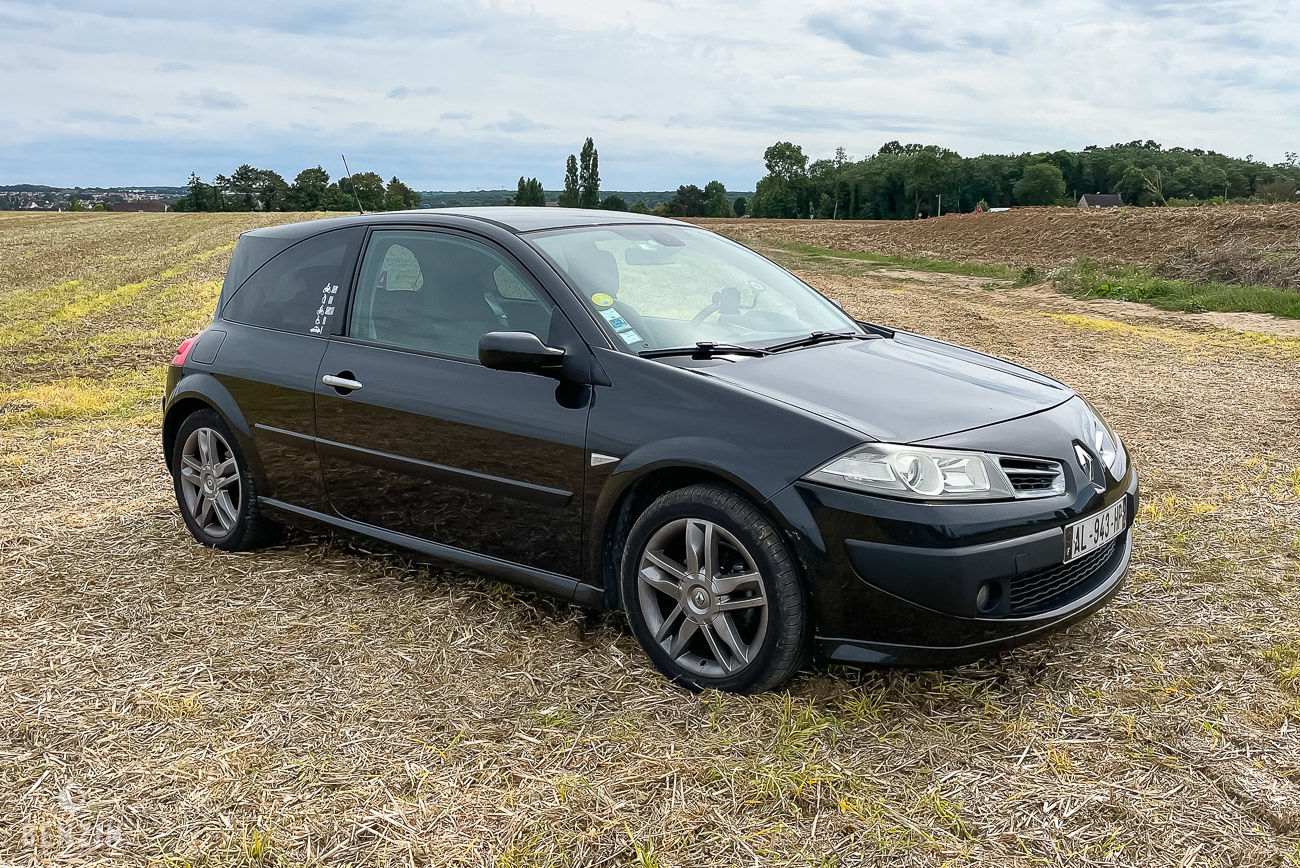
In 2004, the Mégane Renault Sport 225 arrived, giving the second generation real sporting credibility, followed by Cup chassis, R26 and then R26.R variants that became benchmarks among performance front-wheel-drive fans. Between the two, Renault offered more discreet but highly appreciated versions such as the GT 2.0T, recognizable by its specific styling and powered by the 2-liter turbo F4Rt in a more civilized specification than the RS. The 2006 facelift, often called phase 2, brought a redesigned front end, improved interior presentation, a few reliability fixes and a rationalized engine range. The last Mégane II models gradually left the stage from 2008-2009 with the arrival of the Mégane III, while some body styles continued a little longer depending on the market. In total, the Mégane II was produced in more than three million units, making it a major model in Renault’s recent history.
Today, the regular versions are mainly of interest for their usability and variety of body styles, but it is the 2.0T, the GT and, of course, the Renault Sport models that attract enthusiasts’ attention. Fans appreciate the chassis-comfort balance of the phase 2 cars, the character of the design and the personality of the F4Rt, while knowing that the electronics and certain peripheral components require more attention than average. Unmodified examples, well maintained and still original, are increasingly sought after, especially when the paperwork helps clear up the frequent doubts about mileage, clutch replacements or the aftermath of an old crash.
Technical specifications
| Version | Mégane II 1.6 16v | Mégane II GT 2.0T | Mégane R.S. 225 |
| Production years | 2002-2009 | 2004-2009 | 2004-2008 |
| Body style | 3- or 5-door hatchback, Estate depending on market | 3- or 5-door hatchback, Estate depending on market | 3-door hatchback |
| Engine(s) | Inline 4-cylinder, 1,598 cc, naturally aspirated | Inline 4-cylinder, 1,998 cc, turbocharged | Inline 4-cylinder, 1,998 cc, turbocharged |
| Power | 115 hp | 165 hp | 225 hp |
| Transmission | Front-wheel drive, 5-speed manual gearbox | Front-wheel drive, 6-speed manual gearbox | Front-wheel drive, 6-speed manual gearbox |
| Weight | around 1,220 kg | around 1,320 kg | around 1,355 kg |
| 0-100 km/h | around 10.9 s | around 8.3 s | around 6.5 s |
| Top speed | around 190 km/h | around 220 km/h | around 236 km/h |
| Production | More than 3 million units for the entire Mégane II range |
Buyer’s guide
For a collector-fun use, phase 2 cars in 2.0T or GT form are the most recommendable, as they offer the best compromise between character, performance and a more accomplished setup. Renault Sport models are the most sought after, but you need to be stricter about history and chassis condition, as many have seen modifications or hard driving. For a more rational purchase, a well-maintained 1.6 16v is often more reassuring than an older high-mileage dCi diesel.
Points to watch
- Hands-free card / steering column lock : random starting, “steering not unlocked” message, temperamental central locking or card not recognized, especially on early years; check that both cards work and that the steering column lock has already been replaced if necessary.
- UCH and water ingress : multiple electrical faults, wipers or lighting malfunctioning, moisture in the cabin; on Mégane II, water ingress through the doors, the windshield scuttle or blocked drains can damage the cabin control unit, so check carefully.
- Window regulators and door wiring looms : windows dropping, failed window motors, intermittent speakers or central locking; a classic weakness of phase 1 cars, with mechanisms and wires breaking in the door boots.
- Stalk / steering column switch module under the steering wheel : cruise control, radio, indicators or airbag warning light acting up; this is a known issue on the generation, to be checked both stationary and while driving because the faults are sometimes intermittent.
- F4Rt 2.0T engine : generally robust, but you should monitor boost pressure, leaks in the intake system, coils, and the condition of the turbo if the car has been remapped or modified with a stainless-steel exhaust; clearly ask whether the map is original and whether the turbo has already been replaced.
- Timing belt and accessories : on petrol engines as well as several dCi models, the belt replacement interval is essential; on a GT 2.0T, the absence of a recent invoice should mean you budget for the job, and you should also check the water pump and idlers.
- Clutch and 6-speed gearbox : hard pedal, juddering on takeoff, slipping under load or difficulty engaging certain gears; on the 2.0T, GT and powerful dCi models, the clutch suffers if the car has been driven a lot in town or has been tuned.
- Front suspension : knocking on rough roads, wandering under braking or uneven tire wear; shock absorber top mounts, links and front arms wear out fairly often, especially on heavy or sporty versions.
When buying
On a Mégane II, a scan with the Renault diagnostic tool or another serious diagnostic device is very useful for reading stored faults in the UCH, airbag, ABS and injection systems. For a GT 2.0T, insist on invoices for the timing belt, the clutch if it has been done, and any evidence of work on the turbo, exhaust system or remap, because many cars have been modified. If there is any doubt about the mileage or after an old crash, the consistency of the MOT history, the condition of the chassis rails and a recent wheel alignment are more telling than a flattering presentation.
1 of the 2 Renault Megane 2 listed on Benzin found a buyer — 50 % of completed sales.
No Renault Megane 2 is for sale at the moment. Follow the model to be notified as soon as a new one is listed.
Every vehicle comes with a detailed photo report, its history and the public exchanges between seller and community. You bid online; if you win, Benzin secures the payment and supports you through to delivery.
Follow the model from this page and you will get an e-mail as soon as a Renault Megane 2 is listed on Benzin.

 English
 Français
 Español
 Italiano
 Deutsch
 Polski
 Magyar
