Introduced in 1959, the Renault Estafette is the brand’s first mass-produced front-wheel-drive light commercial vehicle, designed to offer a low floor, a practical loading sill and excellent usable volume in a compact footprint. Its development was carried out at Renault under the direction of Fernand Picard, with a very modern architecture for the time: front mid-mounted engine, forward-control cab and self-supporting body. At launch, the Estafette received the small 845 cm³ “Billancourt” four-cylinder derived from the Dauphine, paired with a manual gearbox controlled from the dashboard. Renault quickly expanded the model into van, flatbed, pick-up, chassis cab, minibus and glazed versions, to cover the needs of tradespeople as well as public authorities and transport operators.
Throughout its career, the Estafette evolved in successive steps rather than through true generations, with improvements in payload, appearance and especially mechanics. The 800, 900 and then 1000 kg versions marked the 1960s, while the Alouette, Microcar and Zone Bleue variants illustrate the diversity of the range. The 1 108 cm³ engine from the Cléon family then improved drivability and versatility, before the arrival of the final Estafette 1300 models with the 1 289 cm³ engine at the end of its career. The most visible exterior changes concern the front end, ventilation, certain body details and the interior layout, but the silhouette remained immediately recognizable right up to the final model year.
Produced until 1980, the Estafette was built in more than half a million examples, making it one of the most significant French commercial vehicles of the Trente Glorieuses. It left a lasting mark on the French landscape, from PTT vehicles to support vehicles, as well as market, camper and mobile shop versions. Its sporting career was marginal, but its cultural presence is strong, notably thanks to its popular image and its many period conversions. Today, enthusiasts mainly seek sound, complete and original examples, as the structure rusts readily and many Estafette were heavily modified for professional use. The later 1 289 cm³ models, more road-oriented, are appreciated for their ease of use, while the early versions appeal to collectors attached to authenticity.
Technical data
| Estafette 800/900 | Estafette 1000/Alouette | Estafette 1300 |
| Production years | 1959-early 1960s | 1960s-early 1970s | mid-1970s-1980 |
| Body | van, flatbed, pick-up, chassis cab | van, glazed combi, minibus, specialized versions | van and commercial derivatives |
| Engine(s) | 4-cylinder 845 cm³ petrol “Billancourt” engine | 4-cylinder 1,108 cm³ petrol “Cléon” engine | 4-cylinder 1,289 cm³ petrol “Cléon-Fonte” engine |
| Power | around 30 hp DIN | around 40 hp DIN | around 45 hp DIN |
| Transmission | front-wheel drive, manual gearbox | front-wheel drive, manual gearbox | front-wheel drive, manual gearbox |
| Payload | around 800 to 900 kg | up to 1,000 kg depending on version | up to 1,300 kg depending on version |
| Curb weight | around 950 to 1,050 kg | around 1,000 to 1,100 kg | around 1,050 to 1,150 kg |
| Top speed | around 90 km/h | around 100 km/h | around 105 km/h |
| Production | more than 500,000 examples, all versions combined |
Buyer’s guide
For regular use, the later Estafette models with the 1 289 cm³ engine are generally the easiest to live with, with better performance and less stressful modern traffic. For a collection that is truer to the original spirit, the early 800/900 models and well-preserved Alouette versions have a special charm, but you need to be more vigilant about structural corrosion and the availability of certain specific details. Incomplete projects or old food truck bases that have been poorly converted should be approached with caution, as bringing the body back into compliance can become a major job.
Points to watch
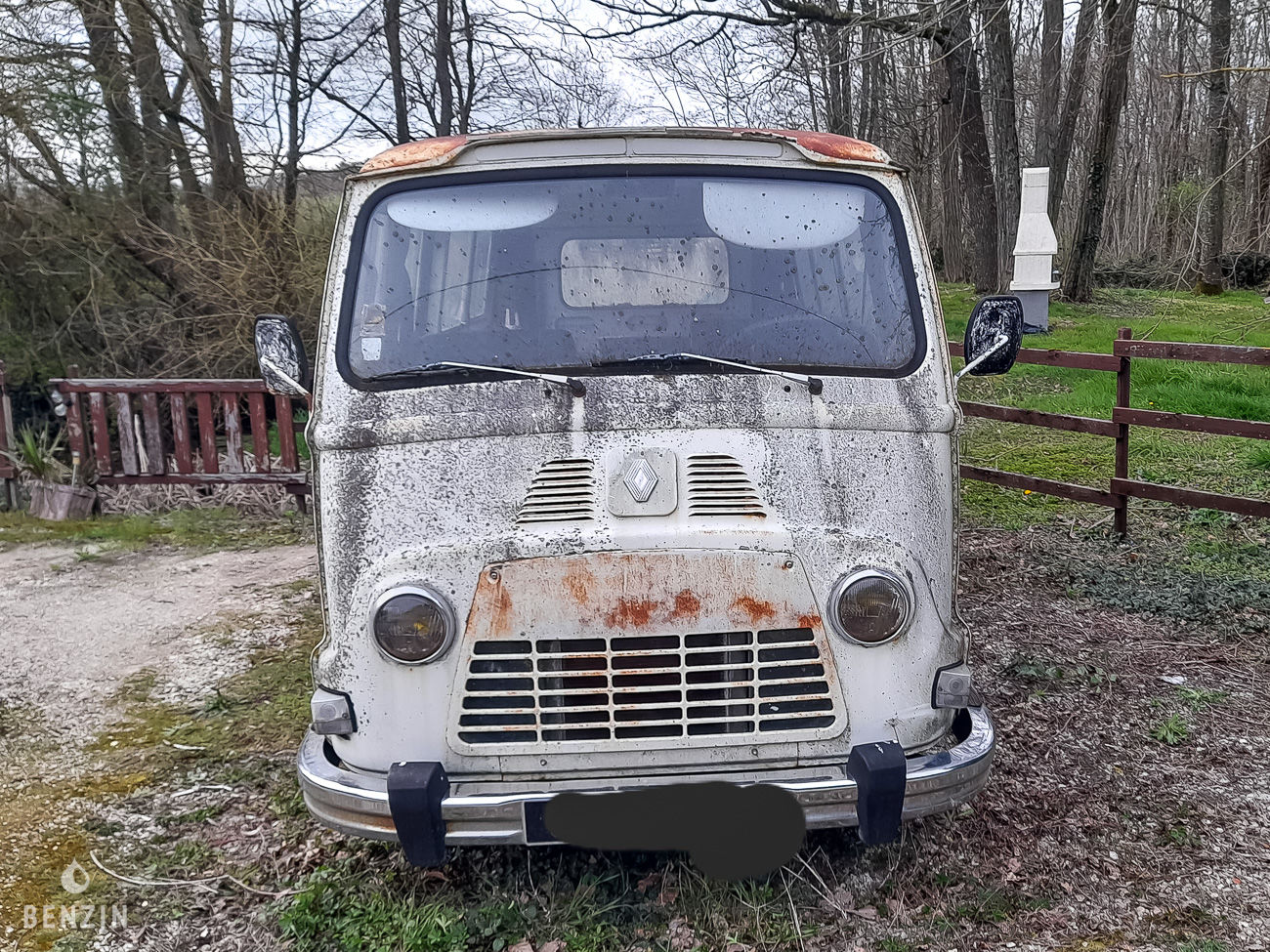
- Self-supporting body corrosion : perforations in the front floors, sills, A-pillars, roof gutters, door surrounds and wheel arches, on all years; you need to inspect the load-bearing areas very carefully and ask what has been replaced, not just filled with body filler.
- Crossmember and front panel : the front end of the Estafette concentrates the engine, cooling system and water spray; on commercial vehicles that have worked hard, the metal around the grille, radiator support and front mountings can be weakened, and should be inspected from underneath and behind the trim panels.
- Door rails and rollers : the sliding side doors develop play, stick or close poorly when the lower rail is worn or eaten away by rust; this is common on heavily used vans and you need to check alignment as well as the condition of the mounting points.
- Gearbox and controls : vague gear changes, crunching or gears jumping out can come from wear in the gearbox or the linkage/control on the dashboard; on this model, you need to distinguish a simple control adjustment from a tired gearbox.
- Cooling : overheating, mayonnaise-like sludge or coolant being pushed back into the expansion tank/radiator on the 1 108 and 1 289 cm³ engines that have been immobilized for a long time; you need to check the radiator, water pump, hose condition and ask whether the cooling system was actually refurbished after a long lay-up.
- Hydraulic braking : wheel cylinders, master cylinder and hoses suffer on vehicles that have stood unused for years; a long pedal or pulling to one side on an Estafette that “starts up again” should make you ask for invoices for a full overhaul, not just a cleaning.
- Driveshafts and boots : knocking during manoeuvres, vibrations under acceleration or grease thrown around the front drivetrains indicate torn boots and worn joints; on an old front-wheel-drive commercial vehicle, this is not something to overlook.
- Old conversions : many Estafette have been converted into camper vans, mobile shops or advertising vehicles; you need to check whether body cuts, added windows, roof raises or furniture have weakened the structure or hidden rough repairs.
When buying
On a restored Estafette or one under restoration, a photo file of the bodywork before painting is particularly important, as it makes it possible to judge the true extent of the structural repairs. It is also useful to check the exact type shown on the plate and in the documents, as the range included many payload and bodywork variants. If the vehicle has not been driven for a long time, a compression test and a documented recommissioning are more meaningful than a simple engine that starts for a few minutes.
On Benzin a Renault Estafette has sold for 4 675 € on average, with a median price of 4 825 €. Based on the 4 sales completed on the platform.
The 4 Renault Estafette sold on Benzin changed hands for between 450 € and 8 600 €, depending on condition, mileage and version.
4 of the 5 Renault Estafette listed on Benzin found a buyer — 80 % of completed sales.
No Renault Estafette is for sale at the moment. Follow the model to be notified as soon as a new one is listed.
Every vehicle comes with a detailed photo report, its history and the public exchanges between seller and community. You bid online; if you win, Benzin secures the payment and supports you through to delivery.
Follow the model from this page and you will get an e-mail as soon as a Renault Estafette is listed on Benzin.


 English
 Français
 Español
 Italiano
 Deutsch
 Polski
 Magyar
