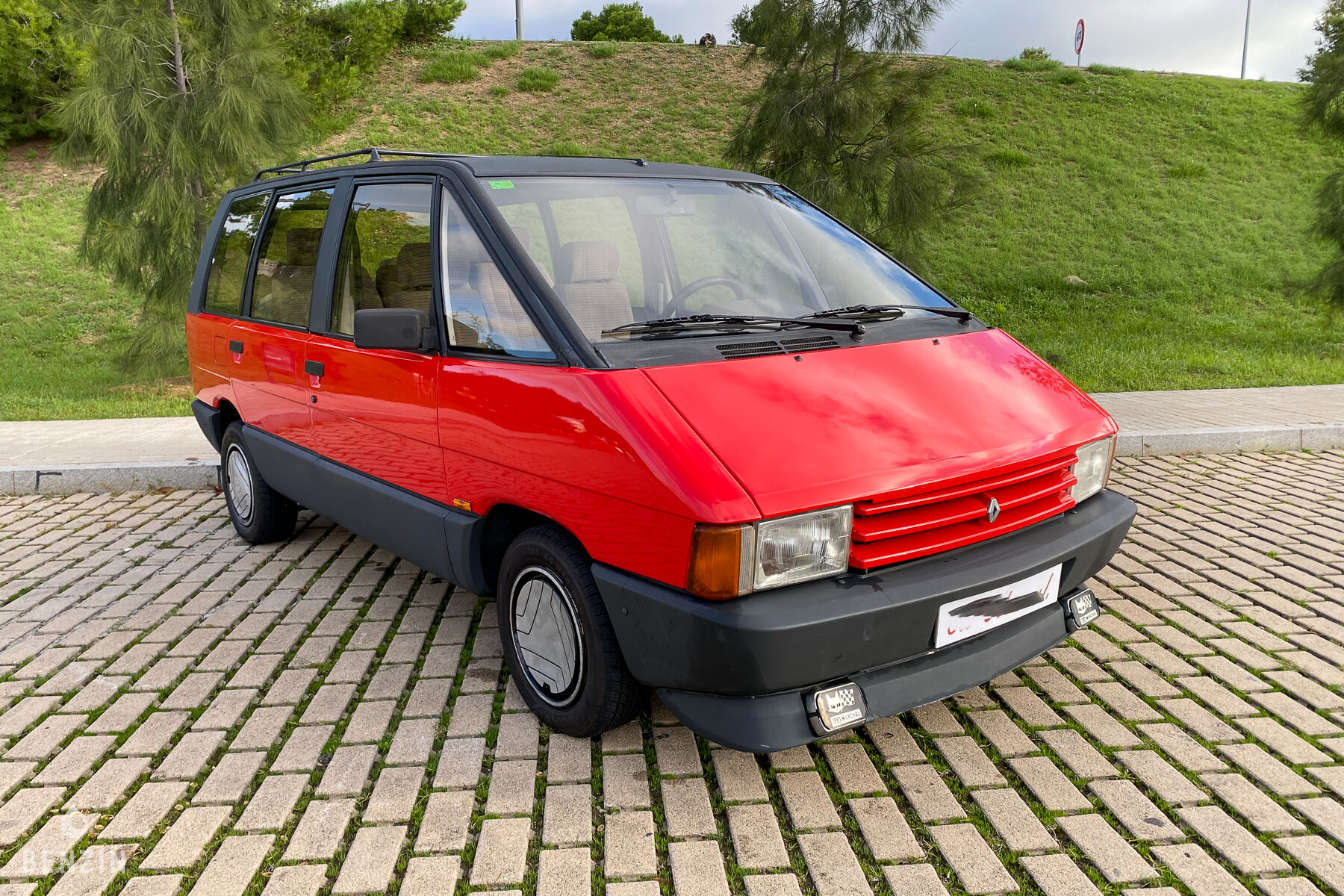
The Renault Espace is one of the most important French models of the 1980s, because it firmly established the MPV concept in Europe. Its origins go back to a Matra project studied for Simca-Talbot, then rejected after Chrysler Europe was taken over by PSA, before being picked up by Renault. The architecture and cabin design owe much to the Matra teams, with a tall, glazed vehicle, flat floor and individually modular seats, very far removed from the conventional family saloons of the time. Launched in 1984 and built by Matra in Romorantin, the first-generation Espace is recognizable by its steel structure clad in composite panels, a costly but lightweight technical solution that resisted corrosion of the body elements themselves. Sales started cautiously, then the model quickly established itself thanks to its spaciousness, seven-seat modularity and very modern image. The early versions, such as the 2000 GTS, TSE and TXE with the 2-liter petrol engine, are now the ones most eagerly sought by enthusiasts of the very first Espace models.
The Espace I evolved in 1988 with a facelift, new engines and the arrival of diesel versions, followed by a rarer Quadra all-wheel-drive transmission. The Espace II, introduced in 1991, remained faithful to the Matra recipe while gaining aerodynamics, refinement and power, notably with the PRV V6. In 1996, the Espace III became more rounded, more spacious and more road-oriented, while the Espace IV in 2002 switched to an entirely Renault design, ended Matra production and moved upmarket significantly. Later generations offered a wide range of petrol and diesel engines, from the naturally aspirated 2.0 to dCi units, up to V6s, with very high equipment levels on the upper trims. Alongside the production versions, the Espace also made an impression with the extravagant 1994 Espace F1, a spectacular Formula 1-engined show car that became more of a cultural icon than a sporting derivative.
Historically, the Espace was produced in more than one million examples across all generations, but survivors from the first two series are far rarer than that overall figure suggests. Collectors are mainly interested in Espace I and II cars in good original condition, especially the early phases, Quadra versions and V6s, while diesels are appreciated more for their usability and period authenticity than for their performance. A 1985 Espace 2000 TSE is now appealing for its pioneering role, its very 1980s atmosphere and its unusual Matra design. As often with this type of vehicle, the rarity of specific body, interior and transmission parts now matters as much as the mechanics to enthusiasts.
Technical sheet
| Espace I 2000 TSE | Espace I Turbo D | Espace II V6 |
| Production years | 1984-1988 | from 1988 | 1991-1996 |
| Body | 5-door MPV, 5 to 7 seats | 5-door MPV, 5 to 7 seats | 5-door MPV, 5 to 7 seats |
| Structure | Steel chassis, composite panels | Steel chassis, composite panels | Steel chassis, composite panels |
| Engine(s) | 4-cyl. petrol, 1,995 cc | 4-cyl. turbo diesel, 2,068 cc | PRV V6 petrol, 2,849 cc |
| Power | 110 hp | 88 hp | approx. 150 hp |
| Transmission | Front-wheel drive, 5-speed manual gearbox | Front-wheel drive, 5-speed manual gearbox | Front-wheel drive, manual or automatic gearbox depending on version |
| Weight | approx. 1,200 to 1,250 kg | approx. 1,250 to 1,300 kg | approx. 1,450 to 1,500 kg |
| Particular features | Iconic early version | Family use and high-mileage driving | Top-of-the-range Espace “Matra” |
Buyer’s guide
For a collector purchase, pre-1988 Espace I models, especially the 2000 TSE/TXE, are the most historically significant and the most distinctive visually. A well-preserved Espace II is often easier to live with, while the V6 and Quadra versions are more desirable but also more demanding in terms of maintenance and parts. Cars that have been bodged, are incomplete inside, or show cooling and structural corrosion issues should be avoided, because bringing them up to standard quickly becomes complex.
Points to watch
- Steel structure under composite panels : the plastic bodywork can give a misleading impression of good condition while the chassis, suspension mounting points, structural sills and floor may be affected; this is a crucial point on Espace I and II, and must be inspected on a lift.
- Cooling system : temperature spikes, a marked expansion tank, hard hoses or signs of mayonnaise-like sludge should raise concern, especially on the 2.0 petrol engines and older diesels; ask what has been replaced in the cooling system and check that the fan cuts in properly.
- Head gasket and cylinder head on diesels : the 2.1 diesel and turbodiesel engines do not tolerate repeated overheating well; smoke, abnormal pressure in the cooling circuit or difficult hot starting should prompt a search for previous work and supporting documentation.
- Quadra transmission : on the rare four-wheel-drive versions, the driveshaft, viscous coupling and rear axle are specific and expensive to refurbish; check for the absence of vibrations and leaks, and confirm that the car has not been converted back to front-wheel drive only.
- Gearbox and linkage : synchro crunching, vague engagement or leaks are known on high-mileage cars or those left unused for a long time; on V6 and heavier versions, the condition of the clutch and linkage deserves particular attention.
- Instrument cluster and odometer : odometer lockup, erratic gauges or temperamental displays exist on early Espace models; if the odometer has been repaired or replaced, the mileage must be reconstructed from invoices and previous checks.
- Headliner and interior trim : the headliner tends to peel away with age in these large cabins, and some specific trim pieces are difficult to find; also check the condition and completeness of the removable seats, rails, tables and covers.
- Matra-specific elements : headlights, glass, certain trim pieces and accessories specific to phase 1 models may be missing or may come from other versions; on an Espace I, the consistency of the front end, dashboard, fabrics and seats with the model year must be checked.
When buying
On an early Espace, inspection on a lift is much more important than the exterior appearance, because the composite panels conceal the true condition of the structure. It is also necessary to check that the odometer works and gather evidence to establish a credible mileage if the instrument cluster has been repaired or replaced. Invoices relating to the cooling system, head gasket, gearbox or, on a Quadra, the rear transmission are particularly valuable. Finally, the presence of the original seats, their mountings and the specific equipment for the correct trim level matters a great deal on this model.
0 of the 2 Renault Espace listed on Benzin found a buyer — 0 % of completed sales.
No Renault Espace is for sale at the moment. Follow the model to be notified as soon as a new one is listed.
Every vehicle comes with a detailed photo report, its history and the public exchanges between seller and community. You bid online; if you win, Benzin secures the payment and supports you through to delivery.
Follow the model from this page and you will get an e-mail as soon as a Renault Espace is listed on Benzin.
 English
 Français
 Español
 Italiano
 Deutsch
 Polski
 Magyar
