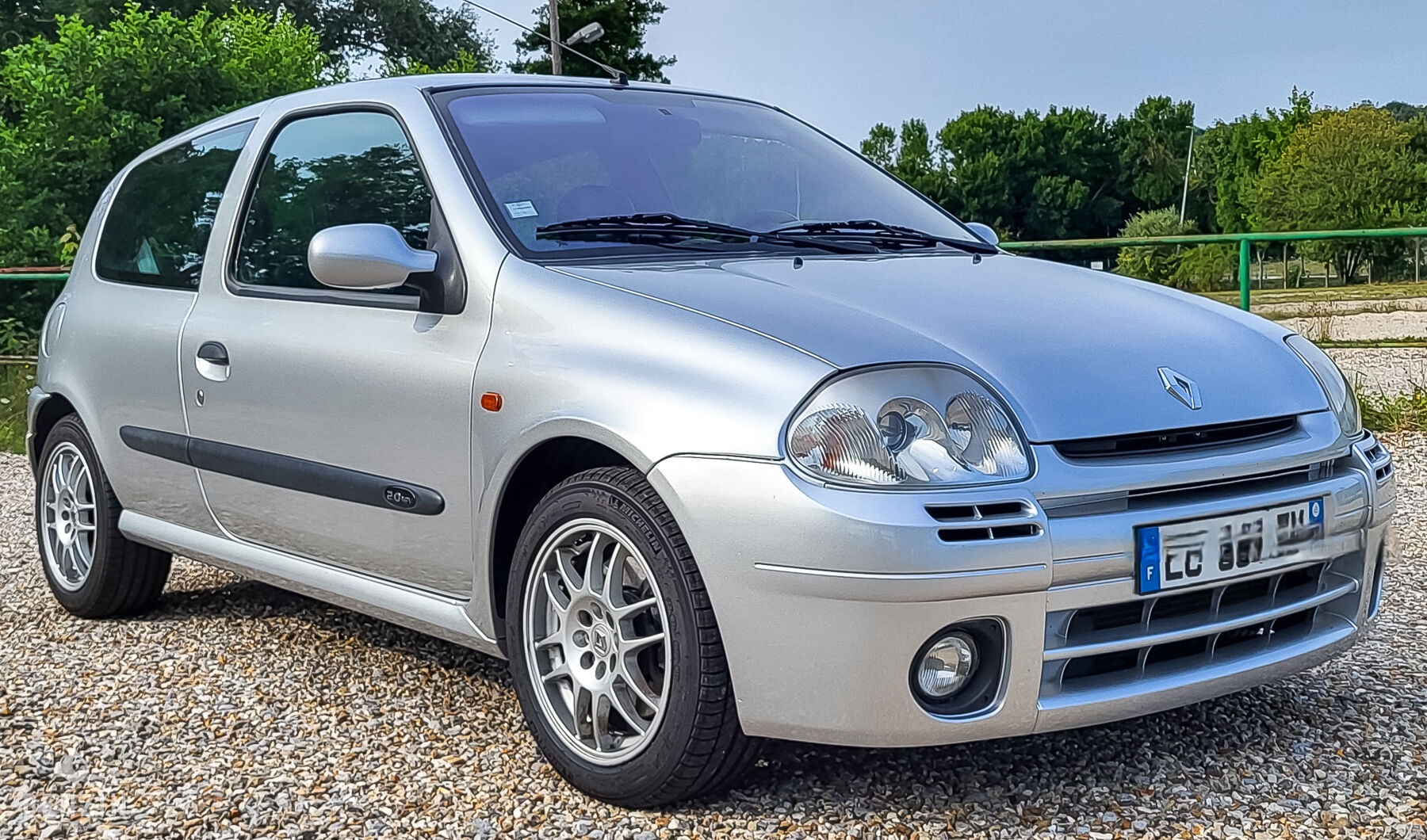
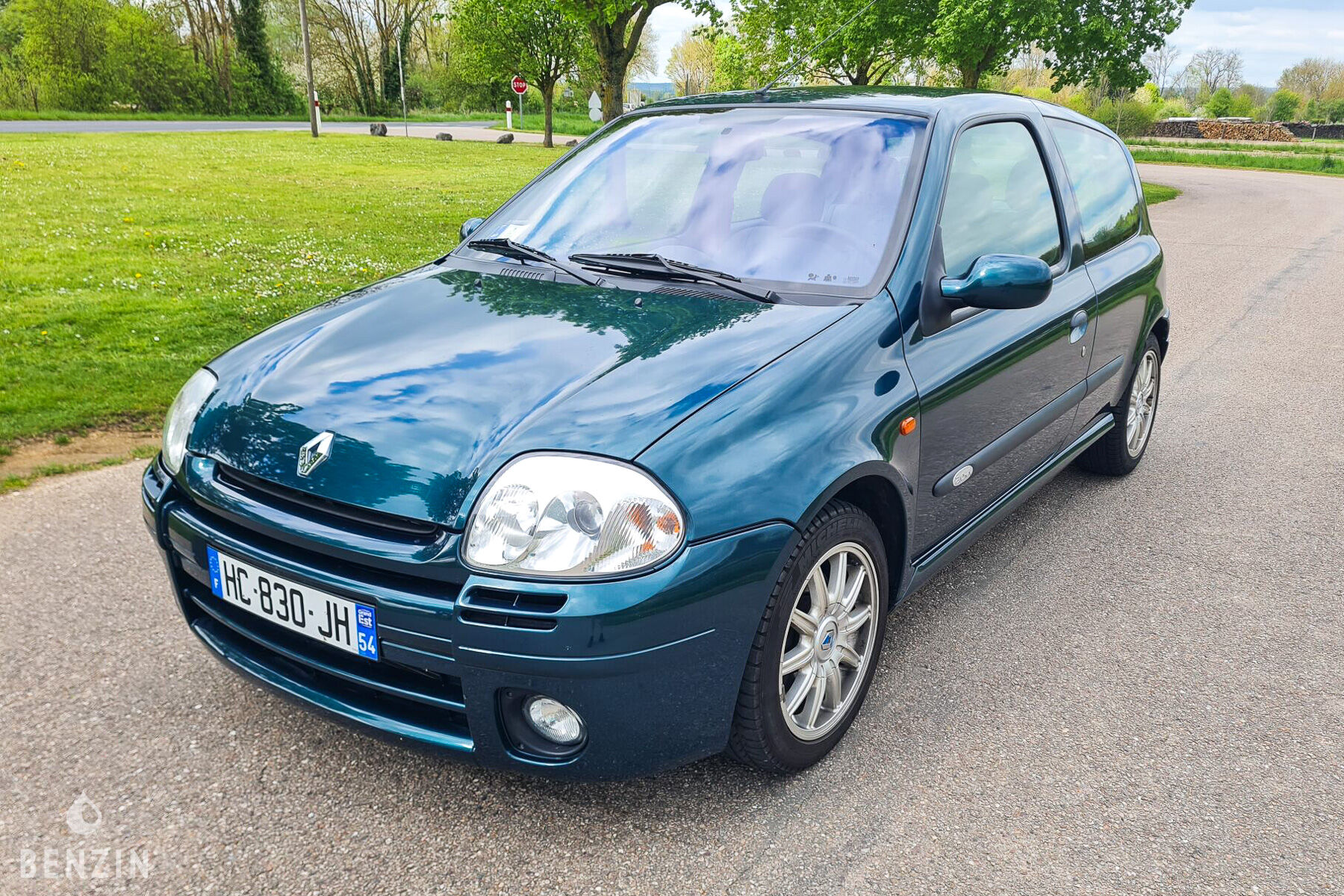
The Clio II Renault Sport appeared in 2000 as the direct heir to the Clio 16S and Williams, with a very simple and very French recipe: a lightweight supermini body, a naturally aspirated 2.0-liter F4R, a short manual gearbox and a chassis tuned by Renault Sport. Developed within the Renault Sport orbit in Dieppe, on the basis of the Clio II designed under the Patrick Le Quément era, it immediately stood out with its widened fenders, specific running gear, generous track width and, on the early RS1s, a few now highly sought-after details such as the aluminum hood and the blue-tinted interior ambiance. The first version, often called Clio RS 172 or RS1, produces 172 hp and favors liveliness, with restrained weight and a very mobile rear axle. It quickly built a reputation as a modern small GTI with old-school charm: a naturally aspirated engine that needs to be worked, direct steering and real effectiveness both on the road and on track. Its image was also boosted by Renault Sport one-make series and by a very active user community, which greatly helped document the evolutions, options and original specifics.
In 2001-2002 came the phase 2, recognizable by its restyled front end and updated presentation, while initially retaining the 2.0-liter 172 hp engine. The range then expanded with lighter or more focused versions, including the 2003 Clio RS Jean Ragnotti, stripped down and sharpened, which became one of the most sought-after by purists. In 2004, the RS 182 took over with 182 hp, slightly revised torque, twin exhaust outlets and, depending on the market, Cup or Sport chassis variants that now require careful checks when buying. The 2005 Trophy, produced in limited numbers, is the most emblematic of the last Clio 2 RS thanks to its very sharp chassis setup and specific Sachs dampers. There were also limited editions depending on the country, some names such as “Limited” potentially causing confusion between national series, imports and simple commercial names. While not rare in the absolute sense, the Clio 2 RS suffered greatly from intensive use, modifications, track outings or approximate repairs, which today increases the appeal of strictly original examples.
Among enthusiasts, the hierarchy is fairly clear: the RS1 appeals for its raw character, the Ragnotti for its radical spirit, and the 182 for its balance between mechanical maturity and effectiveness. The Trophy occupies a special place among collectors, while modified, swapped or poorly rebuilt cars are much less sought after than cars that match their factory configuration. Total Clio II Renault Sport production runs into tens of thousands of examples across all versions, but the most desirable and best-preserved variants are now far from common. Today it is one of the absolute benchmarks among small performance cars of the 2000s, often cited as one of the best front-wheel-drive chassis of its era.
Technical sheet
| Clio RS 172 phase 1 | Clio RS 172 phase 2 / Ragnotti | Clio RS 182 / Trophy |
| Production years | 2000-2001 | 2001-2004 | 2004-2005 |
| Body style | 3-door hatchback | 3-door hatchback | 3-door hatchback |
| Engine(s) | 4-cylinder inline 1998 cc, naturally aspirated | 4-cylinder inline 1998 cc, naturally aspirated | 4-cylinder inline 1998 cc, naturally aspirated |
| Engine code | F4R | F4R | F4R |
| Power | 172 hp | 172 hp | 182 hp |
| Drivetrain | Front-wheel drive, 5-speed manual gearbox | Front-wheel drive, 5-speed manual gearbox | Front-wheel drive, 5-speed manual gearbox |
| Curb weight | approx. 1,035 kg | approx. 1,035 to 1,090 kg depending on version | approx. 1,090 kg |
| 0 to 100 km/h | approx. 7.1 s | approx. 7.1 s | approx. 6.9 s |
| Top speed | approx. 220 km/h | approx. 220 km/h | approx. 222-224 km/h |
| Notable versions | RS1, early series with aluminum hood | phase 2, Jean Ragnotti | 182, Sport/Cup chassis, Trophy |
Buyer’s guide
For collector use, the most desirable are well-preserved RS1s that match their original configuration, as well as the Jean Ragnotti and Trophy, which are rarer and more distinctive. For regular driving, a healthy, unmodified 182 is often the best choice, provided its exact equipment is confirmed. Heavily modified, swapped or track-used cars with no clear history should be approached with caution, because the Clio 2 RS does not tolerate approximation in the chassis and gearbox.
Things to watch for
- Timing belt and camshaft phaser : rattling on cold start, unstable idle or less crisp operation on the 172 and 182; ask for the exact date of replacement of the timing belt, accessory kit and cam phaser, because many cars have run with only partial maintenance.
- JC5 gearbox : worn 2nd and 3rd gear synchros, notchy engagement when hot, or seepage at the selector; this is a classic on examples driven hard or used on track, and you should check for rebuild invoices rather than just a simple oil change.
- Ignition and engine management : misfires, injection fault warning light, engine that runs roughly at startup or on acceleration, especially on cars with older coils; check the condition of the coils, spark plugs, crankshaft position sensor and the absence of bodged repairs in the wiring loom.
- Variable intake : flat spots in the mid-range or irregular engine behavior due to the solenoid valve, control system or intake hoses; this is a well-known fault among owners, often mistaken for an ignition problem.
- Rear axle and alignment : abnormal tire wear, a car that does not track perfectly straight, or a rear end that looks visibly crooked; many Clio 2 RSs have hit curbs, rumble strips or suffered impacts, and a bent rear axle is not uncommon.
- Front structure and chassis rails : old repairs, jig work, differences in alignment or paint shade, especially on imported cars or ex-track cars; inspect the wheel arches, weld points, front end, mounts and chassis rails rather than just the exterior bodywork.
- Dampers and specific chassis versions : on 182 Sport/Cup chassis and especially Trophy, check that the equipment is correct and that the dampers are in good condition; the Trophy Sachs units are specific and expensive to rebuild, and many cars have received non-compliant replacements.
- Original RS1 specifics : aluminum hood, interior components, upholstery details and door panel details; these early series are of greater interest to collectors, so any part replaced by a phase 2 or non-specific item should be noted.
When buying
On this model, timing belt invoices with cam phaser, clutch, and gearbox work matter more than a simple stamped service book. A check with Renault Clip or a tool capable of reading engine faults properly, supplemented by a geometry/alignment check and an inspection of the underbody on a lift, is particularly useful for spotting a car that has been crashed or poorly rebuilt. On a rare or very low-mileage version, you also need to verify that the original configuration matches the serial number, the specific equipment, and, in the case of an import, the mileage traceability.
On Benzin a Renault Clio 2 RS has sold for 8 183 € on average, with a median price of 7 400 €. Based on the 9 sales completed on the platform.
The 9 Renault Clio 2 RS sold on Benzin changed hands for between 4 350 € and 15 100 €, depending on condition, mileage and version.
9 of the 16 Renault Clio 2 RS listed on Benzin found a buyer — 56 % of completed sales.
No Renault Clio 2 RS is for sale at the moment. Follow the model to be notified as soon as a new one is listed.
Every vehicle comes with a detailed photo report, its history and the public exchanges between seller and community. You bid online; if you win, Benzin secures the payment and supports you through to delivery.
Follow the model from this page and you will get an e-mail as soon as a Renault Clio 2 RS is listed on Benzin.
 English
 Français
 Español
 Italiano
 Deutsch
 Polski
 Magyar
