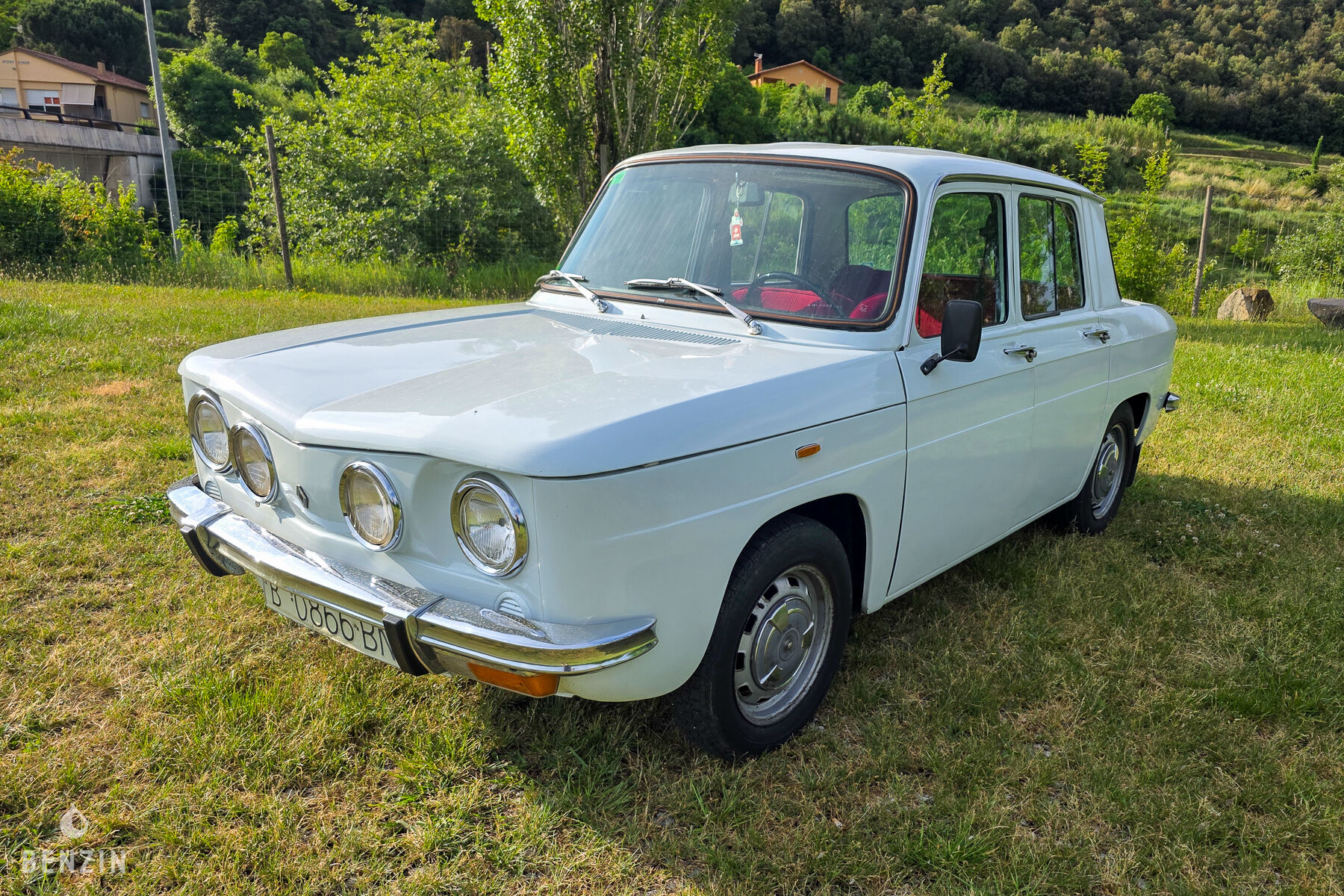
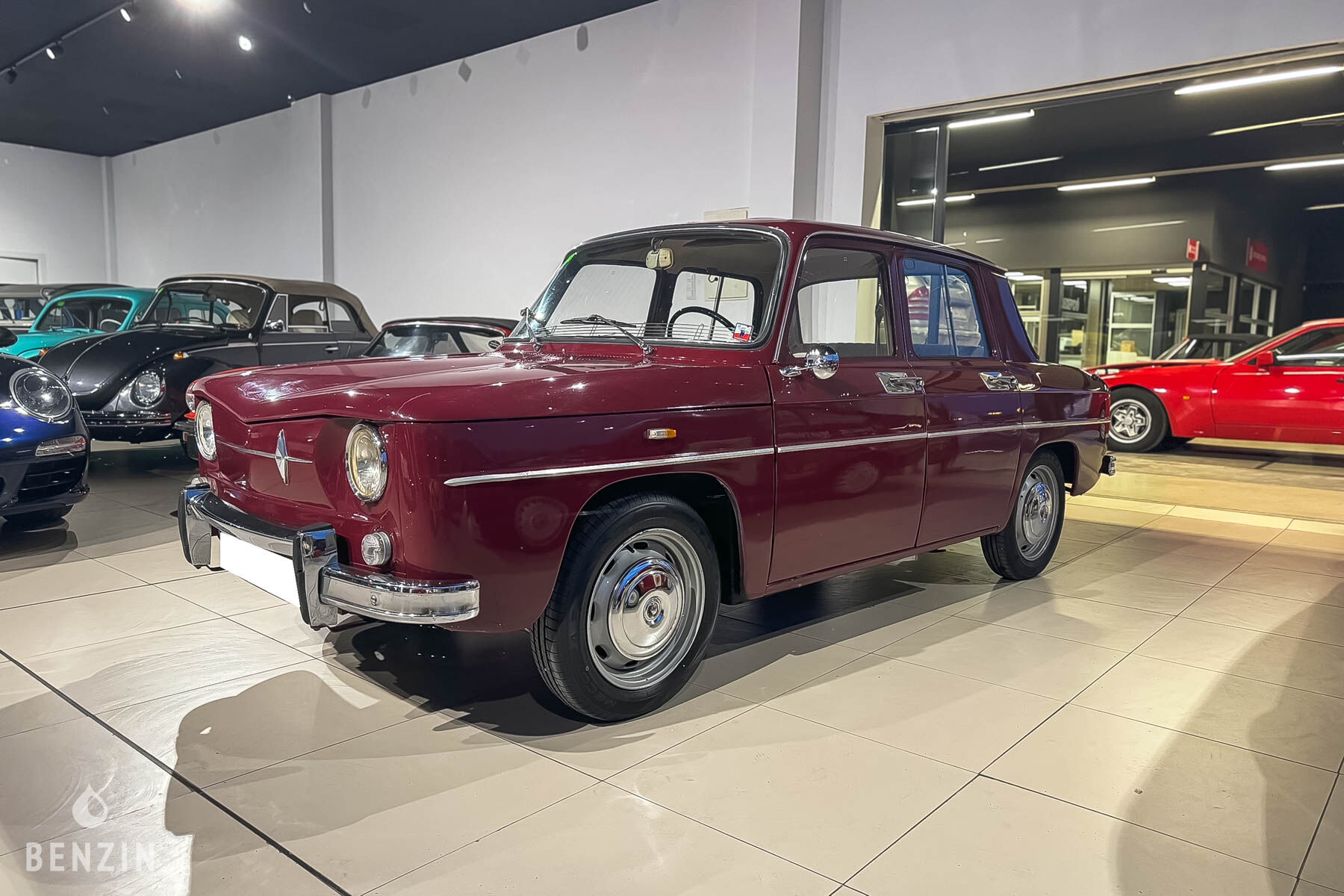
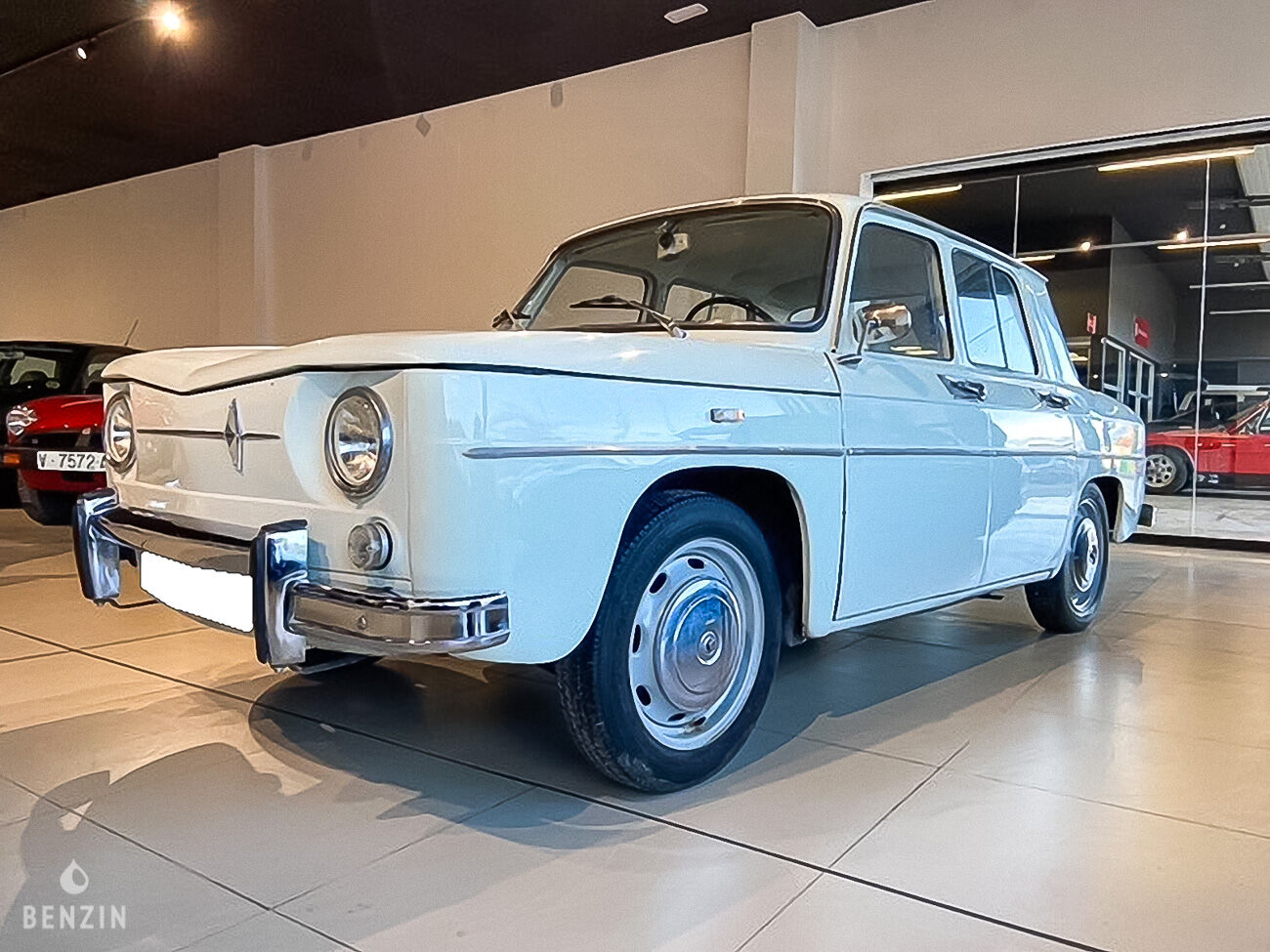
Introduced in 1962, the Renault 8 took over from the Dauphine in Billancourt’s small rear-engined saloon range, with a more modern three-box body, improved roominess, and equipment that was remarkable for the class at the time, notably its four disc brakes. Its styling was drawn in-house at Renault in a very geometric spirit, which also foreshadowed the Renault 10 that later appeared on a similar technical base. The first version, type R1130, received the 956 cc “Cléon-Fonte” four-cylinder, renowned for durability and ease of maintenance. From the mid-1960s onward, the range expanded with better-finished and more powerful variants, including the Major with the 1108 cc engine.
The Renault 8’s career is then marked by two very distinct branches. On one side, the family saloon evolves through small styling and equipment changes, then receives the 8 TS in 1968, more spirited, recognizable by its four headlights and its 1108 cc engine fed by a twin-choke carburetor. On the other, the Renault 8 Gordini, launched in 1964 as the 1100 and later upgraded to the 1300, gives the model a special place in the history of French motorsport thanks to the Coupe Gordini and an entire generation of drivers trained on this platform. In France, Renault 8 production ends in the early 1970s, but its career continues in Spain at FASA-Renault until 1976, which explains the presence of late cars on the market.
In total, the Renault 8 was produced in more than 1.3 million examples across all versions, not counting its assembly in several countries under local production. The standard versions now appeal for their lightness, visibility, very accessible mechanics, and the true feel of a popular saloon from the Trente Glorieuses. The TS versions are especially sought after for their refinement, while the Gordini cars occupy a special place. Among enthusiasts, the Renault 8 retains a high level of esteem because it is at once simple, endearing, highly recognizable, and still well supported by clubs, Cléon-Fonte engine specialists, and a strong mutual-aid network.
Technical data
| Version | Renault 8 956 | Renault 8 Major / 1100 | Renault 8 TS |
| Production years | approx. 1962-1971 | approx. 1964-1970 | 1968-1976 depending on country |
| Body | 4-door saloon, rear engine | 4-door saloon, rear engine | 4-door saloon, rear engine |
| Engine | Inline 4-cylinder, 956 cc, Cléon-Fonte | Inline 4-cylinder, 1108 cc, Cléon-Fonte | Inline 4-cylinder, 1108 cc, twin-choke carburetor |
| Power | approx. 44 hp DIN | approx. 46 to 50 hp DIN | approx. 55 hp DIN |
| Transmission | 4-speed manual gearbox, rear-wheel drive | 4-speed manual gearbox, rear-wheel drive | 4-speed manual gearbox, rear-wheel drive |
| Brakes | 4 disc brakes | 4 disc brakes | 4 disc brakes |
| Curb weight | approx. 760 kg | approx. 780 kg | approx. 800 kg |
| 0-100 km/h | approx. 24 s | approx. 21 to 23 s | approx. 17 to 19 s |
| Top speed | approx. 125 km/h | approx. 130 to 135 km/h | approx. 145 km/h |
| Production | More than 1.3 million examples for the Renault 8 range as a whole |
Buyer’s guide
For regular use, the 8 TS is often the most interesting: it keeps the simplicity of the Renault 8 while offering a livelier engine, a more desirable appearance, and driving that is better suited to modern traffic. The 956 cc cars are charming and very authentic, but slower; the later Spanish cars can be good cars, provided you accept a few specific details of finish and parts supply. However, beware of fake TS cars or mixed-up cars, as the mechanical base is common and conversions are easy.
Points to watch
- Front structural corrosion : frequent attack in the front trunk, spare wheel well, jack points, front chassis rails, and front suspension mounting points; this mainly concerns French cars that were poorly protected and older restorations. It is necessary to inspect underneath, look for sheet-metal patches, and ask for pre-paint photos if the car has been redone.
- Floors and sills : Renault 8s commonly rust in the floors, door bottoms, lower wings, and around the windscreen, with water leaks that then return into the cabin. On a car presented as restored, check the quality of the door gaps and the absence of bubbling under the seals.
- Rear suspension mountings and axle tubes : on this rear-engine architecture with swing axles, the driveshaft boots and axle tubes can leak, with oil spray and brake contamination. Look for grease on the hubs, under the gearbox, and around the boots, and ask when they were last replaced.
- Gearbox : the 4-speed gearbox is robust but can become noisy, baulk when hot, or jump out of gear on certain ratios when synchronizers, bearings, or linkages wear. On the road, listen for droning on overrun and check the precision of gear selection, especially on cars that have been driven little or driven hard.
- Cooling system : on the 956 and 1108 engines, water pumps, clogged radiators, aged hoses, and lazy thermostats quickly cause overheating or erratic heating. Check for signs of coolant, temperature stability after a few kilometers, and the presence of a genuine recent repair if the seller mentions an engine rebuild.
- TS carburation : the twin-choke carburetor on the TS can cause flat spots on acceleration, difficult hot starts, or excessive fuel consumption if carburetor wear or poor adjustment sets in. Ask which carburetor is fitted, whether it has been rebuilt, and check that the engine picks up cleanly from low revs.
- Four-disc braking : this is a strength of the model, but a car that has been parked for a long time can suffer from seized calipers, old hoses, and a poor handbrake. You need to check that the car brakes straight, that the wheels do not stay hot after driving, and that the hydraulic components have already been overhauled.
- Authenticity of the versions : the TS and, even more so, cars presented with a Gordini look may be based on a standard car simply fitted with accessories. The type on the oval plate, the body number, the consistency of the dashboard, the four-headlamp front end, and the actual mechanical components installed must be checked.
At the time of purchase
On a Renault 8, the most useful documents are those that allow the exact version to be identified: type plate, oval plate, stamped number, and old invoices mentioning the engine or gearbox replacement. A lift inspection is almost essential to assess the chassis rails, floors, suspension mounting points, and the quality of a body restoration. On a TS, it is relevant to check the conformity of the front end, dashboard, and fuel system, because many cars have been rebuilt from parts. A compression test and a sufficiently long road test to validate temperature, gearbox, and braking are more revealing on this model than a simple cold start.
On Benzin a Renault 8 has sold for 7 913 € on average, with a median price of 7 000 €. Based on the 4 sales completed on the platform.
The 4 Renault 8 sold on Benzin changed hands for between 4 500 € and 13 150 €, depending on condition, mileage and version.
4 of the 10 Renault 8 listed on Benzin found a buyer — 40 % of completed sales.
No Renault 8 is for sale at the moment. Follow the model to be notified as soon as a new one is listed.
Every vehicle comes with a detailed photo report, its history and the public exchanges between seller and community. You bid online; if you win, Benzin secures the payment and supports you through to delivery.
Follow the model from this page and you will get an e-mail as soon as a Renault 8 is listed on Benzin.
 English
 Français
 Español
 Italiano
 Deutsch
 Polski
 Magyar
