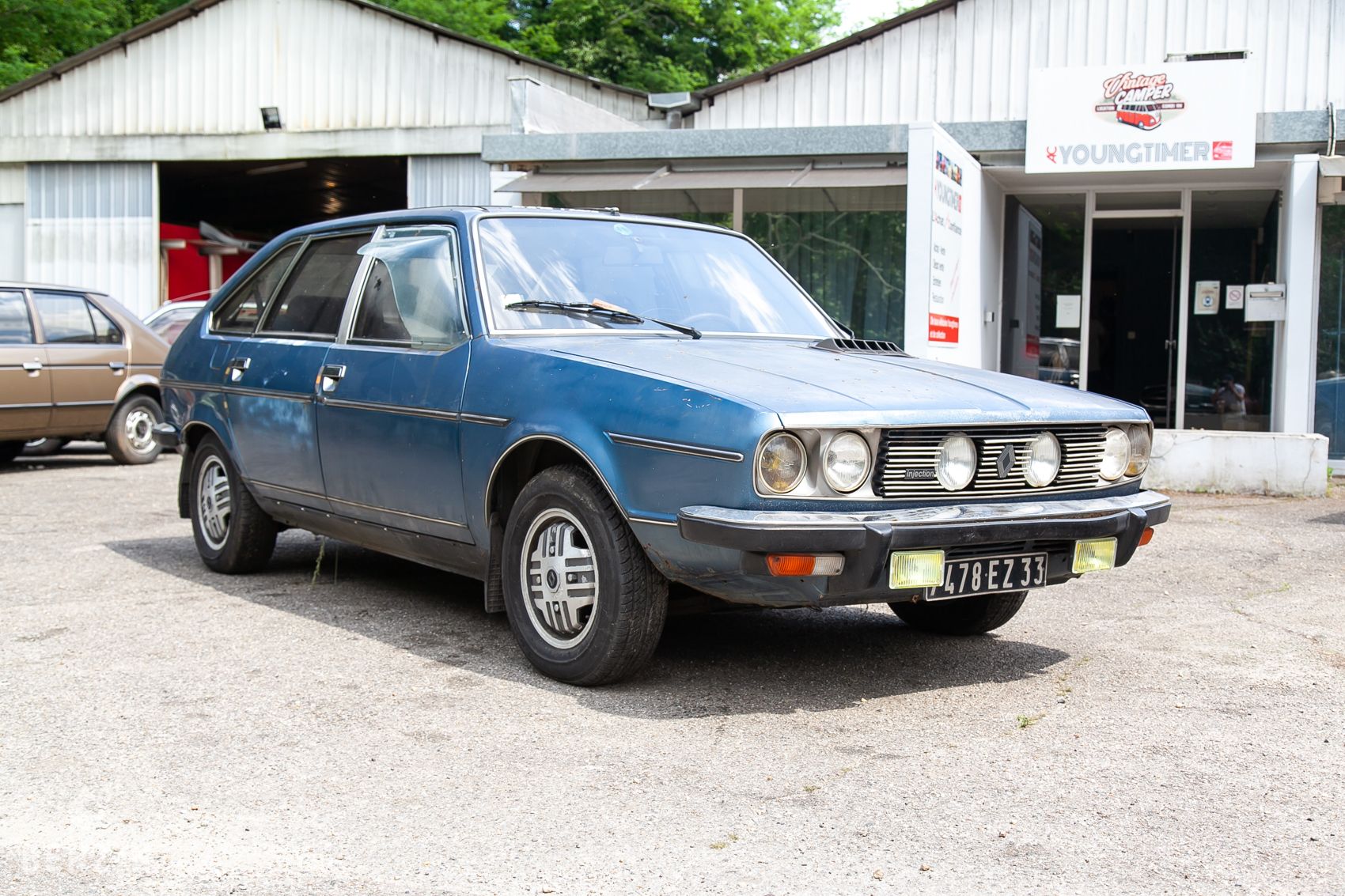
Launched in 1975 alongside the Renault 20, the Renault 30 was then the brand’s flagship and one of the first large front-wheel-drive hatchback saloons in the upper European segment. Its body, developed by Renault’s styling department of the time around Gaston Juchet, took the two-box silhouette of the 20 but with a more upscale presentation and, above all, the 2.7-litre PRV V6. At launch, the 30 TS targeted high-mileage drivers and executives who wanted the comfort of a large French touring car without giving up the practicality of the hatchback. It stood out for its generous equipment for the time, excellent visibility and very sound road manners, leaning more toward comfort than sportiness. In the French market, it sat against the Peugeot 604 and the higher-end Citroën CX, but with a more practical and more modern overall architecture.
The range then evolved in small steps, with improvements in equipment, trim and presentation, followed by a phase 2 at the start of the 1980s, recognizable by its revised front end and interior. The best-known version remains the 30 TX, introduced at the end of the 1970s, which received Bosch injection on the PRV V6 and became the most accomplished Renault 30, livelier and better equipped. Depending on the market and the year, the 30 was also available with an automatic gearbox and, at the end of its career, with turbo diesel power, but the model’s image remains first and foremost tied to the petrol V6. Its career ended in 1983 after total production of around 145,000 examples, with the Renault 25 taking over at the top of the range. Long overshadowed by its rivals and the future 25 V6, the Renault 30 is now sought after by enthusiasts of large Renaults for its comfort, rarity and the very distinctive character of the first PRV.
Among collectors, original 30 TS models are of interest for their authenticity, but TX models are generally the most sought after for their superior refinement and richer specification. Truly sound survivors are few, because corrosion, specific interiors and certain body or equipment parts can make a restoration complicated. A beautiful phase 1 or early phase 2 30 TX, complete and correct, is therefore often the most desirable combination today.
Technical data
| Version | Renault 30 TS | Renault 30 TX | Renault 30 Turbo-D |
| Production years | 1975-1983 | 1978-1983 | 1982-1983 |
| Body | 5-door hatchback saloon | 5-door hatchback saloon | 5-door hatchback saloon |
| Engine(s) | V6 PRV 2,664 cc, carburetors | V6 PRV 2,664 cc, Bosch injection | 4-cyl. 2,068 cc turbo diesel |
| Power | approx. 125-131 hp DIN | 142 hp DIN | 85 hp DIN |
| Transmission | Front-wheel drive, 4- or 5-speed manual gearbox depending on year, automatic depending on version | Front-wheel drive, 5-speed manual gearbox or automatic | Front-wheel drive, 5-speed manual gearbox |
| Weight | approx. 1,320-1,380 kg | approx. 1,350-1,400 kg | approx. 1,350-1,400 kg |
| 0-100 km/h | approx. 11-12 s | approx. 9.5-10.5 s | approx. 14 s |
| Top speed | approx. 180-185 km/h | approx. 190-195 km/h | approx. 170-175 km/h |
| Production | Total production: around 145,000 examples |
Buyer’s guide
The 30 TX is generally the version to go for, especially with the 5-speed manual gearbox, because it combines the best driving pleasure, the most complete equipment and the strongest image of the model. A sound, highly original TS remains interesting if you prefer a simpler mechanical setup, but it needs impeccable fuel-system tuning to perform at its best. It is better to avoid incomplete, heavily corroded or poorly modified cars, because some specific upholstery, body, sunroof or fuel-system parts are becoming much harder to find than common mechanical components.
Points to watch
- Structural and sill corrosion : bubbles at the bottom of the doors, lower wings, rear wheel arches, sills and floors are common on cars that have spent a long time outdoors; on Renault 30, also inspect the front suspension mounting points and the tailgate surround, because a nice paint job can hide old repairs.
- Sunroof : on TX models and well-equipped cars, the steel sunroof can be seized, incomplete or poorly sealed; check that all operating components are present, along with the frame, runners and drain channels, because missing parts are not always easy to find.
- Fuel tank and fuel system : the tank can rust internally after long periods of inactivity and clog the pump, filter and injection system; check for any smell of fuel, the condition of the gauge sender and hoses, and ask whether the tank has ever been removed, cleaned or replaced, as new parts are not always easy to source.
- Bosch K-Jetronic injection on the 30 TX : difficult hot starts, unstable idle or flat spots on acceleration often come from a dirty metering distributor, a worn control pressure regulator or air leaks; you need a car that starts well both cold and hot and idles steadily without any makeshift mixture adjustment.
- PRV cooling system : on both TS and TX, any tendency to run abnormally hot should be a concern, because the radiator, viscous fan coupling, water pump and clogged wiring loom all affect head gasket health; check the temperature rise in slow traffic and the absence of mayonnaise-like sludge or excessive overpressure.
- Gearbox and transmission : manual gearboxes do not take kindly to abuse in a heavy, torquey car; worn synchros, a noisy 5th gear or stiff shifting are not uncommon, and an automatic gearbox must change gears without slipping or pronounced jolts.
- Specific interior trim : door panels, fabrics, seat covers and dashboard parts are often restored or partially replaced; on a 30, it is important to check that the materials and patterns are consistent with the model year, as phase 1 and phase 2 elements do not always mix neatly.
When buying
On a 30 TX, invoices for the injection system, cooling circuit and any gearbox rebuild are particularly important, even more so than a simple service book. An inspection on a lift is essential to check the typical corrosion points, the condition of the fuel tank and the underbody around the mounting points. If the V6 does not run perfectly smoothly, a compression test and fuel pressure check are preferable to a simple road test, and it is useful to verify that the car still has its specific trim and equipment items corresponding to its model year.
2 of the 2 Renault 30 listed on Benzin found a buyer — 100 % of completed sales.
No Renault 30 is for sale at the moment. Follow the model to be notified as soon as a new one is listed.
Every vehicle comes with a detailed photo report, its history and the public exchanges between seller and community. You bid online; if you win, Benzin secures the payment and supports you through to delivery.
Follow the model from this page and you will get an e-mail as soon as a Renault 30 is listed on Benzin.

 English
 Français
 Español
 Italiano
 Deutsch
 Polski
 Magyar
