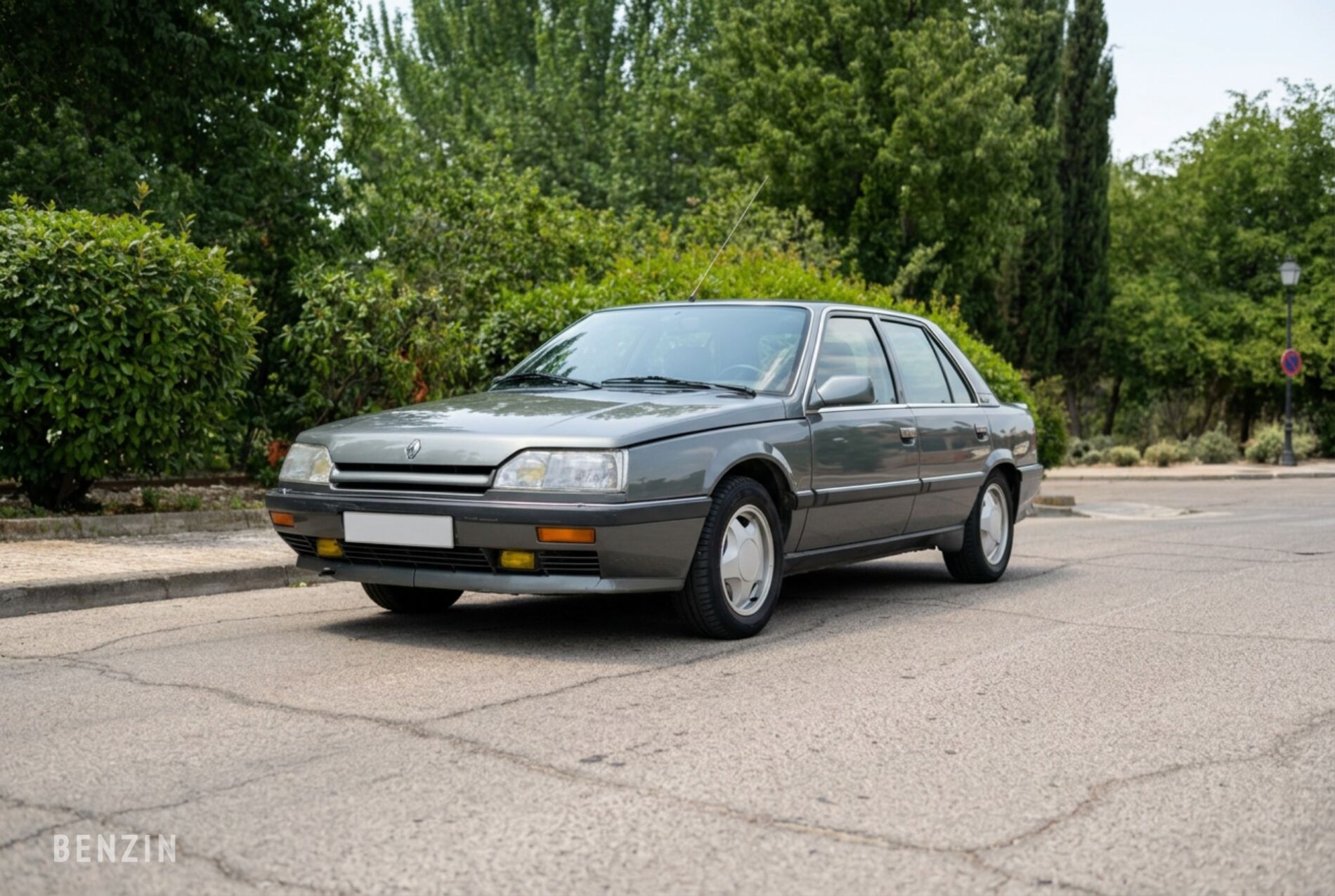
Introduced at the end of 1983 and sold from 1984, the Renault 25 replaced the Renault 20 and 30 at the top of the brand’s range. A large hatchback saloon produced mainly at Sandouville, it relied on excellent aerodynamics for the time, a very spacious cabin and electronic equipment that was unusual in the segment then. Its very 1980s styling, with flush glazing, a futuristic dashboard on some trims and voice synthesis, strongly contributes to its identity. The launch range covered four-cylinder petrol engines, diesel and turbo-diesel engines, as well as the PRV V6, which continued the tradition of large six-cylinder Renaults.
Its career is divided into two main phases, with phase 2 appearing in 1988 with a softened front end, a modernized presentation, revised trim and electronics that were somewhat better controlled. Notable versions include the four-cylinder GTX and TXI, the understated but much appreciated turbo-diesels, the luxurious Baccara with its high-end upholstery and equipment, and above all the V6 Turbo, the technical flagship of the range. This latter model, which became a benchmark among fast French long-distance cruisers, combines the turbocharged PRV with a level of performance that then put it up against much more prestigious German touring cars. Automatic transmission versions, richly equipped special editions and a few long-wheelbase or limousine conversions also existed, but the heart of production remained the large family and executive saloon.
Renault 25 enjoyed strong sales, with total production of around 780,000 examples until it was discontinued in 1992, before the arrival of the Safrane. It has no real sporting record, but its V6 Turbo left a lasting mark on French car culture, while the Baccara embodies Renault’s top-of-the-range offering from the late 1980s. Long overlooked, it is now being rediscovered for its comfort, quiet running, interior space and character that is highly representative of French cars of that era. Enthusiasts mainly look for cars that have not been heavily modified, are still well equipped, with functional electronics, a preserved interior and well-maintained mechanics, with the V6 Turbo and Baccara remaining the most emblematic.
Technical data
| Version | 25 GTS / GTX 2.2 injection | 25 V6 Injection / V6 Baccara | 25 V6 Turbo |
| Production years | 1984-1992 depending on trim | 1984-1992 depending on trim | 1985-1992 |
| Body style | 5-door hatchback saloon | 5-door hatchback saloon | 5-door hatchback saloon |
| Engine(s) | 2,165 cc inline 4-cylinder petrol injection | 2,849 cc PRV V6 petrol injection | 2,458 cc turbocharged PRV V6 petrol |
| Power | approx. 123 hp | approx. 160 hp | 182 hp, then up to 205 hp depending on model year and version |
| Transmission | Front-wheel drive, 5-speed manual | Front-wheel drive, 5-speed manual or 4-speed automatic | Front-wheel drive, 5-speed manual or 4-speed automatic depending on market/version |
| Weight | approx. 1,150 to 1,220 kg | approx. 1,300 to 1,380 kg | approx. 1,350 to 1,450 kg |
| 0-100 km/h | approx. 10.5 s | approx. 8.5 to 9 s | approx. 7.5 to 8.5 s depending on power and gearbox |
| Top speed | approx. 190-195 km/h | approx. 205-210 km/h | approx. 225-233 km/h depending on version |
| Production | included in a total model run of around 780,000 examples | included in a total model run of around 780,000 examples | included in a total model run of around 780,000 examples |
Buyer’s guide
The most sought after are the V6 Turbo, especially in well-equipped phase 2 form, for their performance and status as a flagship model, while a healthy V6 Baccara is ideal for anyone seeking comfort and the most luxurious presentation. For simpler use, a well-preserved 2.2 injection often offers the best compromise between refinement, running costs and complexity. Cars with incomplete electronics, a very tired interior or poorly maintained automatic transmission should, however, be approached with caution.
Points to watch
- On-board electronics : intermittent display faults, silent voice synthesis, temperamental trip computer or erratic central locking, especially on early years; check the warning lights, instruments, locking, power windows and comfort accessories one by one.
- Wiring looms and connectors : poor contacts behind the dashboard, under the seats or in the doors, worsened by moisture; check whether functions return when operating the controls, and ask whether any grounding or connector repairs have already been done properly.
- V6 Turbo – manifolds and exhaust : manifold leaks, cracks, burnt gaskets and high heat in the engine bay are common; when cold and then under acceleration, listen for a metallic hiss and inspect for any trace of soot or smoke in the engine bay.
- PRV cooling system : on naturally aspirated as well as turbo V6s, a clogged radiator, tired hoses, faulty fans or thermostat can cause abnormal overheating; monitor temperature stability while driving and after stopping, as well as the absence of overpressure or fluid smell.
- Automatic transmission : V6 Baccara and several V6 Turbo models often have an automatic gearbox whose operation must be very smooth; harsh shifts, slipping, delayed engagement when cold, or browned fluid mean you should ask for specific maintenance invoices, something that was too often neglected at the time.
- Interior : fabrics, velour, leather, door panels and headliner sometimes age poorly, especially on cars that have been driven little but stored for a long time; an interior that looks very worn compared with the stated mileage should prompt checks of overall consistency and the quality of any refurbishment.
- Water ingress : tailgate, door seals and drains can cause dampness in the boot or under the carpets, leading to corroded connectors and electrical faults; lift the mats, smell for dampness, and inspect the spare wheel well and inner sills.
- Targeted corrosion : less catastrophic than on some older Renaults, but present on the lower edges of doors, lower wings, tailgate surround, windscreen scuttle and boot floor; pay particular attention to cars that have been immobilized for a long time or recently recommissioned.
At the time of purchase
On a Renault 25, it is necessary to insist on checking the operation of all electrical equipment, not just the engine and transmission, because restoring an incomplete car to original specification can take a long time. On V6, invoices for the cooling system, exhaust, and, where applicable, automatic transmission maintenance are particularly important; on V6 Turbo, a road test must confirm the absence of abnormal smoke, overheating, and exhaust blow-by on the manifold side. A car that has been parked for a long time also deserves clear evidence of recommissioning, with servicing of the brakes, fluids, and ancillary components.
2 of the 5 Renault 25 listed on Benzin found a buyer — 40 % of completed sales.
No Renault 25 is for sale at the moment. Follow the model to be notified as soon as a new one is listed.
Every vehicle comes with a detailed photo report, its history and the public exchanges between seller and community. You bid online; if you win, Benzin secures the payment and supports you through to delivery.
Follow the model from this page and you will get an e-mail as soon as a Renault 25 is listed on Benzin.


 English
 Français
 Español
 Italiano
 Deutsch
 Polski
 Magyar
