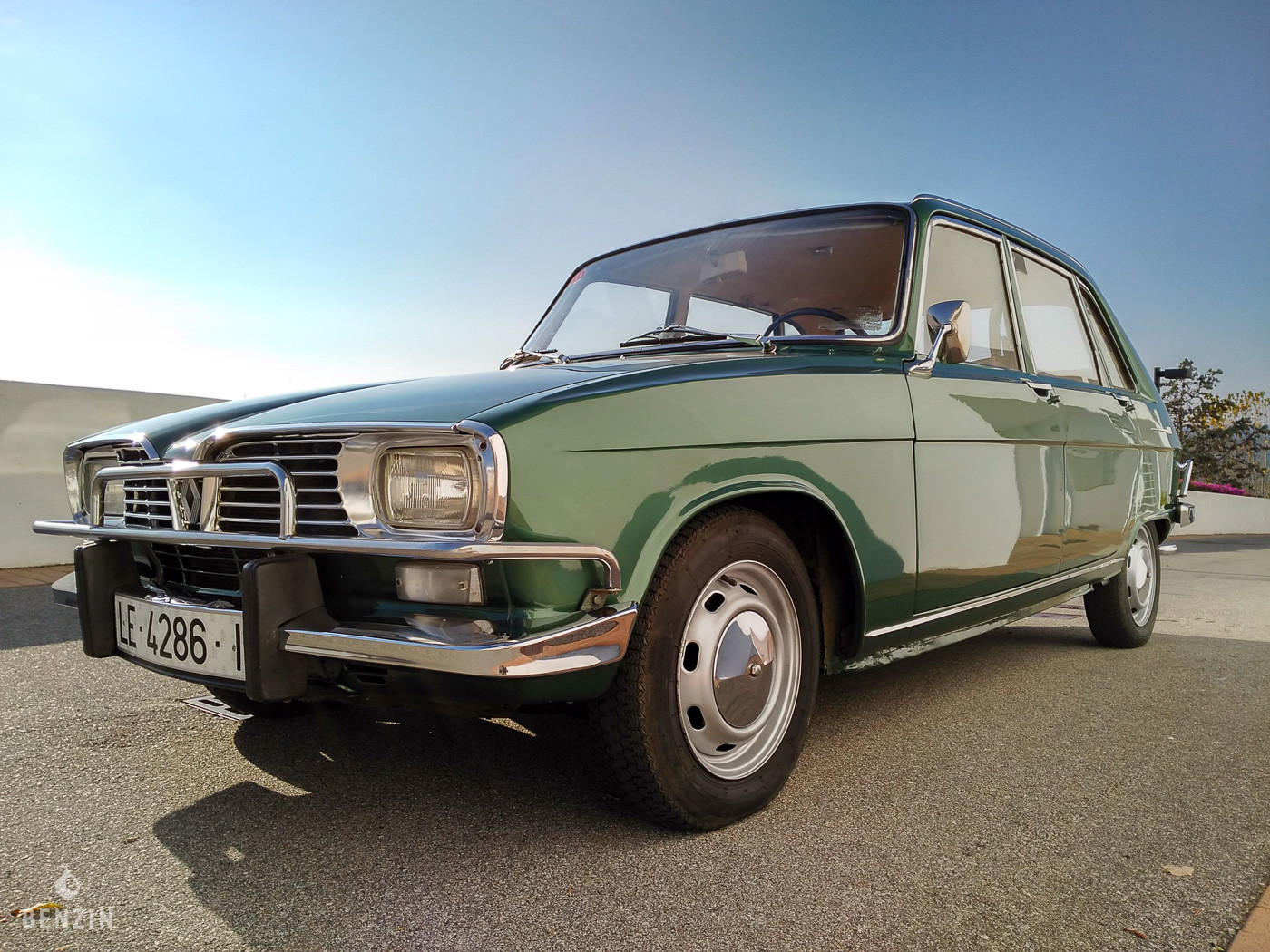
Launched in spring 1965, the Renault 16 occupies a special place in the history of French automobiles: it was one of the first mass-market family cars to establish the hatchback formula, with a five-door two-box body, a modular cabin and a genuine long-distance touring vocation. The project was developed at Renault in the early 1960s to replace the Frégate without reusing its conventional architecture, with front-wheel drive, a longitudinal front overhang engine and very carefully engineered suspension comfort. Its styling, generally attributed to Renault’s teams around Gaston Juchet, stood apart from the three-box saloons of the era and contributed to its reputation as a modern car. The Renault 16 was immediately praised for its intelligent design and received the 1966 European Car of the Year award. Its folding rear bench, multiple load configurations and ride comfort made it a benchmark well beyond France.
The Renault 16’s career ran from 1965 to 1980, with continuous evolution rather than a succession of generations. The early L and Grand Luxe versions used the 1,470 cc engine, then the range was structured around the L, TL and later TS, the latter bringing a clear increase in refinement. Over the years, the styling was modernized, equipment improved and displacement rose to 1,565 cc across much of the range. In 1973, the 16 TX topped the line-up with a 1,647 cc engine, a five-speed gearbox and a level of performance unprecedented for the model. Automatic variants also existed in some markets, but manual versions remained by far the most common.
Produced in more than 1.8 million examples, notably in Sandouville, the Renault 16 enjoyed a very successful commercial career in Europe and strongly influenced the modern family car. It did not build its legend in competition, but its presence in everyday life, in cinema and on French roads gave it real cultural significance. Today, enthusiasts mainly look for structurally sound cars, because corrosion and the difficulty of finding certain trim parts make the difference between a good base and a major restoration. Late-production TLs, such as those from 1977, are appreciated for their relative simplicity, while the TS and TX attract enthusiasts who want the most accomplished Renault 16.
Technical data
| Feature | Renault 16 TL | Renault 16 TS | Renault 16 TX |
| Production years | late 1960s - 1980 | late 1960s - mid-1970s | 1973 - 1980 |
| Body style | 5-door hatchback saloon | 5-door hatchback saloon | 5-door hatchback saloon |
| Engine | inline 4-cylinder, 1,565 cc | inline 4-cylinder, 1,565 cc | inline 4-cylinder, 1,647 cc |
| Power | approx. 67 hp DIN | approx. 83 hp DIN | approx. 93 hp DIN |
| Transmission | front-wheel drive, 4-speed manual gearbox | front-wheel drive, 5-speed manual gearbox depending on model year | front-wheel drive, 5-speed manual gearbox |
| Curb weight | approx. 980 kg | approx. 1,000 kg | approx. 1,050 kg |
| Top speed | approx. 145 km/h | approx. 155-160 km/h | approx. 170-175 km/h |
| Production | more than 1.8 million units across all versions |
Buyer’s guide
For regular classic-car use, a late TL is often the best compromise between drivability, mechanical simplicity and the relative availability of parts. The TS and especially the TX are more sought after for their performance and equipment, but they require even more attention to authenticity and the condition of the specific components. Cars with heavy corrosion or poor-quality repairs should be avoided, because restoring the body shell quickly costs more time and money than the mechanicals.
Points to watch
- Body corrosion : sills, front chassis rails, wheel arches, floors, tailgate surround and C-pillars are sensitive areas throughout the car’s life; you need to inspect underneath, behind the trim panels and ask for restoration photos if the car has been rebuilt.
- Rear suspension mounting points : the Renault 16 uses torsion bars with a particular layout; a sagging body, uneven stance or bodywork repairs around the mounting points should raise concern, especially on cars that have been stored for a long time or poorly repaired.
- Gearbox and steering-column shift : manual gearboxes do not tolerate poor linkage adjustment or worn bushes; on early cars and poorly maintained ones, gears may stick or jump out, which is why a test both cold and hot is important.
- Cooling system : on the 1.5 and 1.6 litre engines, repeated overheating can lead to a tired head gasket or a damaged cylinder head; check temperature stability, the absence of abnormal pressure in the expansion tank and invoices for the radiator, water pump or hoses.
- Fuel system : depending on the version, the carburetors can cause difficult hot starts, unstable idle or flat spots on acceleration; you should check whether the carburetor matches the version and whether it has been adjusted by a specialist familiar with this engine.
- Front brakes : on a car that has been standing still, calipers and hoses can seize up, causing pulling under braking or a wheel that overheats; you need to make sure the refurbishment was done properly, because the 16’s mechanical layout is not the easiest to work on.
- Trim and chrome items : trim strips, hubcaps, surrounds, handles and certain dashboard parts become difficult to replace, especially on higher trims and depending on the model year; you need to check that the car is complete, because a nice but incomplete body is long and costly to bring back to original specification.
When buying
On a Renault 16, bodywork repair invoices are almost as important as proof of mechanical maintenance, especially if they detail the sills, chassis rails and suspension mounting points. A road test must absolutely include a cold start, checking that all gears engage properly and verifying the temperature while driving. On a TS or a TX, it is useful to confirm the engine type, gearbox and version-specific trim items, because many cars have been modified over the decades.
0 of the 1 Renault 16 listed on Benzin found a buyer — 0 % of completed sales.
No Renault 16 is for sale at the moment. Follow the model to be notified as soon as a new one is listed.
Every vehicle comes with a detailed photo report, its history and the public exchanges between seller and community. You bid online; if you win, Benzin secures the payment and supports you through to delivery.
Follow the model from this page and you will get an e-mail as soon as a Renault 16 is listed on Benzin.
 English
 Français
 Español
 Italiano
 Deutsch
 Polski
 Magyar
