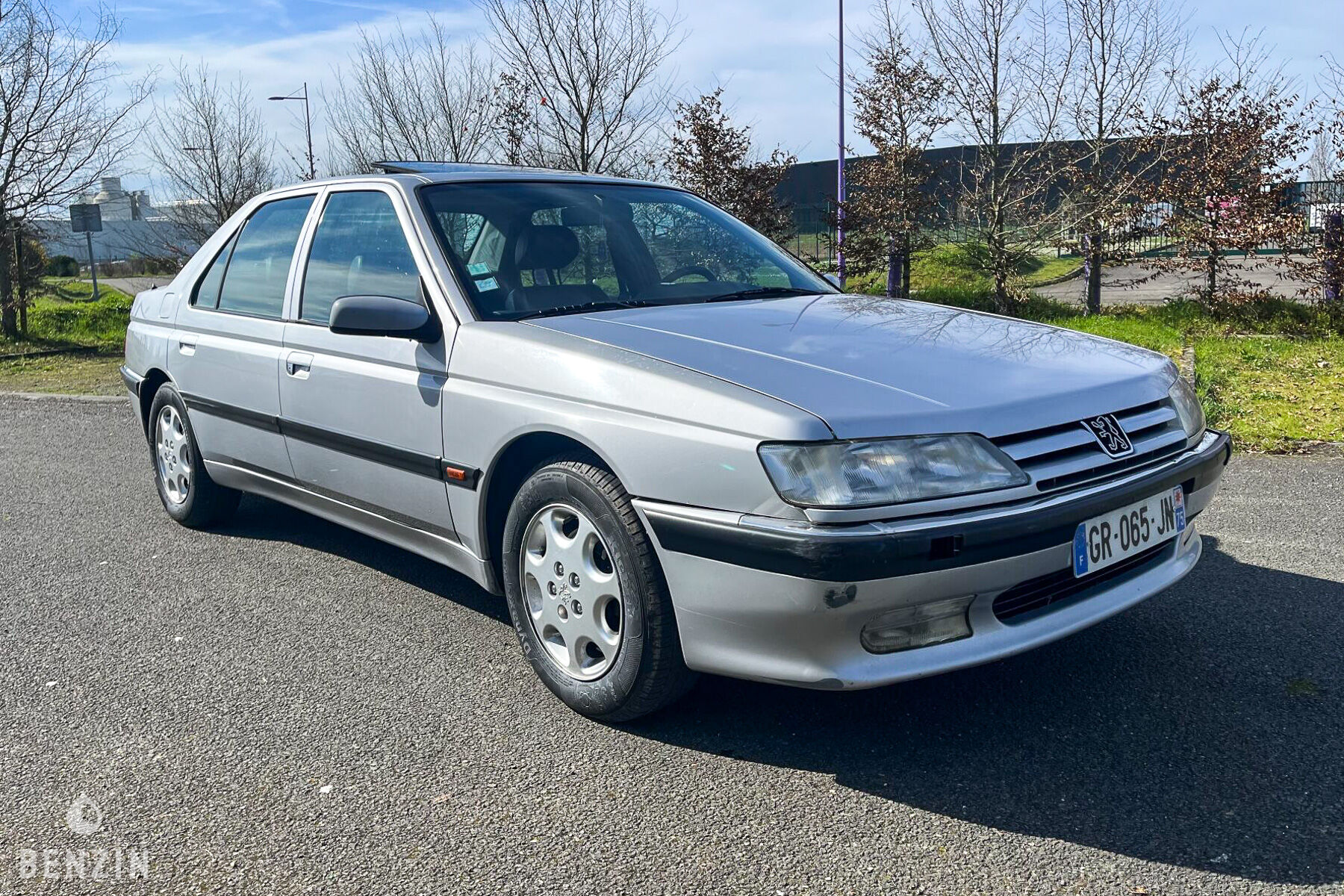
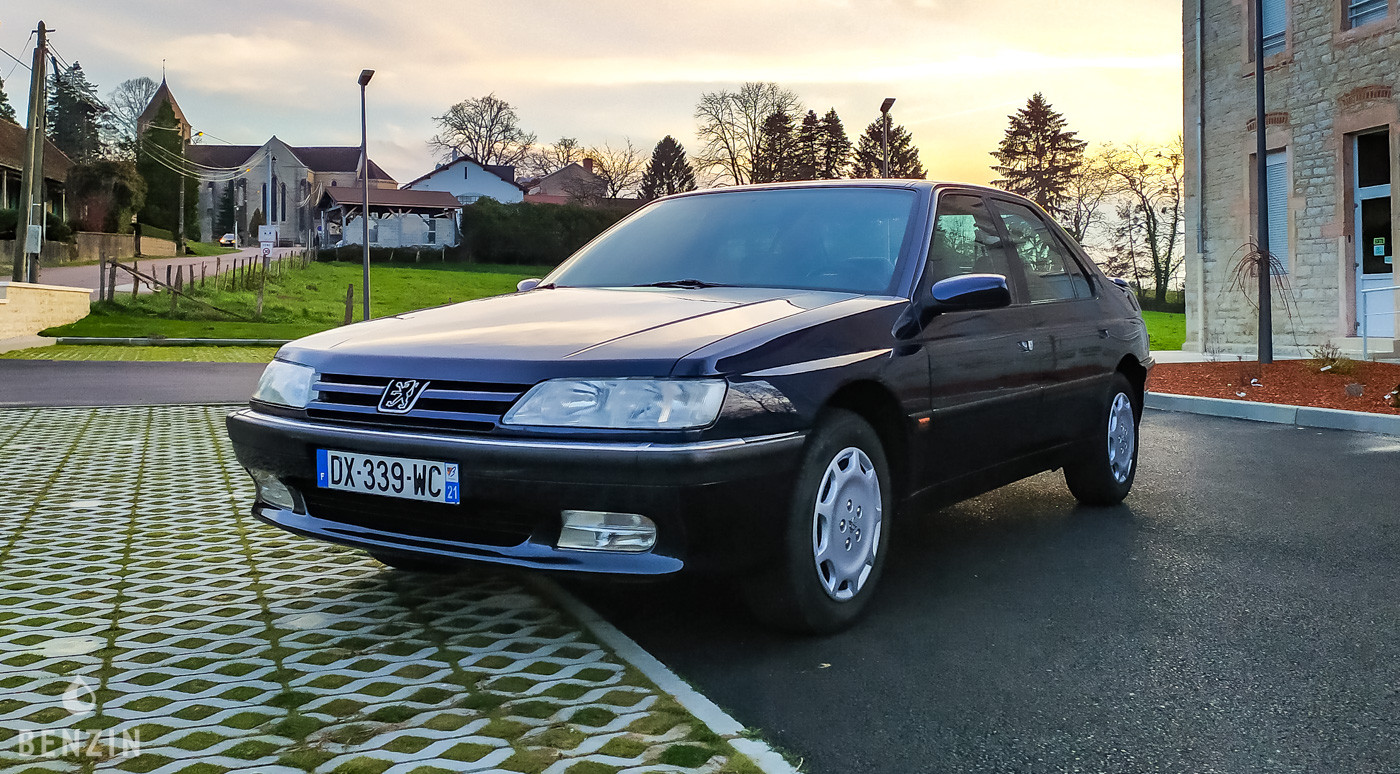
Unveiled in autumn 1989, the Peugeot 605 is the large premium sedan tasked with replacing the 604 and repositioning the brand against German and French executive cars in the upper segment. Its very sober styling was penned by Pininfarina, in the continuity of the 405 and 605 of the same era, with a transverse-engine, front-wheel-drive layout derived from the platform shared with the Citroën XM. At launch, the range included 2.0-liter 4-cylinder petrol engines and 3.0-liter PRV V6s, then it quickly expanded with the 2.1 Turbo Diesel, an engine that became central in the French large-car market. The car won over buyers with its spaciousness, high-speed comfort and excellent ride/handling balance, but its first years were marred by imperfect electronic and electrical development that weighed heavily on its reputation for a long time.
Peugeot evolved the 605 in successive steps in the early 1990s, with the arrival of the 2.0 16-valve, the 2.5 Turbo Diesel and, at the top of the range, the sporty SV24 with a 24-valve V6. In 1995, phase 2 brought the most significant overhaul: modernized styling, improved perceived quality, revised wiring and electronic management, improved soundproofing and a rationalized range. The late versions notably received the more modern ES9 V6, smoother and more reliable than the early PRV units, while the SRI and SV trims remained the best-known petrol versions. Alongside the production sedan, the 605 also gave rise to very specific conversions, including limousines and armored cars made by Labbé for official, diplomatic or close-protection use.
The 605 did not have a true sporting career, but it occupied a visible place in French ministerial, prefectural and protocol fleets in the 1990s, which today gives it a real institutional period-car dimension. Its career ended in 1999 after production of around 254,000 units, with no direct successor until the much later arrival of the 607. Long undervalued, it is now being reassessed by enthusiasts of large Peugeot models for its comfort, understated design and noble engines, especially in phase 2. Collectors mainly seek out the best V6s, the rare SV24s, the well-maintained 2.0 16v for simpler use, as well as Labbé derivatives when their conversion and registration file is complete.
Technical sheet
| Specification | 605 SRI 2.0 16v | 605 SV 3.0 V6 | 605 Limousine Labbé |
| Production years | 1992-1999 | 1989-1999 depending on version | Conversions on 605 base in the mid and late 1990s |
| Body style | 4-door sedan | 4-door sedan | Converted armored limousine/sedan |
| Engine(s) | 2.0 l 16-valve inline 4-cylinder petrol engine | 3.0 l petrol V6, 12 or 24 valves depending on model year | Most often 3.0 l petrol V6 on 605 base |
| Power | Around 135 hp | Around 170 to 200 hp depending on engine | Depending on the base used; performance heavily reduced by the armor |
| Transmission | Front-wheel drive, 5-speed manual | Front-wheel drive, 5-speed manual or 4-speed automatic | Front-wheel drive, manual or automatic gearbox depending on donor car |
| Weight | Around 1,400 to 1,450 kg | Around 1,500 to 1,600 kg | Around 2.7 to over 3.0 t depending on protection level |
| 0-100 km/h | Around 10 s | Around 8 to 9 s | Not applicable on an armored version, very variable depending on weight |
| Top speed | Around 200 km/h | Around 220 to 235 km/h depending on engine | Very variable depending on conversion |
| Production | Around 254,000 Peugeot 605s all versions combined |
Buyer’s guide
The 605 phase 2, produced from 1995 onward, is the most recommendable: it corrects the main early faults and offers the best finish. In petrol form, the SRI 2.0 16v is often the best compromise between refinement, running costs and simplicity, while the late V6s are to be preferred for their mechanical nobility, provided you accept more demanding maintenance. Early-production examples require more vigilance regarding electrics, and a Labbé only makes sense if its conversion and registration file is perfectly in order.
Points to watch
- Wiring harness and connectors : intermittent accessory failures, erratic warning lights, temperamental ventilation or central locking, especially on cars from 1989 to 1994; check whether wiring repairs, grounds and control units have already been addressed, and test absolutely all equipment.
- Cooling and fan management : abnormal temperature rise in city driving, erratic fan activation or ineffective air conditioning can come from the sensors, the control unit or the system itself; an important point on all engines, with increased risk on V6 and 2.5 TD.
- ZF 4HP18 automatic gearbox : jerks, slipping when hot, late shifts or hesitant reverse on some V6s; ask whether fluid changes have been done despite the period talk of “lifetime” lubrication, and test the car thoroughly when hot.
- Front axle and steering : wandering, braking vibrations, uneven tire wear or knocking over rough surfaces often come from the control arms, bushings, tie rods and top mounts; the 605 is sensitive to the condition of its front end and only regains its refinement if everything is in good shape.
- Electronically controlled suspension : on some high-end trims, tired electronically controlled dampers or a faulty control system can make the car feel harsh, inconsistent or trigger a warning light; check for the presence of the system, its proper operation and the availability of suitable parts.
- Air conditioning, heating and flap servomotors : lack of cold air, stuck air distribution or erratic automatic control are common with age; on a well-equipped 605, all functions must be checked, not just compressor engagement.
- Labbé conversions : on limousines or armored cars, the issue is not only mechanical; you must check the compliance of the special glazing, the actual weight, the specific opening panels and, above all, the presence of period conversion documents, essential for any administrative regularization.
When buying
On a standard 605, the most important invoices are those related to cooling, phase 1 electrical repairs, the automatic gearbox where applicable, and the timing system when the engine in question is equipped with one. A diagnostic scan is not superfluous on well-equipped phase 2 cars, simply to check for stored faults in the air conditioning, ABS or electronically controlled suspension. For a 605 Labbé, you must also require the bodywork and conversion documents, consistency between the plate, registration document and listed specifications, as well as any old certificate proving the vehicle’s exact configuration.
On Benzin a Peugeot 605 has sold for 3 550 € on average, with a median price of 2 500 €. Based on the 3 sales completed on the platform.
The 3 Peugeot 605 sold on Benzin changed hands for between 1 850 € and 6 300 €, depending on condition, mileage and version.
3 of the 3 Peugeot 605 listed on Benzin found a buyer — 100 % of completed sales.
No Peugeot 605 is for sale at the moment. Follow the model to be notified as soon as a new one is listed.
Every vehicle comes with a detailed photo report, its history and the public exchanges between seller and community. You bid online; if you win, Benzin secures the payment and supports you through to delivery.
Follow the model from this page and you will get an e-mail as soon as a Peugeot 605 is listed on Benzin.

 English
 Français
 Español
 Italiano
 Deutsch
 Polski
 Magyar
