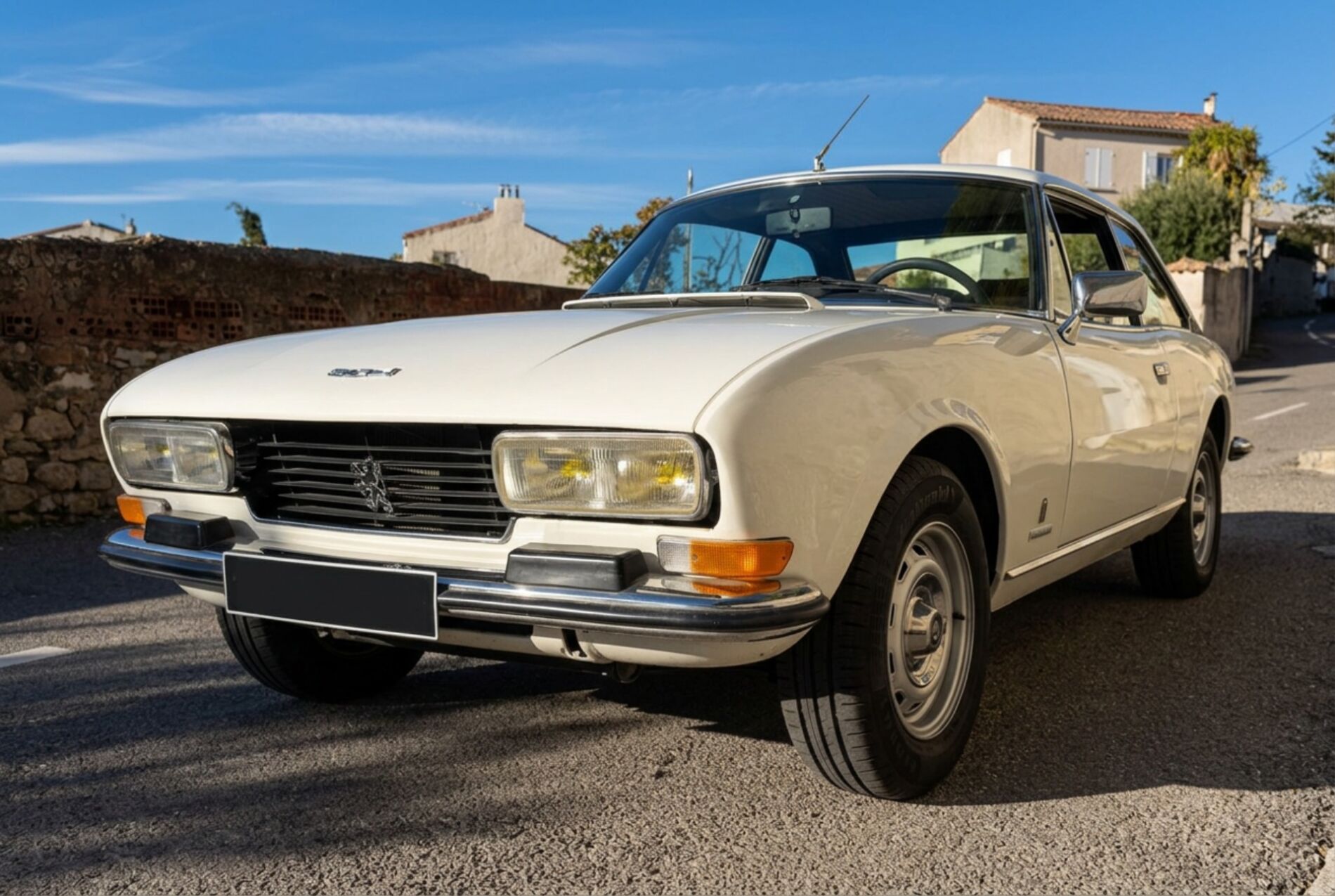
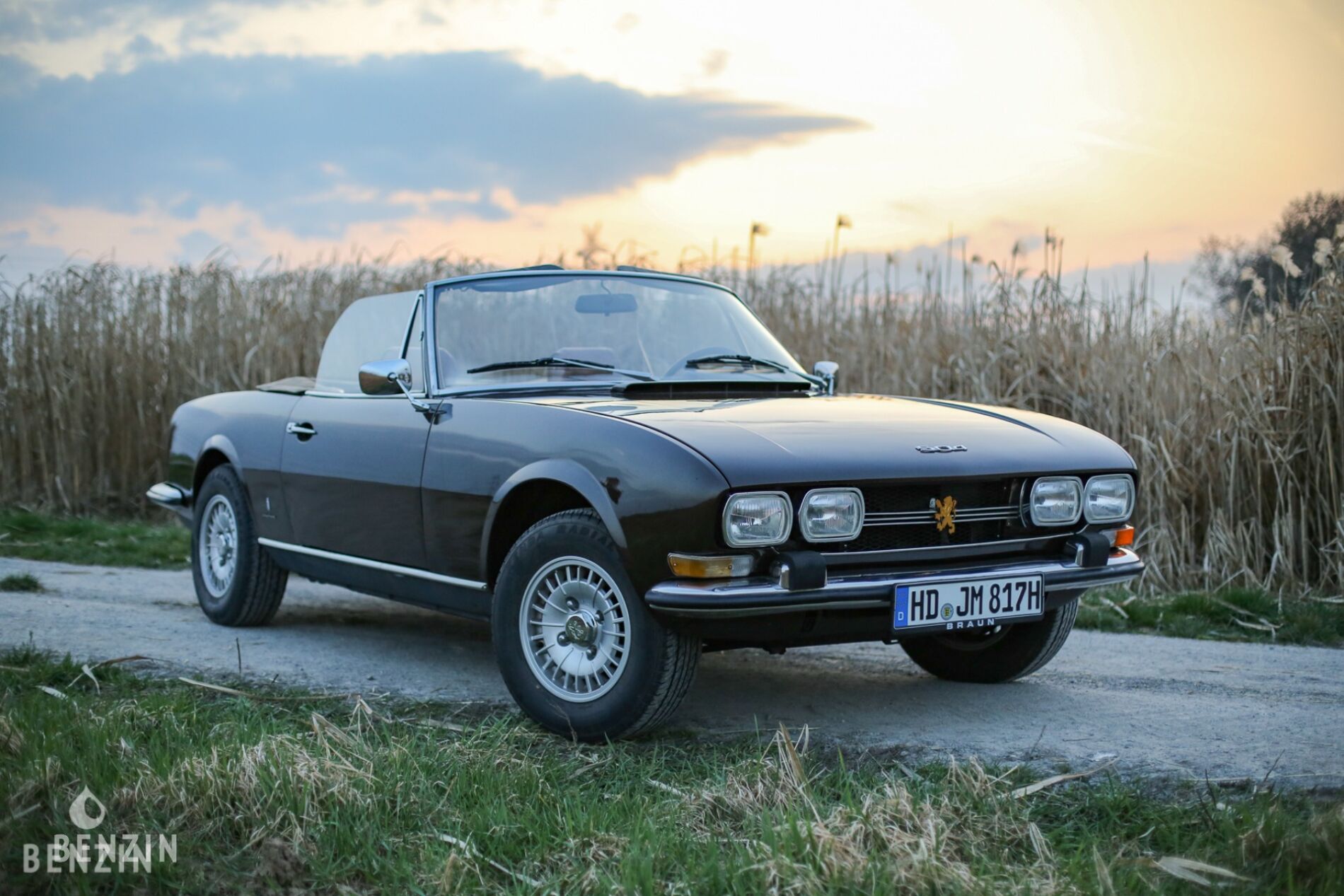
Unveiled at the 1968 Paris Motor Show, the Peugeot 504 succeeded the 404 with a more upscale ambition, improved safety and a genuine vocation as a world touring car. The saloon was designed with the collaboration of Pininfarina, while the very elegant coupé and cabriolet, launched in 1969, received a specific body signed and assembled in Italy by the Turin coachbuilder. The French commercial launch, disrupted by the social climate of 1968, really took off in 1969, the year the 504 was voted European Car of the Year. From the outset, it stood out for its independent suspension on all four wheels, its ride comfort and excellent behavior on poor surfaces, qualities that would make its reputation in Europe and Africa. The range quickly expanded with carbureted or injected saloons, then estates, family versions, commercial variants and pickups, not to mention very durable Diesels. The most common engines are the 1.8-liter and 2.0-liter petrol units with carburetor or injection, as well as the 2.1- then 2.3-liter Indenor Diesels, especially appreciated by high-mileage drivers.
The coupé and cabriolet start with the 1.8-liter injection, before moving to the 2.0-liter, then to the PRV V6 at the top of the range from the mid-1970s. On these versions, the 504 moves away from the simple family-car category and into that of the French GT, especially the Coupé V6 TI, which is more powerful and better equipped. The European saloon evolves in small steps until the early 1980s, while utility versions and licensed production greatly extend the model’s career in other markets. In competition, the 504 left a lasting mark on African rallies and major endurance events on rough tracks, where its robustness became legendary. Across all body styles, production far exceeds 3.7 million units if non-French production is included. Today, the 504 saloon appeals through its comfort and simplicity, while the coupé and cabriolet, rarer and more refined, hold a special place among collectors, with particular interest in well-tuned original injection cars and complete, healthy V6s.
Technical data
| 504 Berline 2.0 Injection | 504 Coupé/Cabriolet 2.0 Injection | 504 Coupé V6 TI |
| Production years | Early 1970s - early 1980s | Early 1970s - late 1970s | 1974 - early 1980s |
| Body style | 4-door saloon | 2-door coupé or 2-door cabriolet | 2-door coupé |
| Engine(s) | Inline 4-cylinder, 1,971 cc, injection | Inline 4-cylinder, 1,971 cc, injection | PRV V6, 2,664 cc, injection |
| Power | Around 104 hp | Around 104 hp | Around 144 hp |
| Transmission | Rear-wheel drive, 4-speed manual or automatic depending on version | Rear-wheel drive, 4- or 5-speed manual depending on year | Rear-wheel drive, 5-speed manual or automatic depending on market |
| Weight | Around 1,200 kg | Around 1,250 to 1,300 kg | Around 1,350 kg |
| 0-100 km/h | Around 12 s | Around 11.5 to 12 s | Around 10 s |
| Top speed | Around 170 km/h | Around 175 km/h | Around 185 to 190 km/h |
| Production | More than 3.7 million units for the entire 504 family, all body styles and international production combined |
Buyer’s guide
For regular use, the 2.0-liter petrol or Diesel saloons are the easiest to live with, with excellent availability of specialists and a well-known mechanical layout. The most sought-after remain the Pininfarina Coupé and Cabriolet, especially in well-correct 2.0 Injection form or as a complete V6 TI, while cars that have been superficially restored or modified in the injection system and wiring loom deserve more caution. The Diesels are very endearing but should be bought for their authenticity and durability, not for their performance.
Points to watch
- Structural corrosion : front rails, sills, floors, rear suspension mounting points, wheel arches, windshield scuttle and trunk lid can be heavily affected, especially on European saloons and cabriolets; ask where the bodywork was repaired and check for bodywork photos, not just a recent paint job.
- Kugelfischer mechanical injection : hard cold starting, unstable idle, hesitation on acceleration or abnormally high fuel consumption on the 1.8 and 2.0 Injection; check whether the pump, injectors, lines and tuning have been rebuilt by a specialist familiar with this system.
- Inboard rear brakes : oil seepage at the differential output seals or uneven braking on saloons and coupés with rear brakes near the axle; check whether the output seals, discs and calipers have already been renewed, because access is longer and the repair is time-consuming and costly.
- PRV V6 : overheating, rough running or a noisy timing chain on the V6 Coupé/Cabriolet, especially if the cooling system has been neglected; ask for invoices for the radiator, water pump, ignition and injection tuning.
- Indenor Diesel cylinder head : old overheating, mayonnaise-like sludge or pressurization of the cooling system on the 2.1 and 2.3 Diesel; check cold starting, the absence of bubbles in the expansion tank and proof of cooling-system maintenance, because these engines do not tolerate repeated temperature spikes well.
- Front suspension and steering : wandering, vibrations or uneven tire wear can come from the ball joints, bushings, arms and steering box, a common issue on high-mileage, heavy 504s; check straight-line precision and evidence of recent front-end work rather than just a wheel alignment.
- Pininfarina Coupé/Cabriolet : panel alignment, side windows, seals and door mechanisms are often tricky, especially after restoration; on a cabriolet, make sure the body shell has not moved and that the soft top, its frame and its compartment close properly without strain.
When buying
On a 504 Injection, the invoices for rebuilding the Kugelfischer pump, the distributor and the bench tuning are worth far more than a simple “engine rebuilt” mention. On a Coupé or Cabriolet, you should ask for detailed photos of the body restoration and the underbody, because the actual condition of the structure matters more than the exterior presentation. For a V6 or a Diesel, a cold start test is important to judge starting, idle quality and temperature stability; on the most collectible versions, matching original engine/gearbox/color is a real plus.
2 of the 9 Peugeot 504 listed on Benzin found a buyer — 22 % of completed sales.
No Peugeot 504 is for sale at the moment. Follow the model to be notified as soon as a new one is listed.
Every vehicle comes with a detailed photo report, its history and the public exchanges between seller and community. You bid online; if you win, Benzin secures the payment and supports you through to delivery.
Follow the model from this page and you will get an e-mail as soon as a Peugeot 504 is listed on Benzin.
 English
 Français
 Español
 Italiano
 Deutsch
 Polski
 Magyar
