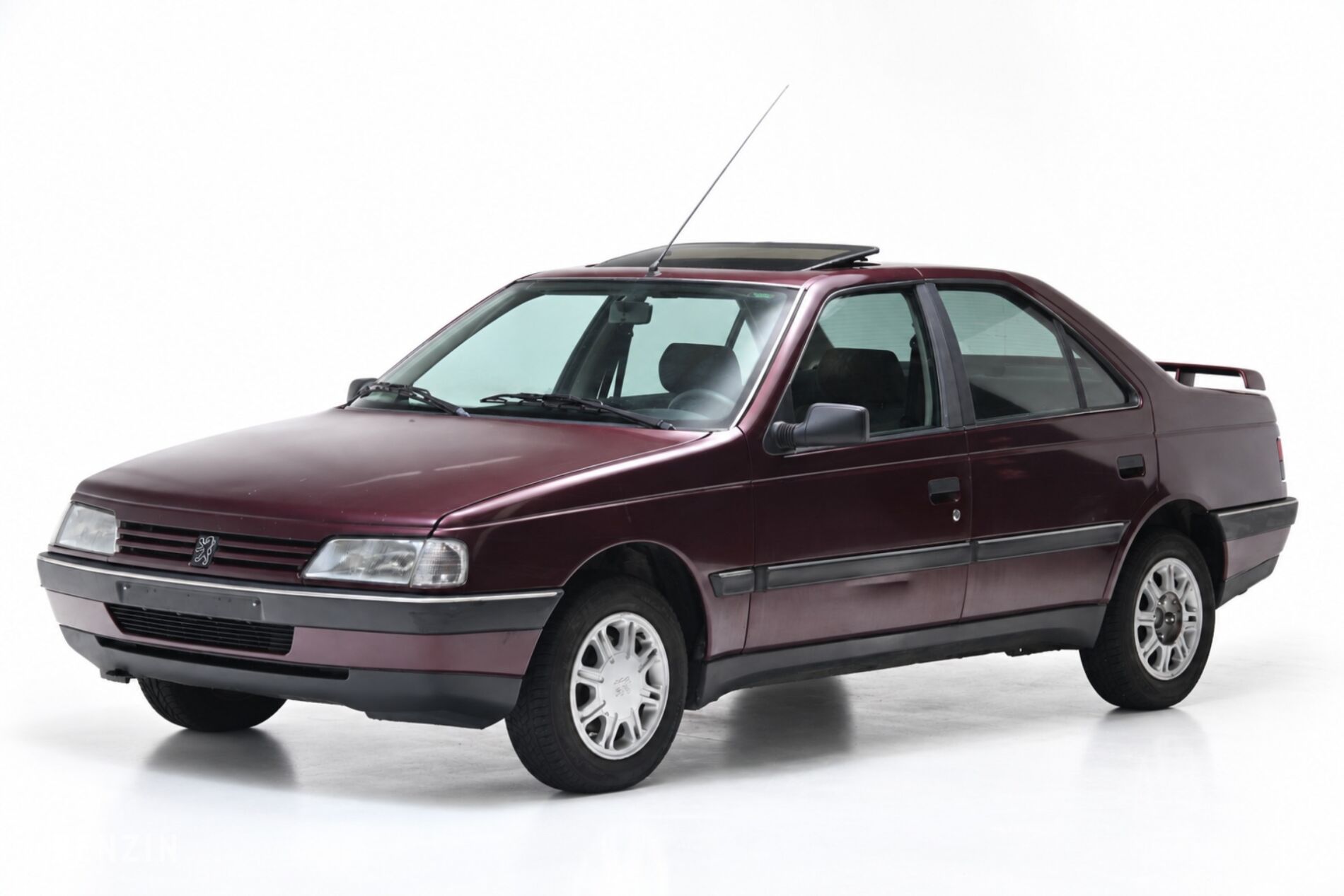
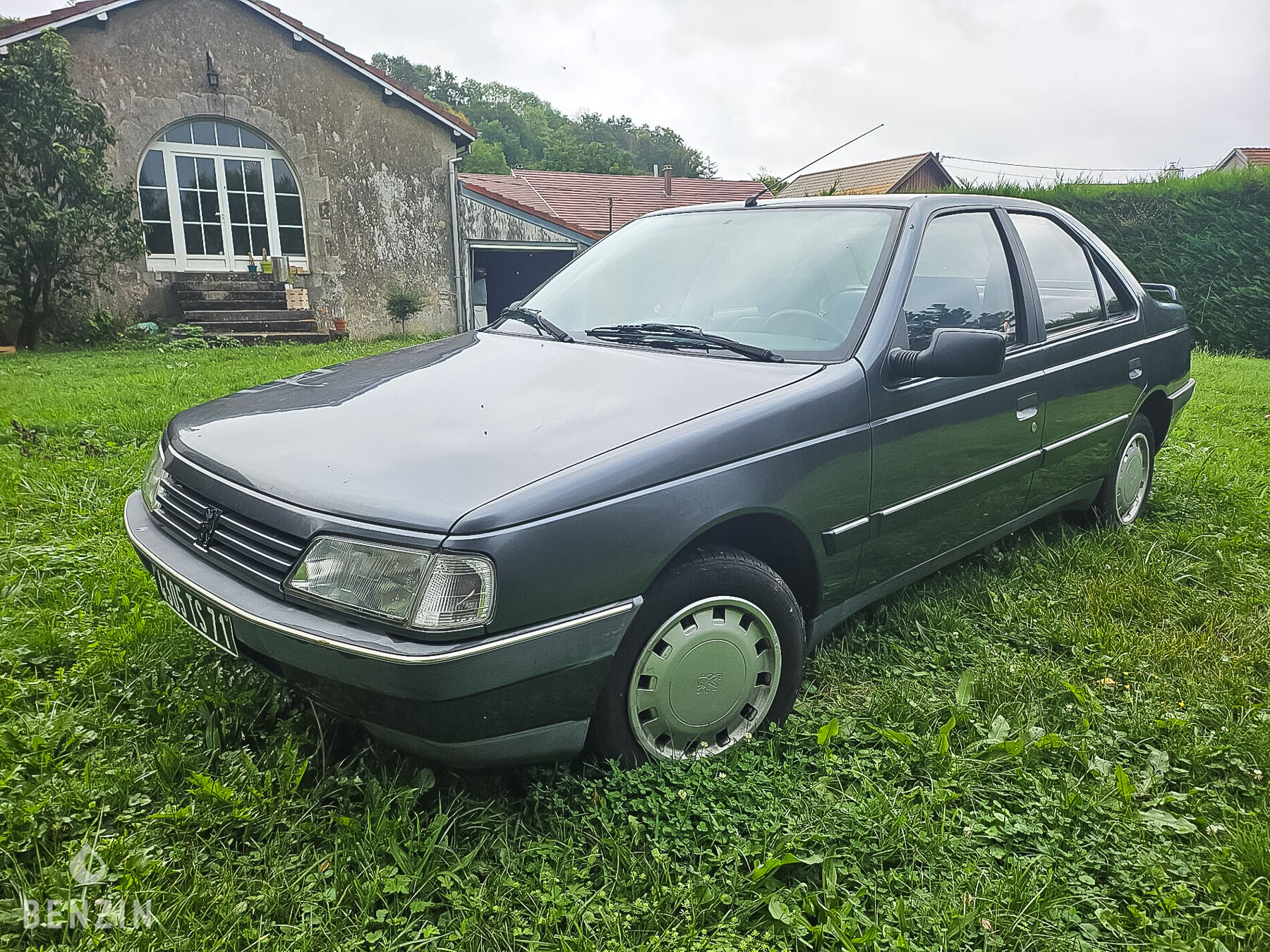
Presented in spring 1987 to replace the 305 at the upper end of Peugeot’s core range, the 405 immediately established itself as one of the major French family cars of the late 1980s. Its Pininfarina-designed lines contrasted sharply with the 305 through their low proportions, large glass area, and very clean styling that has aged remarkably well. Named European Car of the Year 1988, it was launched first as a front-wheel-drive saloon, then quickly expanded into an estate and, later, all-wheel-drive versions on certain sporty or turbocharged variants. The mechanical range was broad, from TU and XU petrol engines to naturally aspirated or turbocharged XUD diesels, which explains its very wide spread among private owners and high-mileage drivers alike.
The European career breaks down into two main periods: the first series from 1987 to 1992, then phase 2 from summer 1992 onward with a revised front end, modified rear lights, a modernized dashboard, and equipment often presented more attractively on trims such as GR, SR, STDT, or Privilège. The standout versions remain the Mi16, launched in 1987 with its 1.9-litre 16-valve engine and later its 2.0-litre, and the rare T16 turbo with four-wheel drive, the technological showcase of the range. At the same time, the 405 made its mark in competition and rally raid: the 405 Turbo 16 Grand Raid won the Paris-Dakar, and the saloon’s image also owes much to the Mi16, the dynamic benchmark of its era. The 405 was produced in France until 1997, then continued its career in certain countries in other forms of production.
In total, worldwide production approached 2.5 million units, making it an important model in Peugeot history. Today, enthusiasts mainly seek out the Mi16 and T16, but the best standard saloons, with low mileage, unmodified and well preserved, are increasingly appealing for their comfort, visibility, and the quality of their chassis. Phase 2 versions, such as many 1994 cars in Privilège trim, are particularly appreciated for their more polished presentation and their easy use as a rolling classic.
Technical data
| Version | 405 1.6 petrol | 405 1.9 Diesel | 405 Mi16 1.9 |
| Production years | 1987-1997 | 1987-1997 | 1987-1992 |
| Body style | 4-door saloon, estate | 4-door saloon, estate | 4-door saloon |
| Engine(s) | Inline 4-cylinder, petrol | Inline 4-cylinder, naturally aspirated diesel | Inline 4-cylinder, 16 valves |
| Displacement | 1,580 cc | 1,905 cc | 1,905 cc |
| Power | approx. 92 hp | approx. 71 hp | 160 hp |
| Transmission | Front-wheel drive, 5-speed manual gearbox | Front-wheel drive, 5-speed manual gearbox | Front-wheel drive, 5-speed manual gearbox |
| Weight | approx. 1,000-1,050 kg | approx. 1,050-1,100 kg | approx. 1,140 kg |
| 0-100 km/h | approx. 11.5 s | approx. 15.5 s | approx. 8.6 s |
| Top speed | approx. 175 km/h | approx. 160 km/h | approx. 220 km/h |
| Production | Nearly 2.5 million examples across all versions and production runs |
Buyer’s guide
For trouble-free use, phase 2 405s with a simple petrol engine or naturally aspirated diesel are often the easiest to live with, with a more modern appearance and better availability of common parts. Driving enthusiasts will naturally look for an authentic, unmodified Mi16, while very tired, modified, or overheating-affected examples should be avoided, even if they seem complete. A low-mileage, original GR or Privilège is often the best compromise between historical interest and simplicity.
Points to watch
- Head gasket and cooling : XU petrol engines do not tolerate repeated overheating well; on cars that have run hot, check for any signs of excessive pressure in the expansion tank, mayonnaise, hard hoses when hot, radiator fan operation, and a detailed invoice if the gasket has already been replaced, ideally with cylinder head and water pump checks.
- Rear axle : as on many Peugeot models with torsion bars from this era, the arm bearings can wear; visibly negative rear camber, squeaks, or a sagging stance mean you should ask whether the axle has already been rebuilt.
- BE3 gearbox and linkage : on manual gearbox versions, a stiff or notchy shift, especially between 1st, 2nd, and reverse, is common as the linkage, synchros, or mounts wear; also check for oil leaks at the differential output.
- Localized corrosion : the 405 resists corrosion better than some rivals, but the early years and poorly stored cars can rust at the sills, jacking points, windshield scuttle, sunroof surround, lower rear wings, and floor near the axle mounts; an inspection under the carpets and underbody is useful.
- Sunroof : common on higher trim levels, it can seize or let water in through blocked drains; check full operation, the absence of moisture in the headliner, and signs of water in the pillars.
- Interior electrics : the power windows, central locking, display, and certain column or heating controls age; on a well-equipped phase 2 such as a Privilège, everything must be tested because faults often come from door looms or worn contacts.
- XUD diesel : on the 1.9 D and TD, watch cold starts, diesel return lines, air leaks, and pump seepage, with particular attention to Lucas pumps, which are more delicate than Bosch units depending on the version.
- Mi16 : on the sports versions, authenticity matters as much as condition; check for the correct 16-valve engine, the condition of the exhaust manifold, the absence of bodged intake or wiring work, and the consistency of the front axle with the sporty use it has endured.
When buying
On a 405, the most important invoices are for timing belt replacement, water pump replacement, work on the head gasket, and any possible rear axle rebuild. A road test should confirm stable temperature, a gearbox that does not crunch when hot, and a rear end with no wandering or abnormal camber. For a Mi16, identifying the engine and the original specific components deserves particular attention; for a very low-mileage car, consistency between interior wear, paint, and history is essential.
On Benzin a Peugeot 405 has sold for 2 667 € on average, with a median price of 2 000 €. Based on the 3 sales completed on the platform.
The 3 Peugeot 405 sold on Benzin changed hands for between 1 500 € and 4 500 €, depending on condition, mileage and version.
3 of the 3 Peugeot 405 listed on Benzin found a buyer — 100 % of completed sales.
No Peugeot 405 is for sale at the moment. Follow the model to be notified as soon as a new one is listed.
Every vehicle comes with a detailed photo report, its history and the public exchanges between seller and community. You bid online; if you win, Benzin secures the payment and supports you through to delivery.
Follow the model from this page and you will get an e-mail as soon as a Peugeot 405 is listed on Benzin.

 English
 Français
 Español
 Italiano
 Deutsch
 Polski
 Magyar
