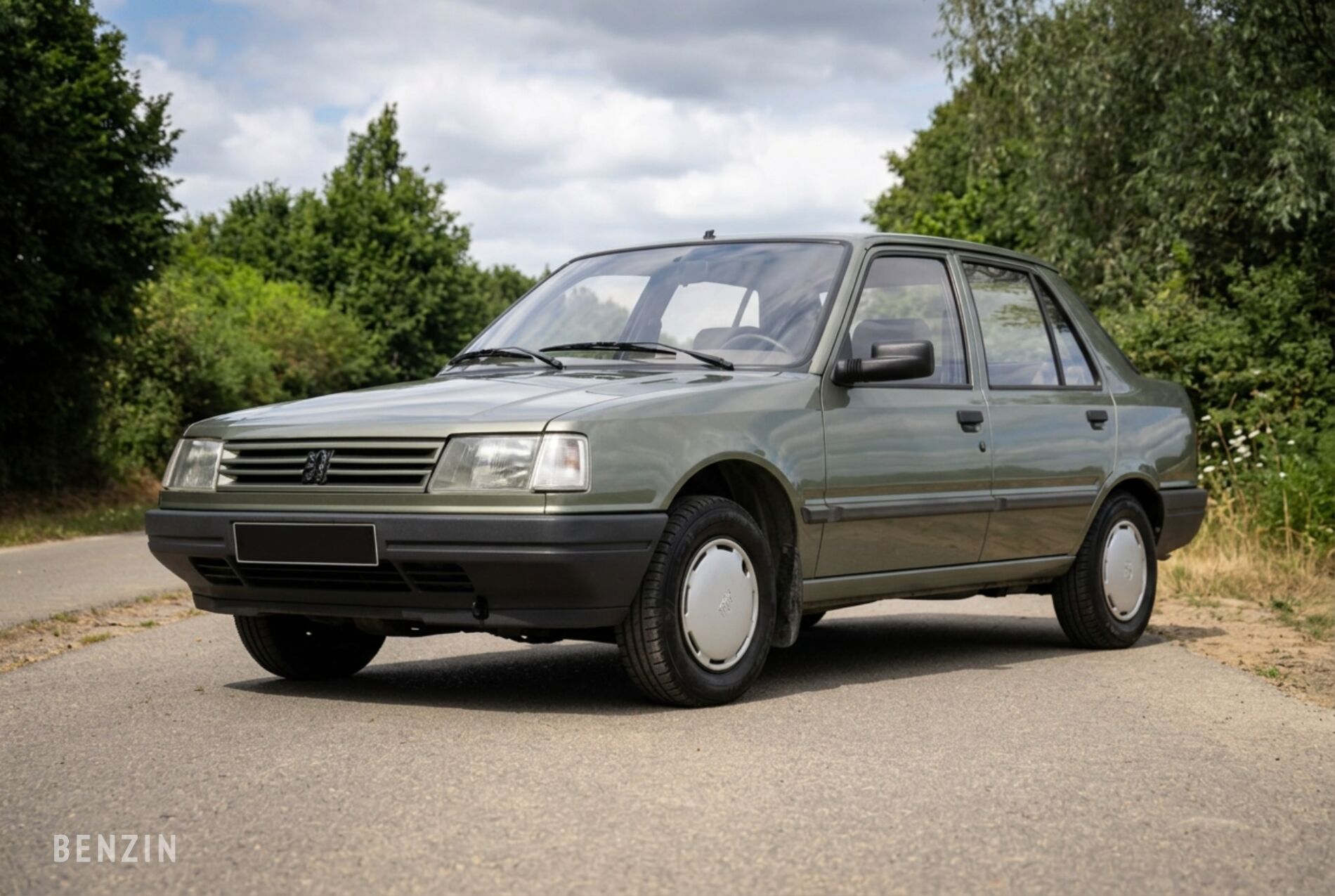
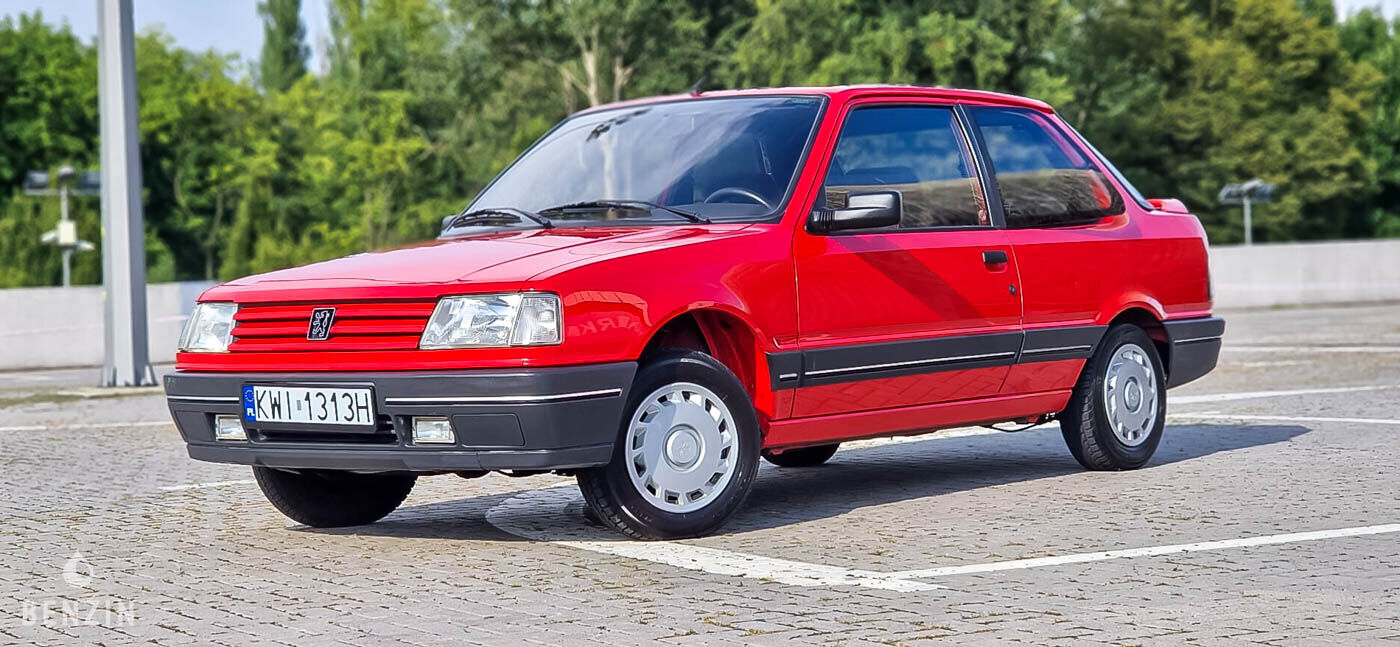
The Peugeot 309 appeared in autumn 1985 in a particular context: the project was born at Talbot under the name Arizona, before being taken over by PSA and ultimately launched under the Peugeot badge to effectively replace the Talbot Horizon and Solara at the end of their careers. Its hatchback two-box silhouette, taller and more angular than a 205, betrays this mixed origin, with final development carried out within Peugeot’s orbit rather than as a completely new design. Produced notably at Poissy, the 309 sits above the 205 without really replacing the 305, which explains its somewhat atypical position in the range. The early versions still received certain Simca-Talbot engines, then the range gradually switched to PSA TU and XU units, now much better known to enthusiasts and specialists. In France, the GR, SR, Chorus, Profil, and later Vital or Green trims made up the bulk of sales, alongside the much-appreciated XUD diesels for their durability.
The 309 evolved significantly in 1989 with phase 2, sold for the 1990 model year: redesigned front end, revised dashboard, more cohesive presentation with the rest of the Peugeot range and a rationalized mechanical lineup. It was also around this time that the 309 best asserted its road-going character, often judged more stable and roomier than a 205 for family use, while retaining a precise front end and a very lively rear axle when driven harder. The sporty versions greatly contributed to its reputation: first the 130 hp 1.9 GTI, then the rare and formidable GTI 16 with its 160 hp 16-valve engine, which remains one of the most significant French compact cars of its era. The 309 also had a career in amateur motorsport, rallying and one-make circuit racing, especially in GTI and GTI 16 form, thanks to its effective chassis and a mechanical base well known to tuners.
Production ends in 1993 after around 1.6 million units, with the 306 then taking over with a more modern presentation. Long overshadowed by the 205, the 309 is now being rediscovered for its dynamic qualities, technical simplicity and still-easy usability, especially in its well-preserved mainstream versions. Very original, low-mileage and unmodified base cars are becoming hard to find, while the GTI and GTI 16 are now the most sought after by collectors.
Technical data
| Version | 309 GR / Chorus 1.3 phase 1 | 309 XS 1.6 phase 2 | 309 GTI 16 |
| Production years | 1985-1989 | 1990-1993 | 1990-1993 |
| Body | Compact 5-door hatchback | Compact 3- or 5-door hatchback | Compact 3- or 5-door hatchback |
| Engine(s) | 4-cyl. petrol, 1,294 cc, carburetor | 4-cyl. petrol, 1,580 cc, injection | 4-cyl. petrol, 1,905 cc 16-valve, injection |
| Power | approx. 65 hp | 92 hp | 160 hp |
| Transmission | Front-wheel drive, 4- or 5-speed manual gearbox depending on version | Front-wheel drive, 5-speed manual gearbox | Front-wheel drive, 5-speed manual gearbox |
| Weight | approx. 850-900 kg | approx. 930 kg | approx. 975 kg |
| 0-100 km/h | approx. 14 s | approx. 10.5 s | approx. 7.8 s |
| Top speed | approx. 155 km/h | approx. 180 km/h | approx. 220 km/h |
| Production | Around 1.6 million units across all versions |
Buyer’s guide
For regular use, phase 2 cars with TU, XU or XUD diesel engines are generally the easiest to live with and the best supported for parts. The 309 XS offers an excellent compromise between enjoyment, simplicity and running costs, while the GTI and especially GTI 16 are the most desirable for the informed enthusiast. The very first versions with original Talbot mechanicals should not be ruled out, but they require a more careful purchase because of certain specific parts and a history that is often less clear.
Points to watch
- Torsion-bar rear axle : play in the arms, rear wheels that develop negative camber or squeaks, on all high-mileage 309s; check whether the arm bearings or the complete axle have already been rebuilt.
- Body corrosion : sills, jacking points, rear floors, wheel arches and lower tailgate can be affected, especially on phase 1 cars and those that received late undersealing; check that the stonechip coating is not hiding structural repairs.
- Early-year Poissy/Talbot engines : oil seepage, noisy timing and temperamental carburation both cold and hot on 1.1, 1.3 or 1.6 engines from the early years; ask exactly which engine is fitted and what has been rebuilt on the ignition and fuel system.
- BE1 gearbox and linkage : vague engagement, synchro crunching and imprecise shifting, especially on lively or abused petrol versions; check hot shifting through all gears and the absence of excessive play at the lever.
- Cooling system : tired radiator, old hoses, faulty fan or temperature switch can cause overheating; an important point on XU and even more so on GTI, where repeated overheating can precede a head gasket failure.
- Carburetors and air leaks : unstable idle, flat spots on acceleration and difficult starting are common on carbureted versions that have been left unused for a long time; check the condition of the diaphragms, intake manifolds and adjustment rather than just a simple “cleaning.”
- Phase 1 electrics : instrument cluster, gauges, central locking or power windows can become intermittent with age; inspect the wiring loom behind the dashboard and the earths, especially if accessories have been added.
- GTI / GTI 16 specifics : trim parts, wheels, upholstery, running gear and intake are often replaced or mixed and matched; check that the car still retains its original configuration and has not been rebuilt from a standard version.
When buying
On a 309, the biggest bills are usually for the rear axle, the cooling system and, depending on the version, rebuilding the carburetor or injection. A lift inspection is particularly useful to distinguish a sound body from a car that has simply been “undersealed,” and to see the true condition of the floors, sills and jacking points. On a GTI or GTI 16, you also need to check that the engine type, running gear and trim items match the stated model year.
On Benzin a Peugeot 309 has sold for 4 425 € on average, with a median price of 5 113 €. Based on the 4 sales completed on the platform.
The 4 Peugeot 309 sold on Benzin changed hands for between 1 250 € and 6 225 €, depending on condition, mileage and version.
4 of the 6 Peugeot 309 listed on Benzin found a buyer — 67 % of completed sales.
No Peugeot 309 is for sale at the moment. Follow the model to be notified as soon as a new one is listed.
Every vehicle comes with a detailed photo report, its history and the public exchanges between seller and community. You bid online; if you win, Benzin secures the payment and supports you through to delivery.
Follow the model from this page and you will get an e-mail as soon as a Peugeot 309 is listed on Benzin.

 English
 Français
 Español
 Italiano
 Deutsch
 Polski
 Magyar
