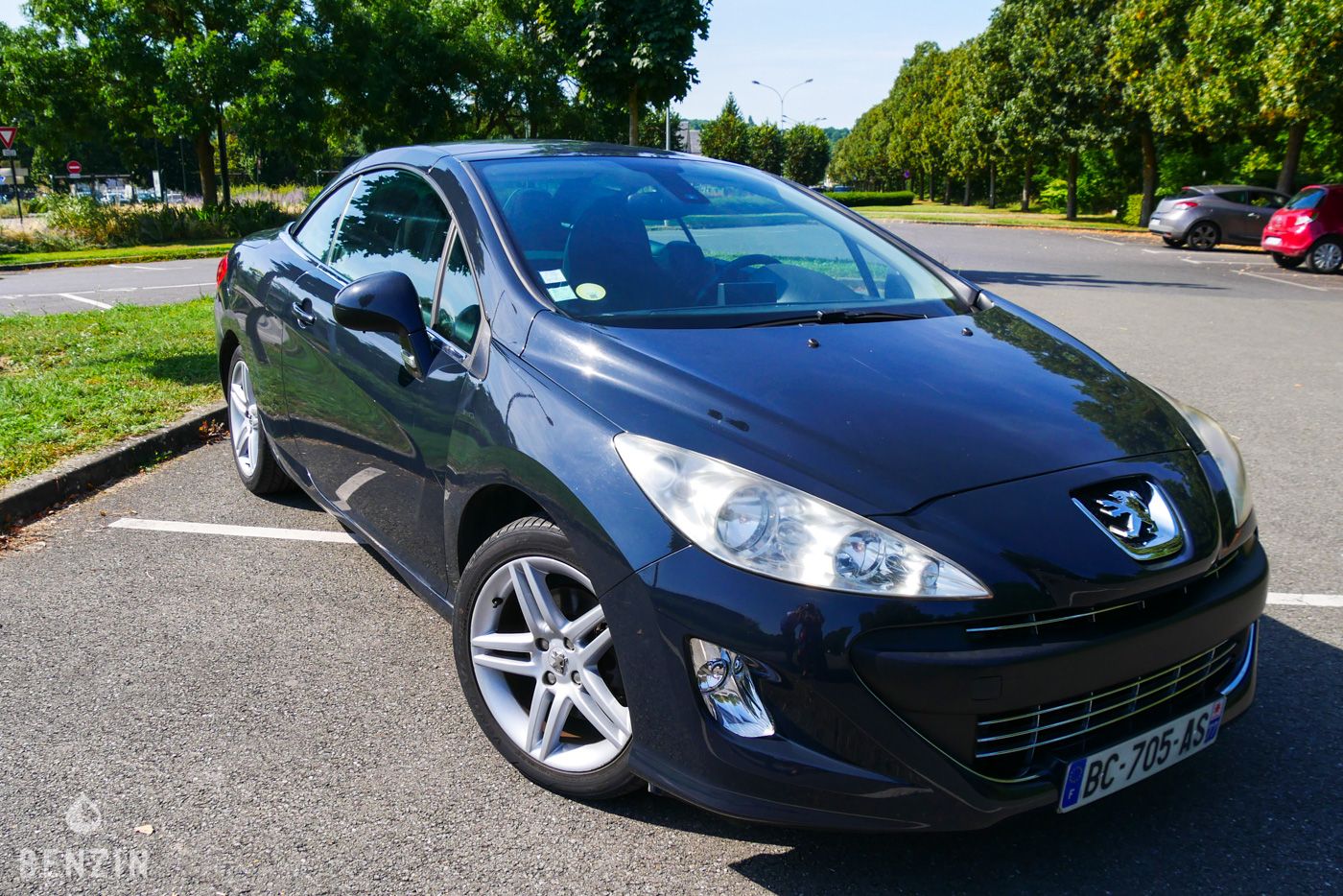
Unveiled in spring 2003, the Peugeot 307 CC transferred to the 307 compact the recipe introduced with the 206 CC: a coupé-cabriolet with a retractable hardtop, capable of offering a true closed silhouette without a fabric roof. The model is derived from the 307 three-door, with a wheelbase and structure adapted accordingly, a very steeply raked windscreen and a specific rear end designed to house the two-piece roof. As was often the case at Peugeot at the time, the project was carried out with Pininfarina, which also handled assembly. The 307 CC was launched with 1.6 16V and 2.0 16V petrol engines, soon joined in some markets by a 2.0 HDi, making it one of the few compact coupé-cabriolets of its time to offer a diesel engine. Its positioning is more upscale and more road-oriented than that of the 206 CC, with four seats announced, even if the rear seats are limited.
In 2005, the 307 CC adopted the updated 307 range, with a new front end, revised interior presentation and modernised equipment. Depending on the version and market, the range then received the 2.0 16V with 177 hp, better suited to the model’s high weight, while automatic transmissions remained mainly associated with the naturally aspirated 2.0. The car never had a sporty RC or GTi variant, and its career was not built on competition, but on the chic leisure image and all-season versatility offered by its steel roof. The 307 CC gradually left the stage with the arrival of the 308 CC, unveiled in 2008, which took up the same concept in a heavier, more prestigious form and with the new engines from the THP family.
Today, the 307 CC mainly appeals to fans of affordable modern cabriolets and loyal Peugeot enthusiasts, more for its cruising comfort than for any real sporting vocation. The most sought-after examples are well-maintained Phase 2 cars, especially the 2.0 petrol with manual gearbox, as well as the rare 2.0 177 hp versions, which are more balanced. Enthusiasts know, however, that the car requires close monitoring of the retractable roof, water ingress and comfort electronics, three topics that come up constantly in clubs, forums and specialist workshops. The 308 CC, which succeeded it, took over part of this clientele, but with an even more GT-oriented philosophy; that is why the 307 CC still holds a special place today as the lighter and simpler of the two.
Technical data
| 307 CC 1.6 16V | 307 CC 2.0 16V | 307 CC 2.0 16V 177 |
| Production years | 2003-2008 | 2003-2008 | 2005-2008 |
| Body style | 2-door coupé-cabriolet, 4 seats, retractable hardtop | 2-door coupé-cabriolet, 4 seats, retractable hardtop | 2-door coupé-cabriolet, 4 seats, retractable hardtop |
| Engine(s) | Inline 4-cylinder, petrol, 1587 cc, 16 valves | Inline 4-cylinder, petrol, 1997 cc, 16 valves | Inline 4-cylinder, petrol, 1997 cc, 16 valves |
| Power | 110 hp | 138 hp | 177 hp |
| Transmission | Front-wheel drive, 5-speed manual gearbox | Front-wheel drive, 5-speed manual gearbox or 4-speed automatic | Front-wheel drive, 6-speed manual gearbox |
| Weight | around 1,450 kg | around 1,500 kg | around 1,530 kg |
| 0-100 km/h | around 13 s | around 10.5 s | around 9 s |
| Top speed | around 190 km/h | around 205 km/h | around 220 km/h |
Buyer’s guide
The most recommendable versions are the Phase 2 cars, better finished and often better equipped, preferably the 2.0 petrol with manual gearbox for its good balance of reliability, refinement and performance. The 2.0 177 hp is the most desirable for an enthusiast, rarer and better suited to the car’s size. The 1.6 versions are suitable for relaxed driving, while the automatic versions with the AL4 gearbox require more caution; the 308 CC 1.6 THP 150, which took over from 2008, belongs to a different model and a different mechanical setup.
Points to watch
- Retractable roof : cycle interrupted, beep, fault message or boot refusing to lock; this concerns the entire production run. Several full opening and closing cycles should be checked, with the engine running, on level ground, and you should ask whether sensors, rams or the roof ECU have already been replaced.
- Boot and hinge wiring looms : broken wires in the cable runs, causing faults with the roof, boot lock, number plate lights or third brake light. This is a classic issue on cabriolets of this type; inspect the looms at the hinges and ask whether a lasting repair has been carried out.
- Water ingress : moisture in the spare-wheel well, damp carpets, recurring misting or electrical faults after rain. The roof seals, water drains and boot sealing are sensitive points; lift the boot mats and check for water marks or corrosion.
- Frameless windows and indexing : windows that do not lower properly, rise crookedly or no longer press correctly against the seals, causing wind noise or water ingress. The fault appears especially with age; check that the movement is correct every time a door is opened and that the mechanism is not binding.
- AL4 automatic gearbox : jerks, harsh shifts, flashing snow/sport lights or limp mode on the 2.0 automatics. A proper fluid change and solenoids already replaced are good signs; otherwise, caution is advised.
- Front suspension : knocking from link rods, top mounts or bushings, uneven tyre wear and a vague feel under braking. The coupé-cabriolet’s weight wears this suspension faster than on a 307 saloon; on a bumpy road, the front end should not knock or pull.
- EW/TU petrol engines : ignition coils, thermostat housings and small coolant leaks often reappear over the years, especially if the car is driven little. On the 2.0, you should also make sure there is no mayonnaise-like sludge, no abnormal temperature rise and no temperamental fan.
- Body electronics (BSI/COM2000) : erratic wipers, indicators, horn or steering-wheel controls on cars from the early 2000s. A diagnostic scan can reveal stored faults linked to a past water ingress or unstable power supply.
When buying
On a 307 CC, the key is to check the roof’s operation in real-world conditions, several times in a row, then carefully inspect the boot, seals and carpets to detect any leaks. A Peugeot or compatible diagnostic scan is particularly useful for reading faults from the roof ECU, the BSI and, if applicable, the AL4 gearbox. The most telling invoices are those relating to the roof system, wiring repairs, sealing gaskets and, mechanically, the timing system and cooling circuit.
1 of the 1 Peugeot 307 CC listed on Benzin found a buyer — 100 % of completed sales.
No Peugeot 307 CC is for sale at the moment. Follow the model to be notified as soon as a new one is listed.
Every vehicle comes with a detailed photo report, its history and the public exchanges between seller and community. You bid online; if you win, Benzin secures the payment and supports you through to delivery.
Follow the model from this page and you will get an e-mail as soon as a Peugeot 307 CC is listed on Benzin.
 English
 Français
 Español
 Italiano
 Deutsch
 Polski
 Magyar
