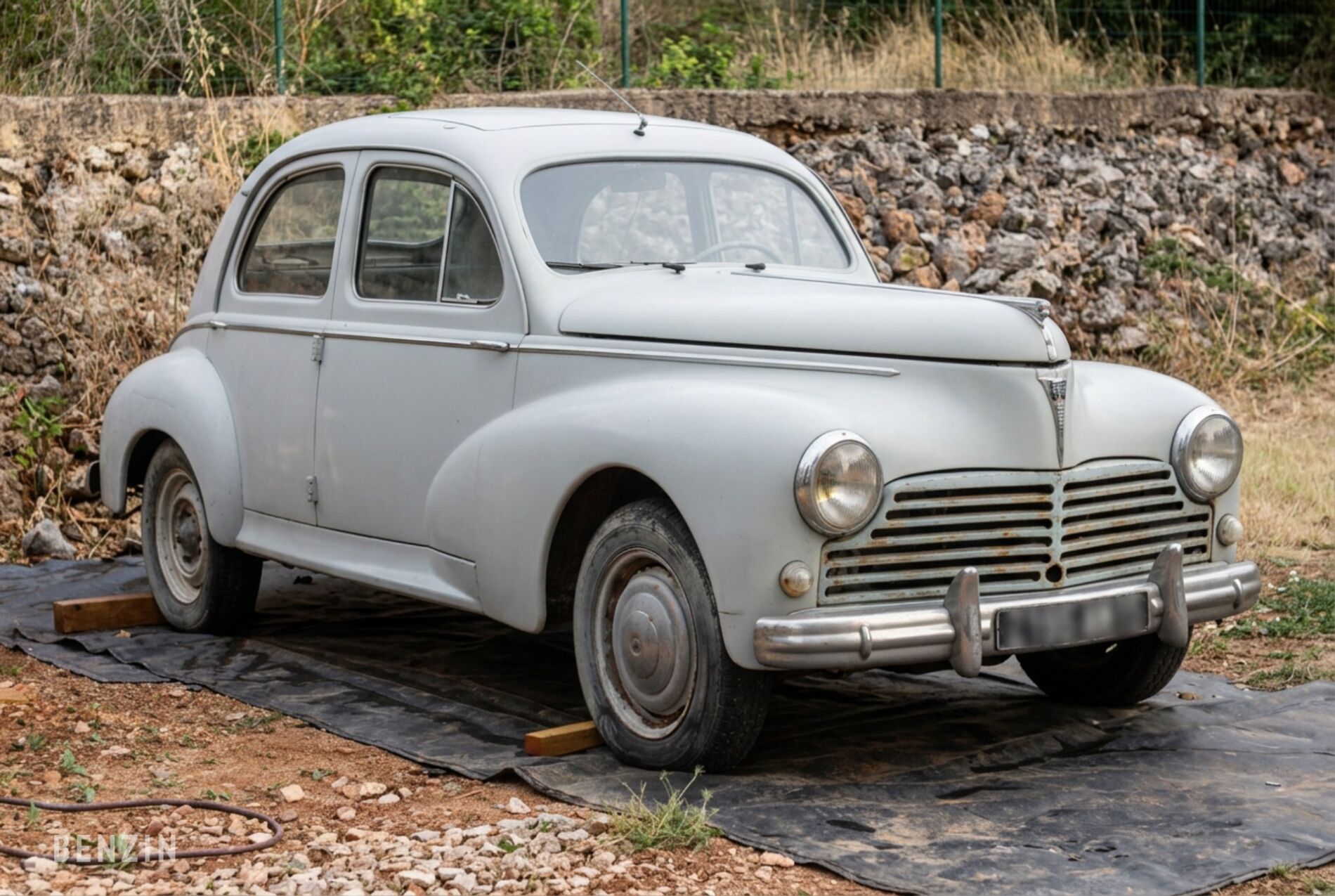
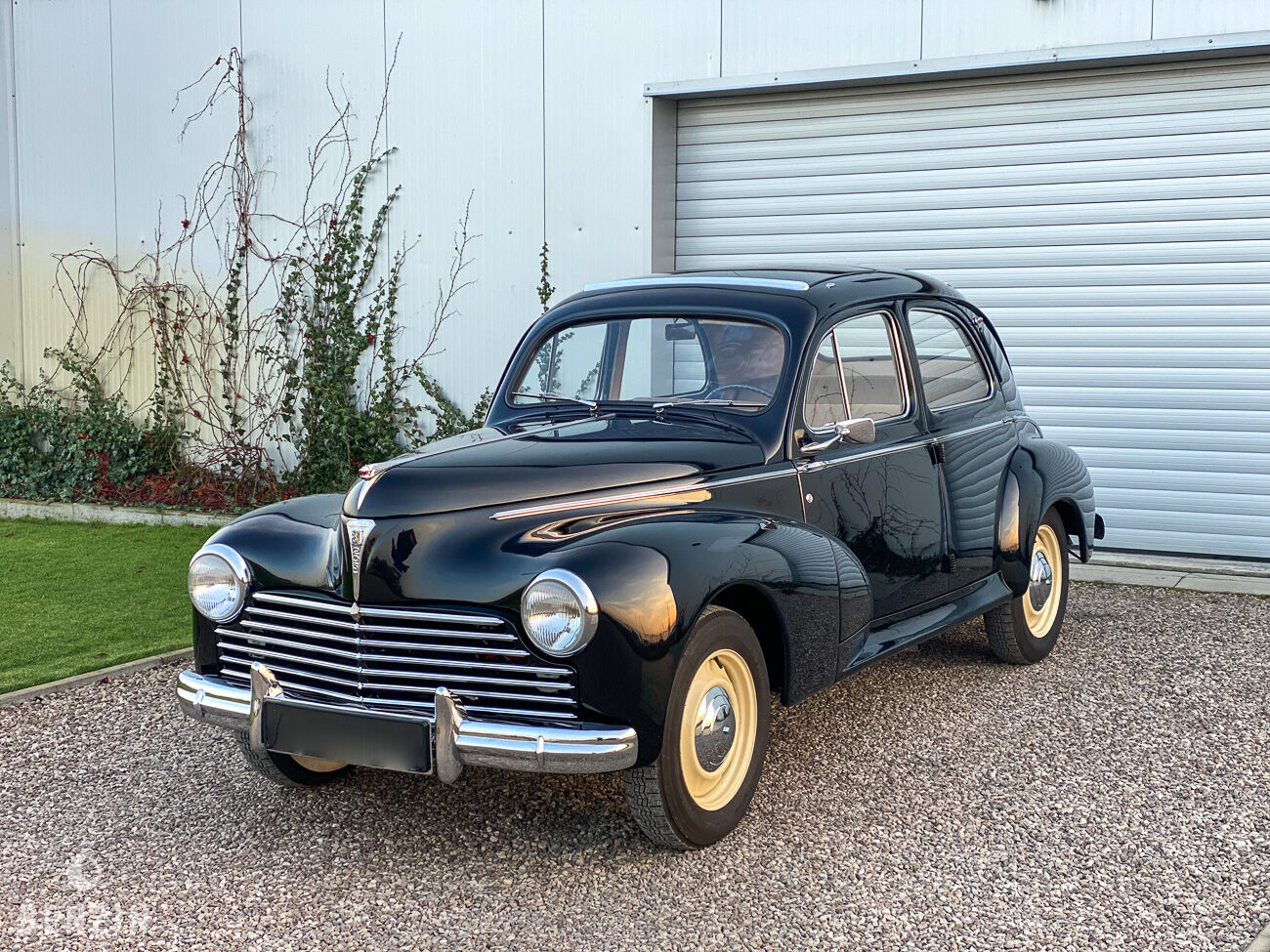
Presented at the 1948 Paris Motor Show and launched immediately afterward, the Peugeot 203 is Peugeot’s first entirely new post-war car and the model that truly relaunched the brand in Sochaux. Its fastback pontoon styling, designed in-house in a style strongly influenced by late-1940s American aerodynamics, stands in sharp contrast to the pre-war 202 and 402. The 203 adopted a monocoque body, independent front suspension and a 1,290 cc four-cylinder engine with an alloy cylinder head and hemispherical combustion chambers, an ambitious design for a French family car at the time. The four-speed manual gearbox, operated from the steering column, also contributed to its modern character, even if the early cars remained more delicate to set up and drive than the later ones. Very early on, the range expanded to include a saloon, open-top version, convertible, family car, commercial and utility models, which explains its lasting presence in 1950s France. The 203 A of 1950 brought several detail and reliability improvements, then the 203 C, introduced in the middle of the decade, further refined the styling and certain equipment.
The mechanical layout changed little in principle, but tuning improved, with a slightly livelier engine and an overall better-finished car on the later series. Convertibles and open-top versions are now the most visible variants at gatherings, but the saloon remains the model’s historical core and the one enthusiasts most often seek for driving thanks to its versatility. The 203 also built its reputation in regularity trials, rallies and long-distance runs, where its robustness, endurance and economy were heavily relied upon. Its career lasted until 1960, even as the 403 gradually replaced it on the market. Total production exceeded 680,000 examples, making it a major success for Peugeot. Today, the 203 is appreciated for its historical importance, its relaxed driving character, the decent availability of wear parts and a very active community of enthusiasts, but strictly original cars and special-bodied versions have become significantly harder to find.
Technical sheet
| Version | 203 | 203 A | 203 C |
| Production years | 1948-1950 | 1950-1954 | 1954-1960 |
| Body style | Saloon, open-top, convertible, family car, commercial, utility | Saloon, open-top, convertible, family car, commercial, utility | Saloon, open-top, convertible, family car, commercial, utility |
| Engine | Inline 4-cylinder, 1,290 cc | Inline 4-cylinder, 1,290 cc | Inline 4-cylinder, 1,290 cc |
| Power | approx. 42 hp | approx. 42-45 hp | approx. 45 hp |
| Transmission | Rear-wheel drive, 4-speed manual gearbox | Rear-wheel drive, 4-speed manual gearbox | Rear-wheel drive, 4-speed manual gearbox |
| Curb weight (saloon) | approx. 930-980 kg | approx. 930-980 kg | approx. 950-990 kg |
| Top speed | approx. 110-115 km/h | approx. 115 km/h | approx. 115-120 km/h |
| Total production of the model | more than 680,000 examples |
Buyer’s guide
For regular use, the 203 A and especially the 203 C are generally the most recommended: they benefit from more refined tuning, a more consistent presentation and a better identified parts supply thanks to their wider production. The very first 203s appeal to purists, but they often require more model knowledge and an incomplete or long-immobilized car can quickly become time-consuming. Convertibles, open-top versions and family models are highly desirable, but a sound, correct saloon often remains the best balance between historical interest, ease of recommissioning and running costs.
Points to watch
- Monocoque body : frequent corrosion of the sills, floors, body mounts, spare-wheel well and front suspension mounting points; all 203s are affected, and a poorly done old repair can compromise panel alignment. The underside, the inside of the chassis rails and the quality of the welds should be inspected rather than just the exterior appearance.
- Cooling system : overheating, mayonnaise-like sludge or signs of leaks around the cylinder head on the 1.3-liter engine, especially on a car that is little used or has been standing for a long time. Check the condition of the water pump and radiator, the absence of sludge in the system, and ask whether the cylinder head has ever been properly removed.
- Wet-liner engine : seepage, loss of compression or water in the oil can come from cylinder liner base seals or from an imperfect older rebuild. On a 203 that has been off the road for a long time, it is wise to check compression and the stability of oil pressure once the engine is hot.
- Gearbox and steering-column shift : imprecise shifts, crunching and reluctant selection are often linked to wear in the bushes, linkages and synchronizers, especially on high-mileage cars. A vague lever is not unusual, but a gearbox that jumps out of gear or grates noticeably needs more extensive work.
- Rear axle and drivetrain : humming under load or on overrun, seepage at the differential nose and noticeable play in the drivetrain are classic owner complaints. On a test drive, listen to the axle at steady speed and then on acceleration, because a proper rebuild is more specialized than routine maintenance.
- Lockheed brakes : seized wheel cylinders, leaking master cylinder and contaminated linings are very common after a long period off the road. A pedal that sinks, a car that pulls under braking or drums that are very hot after a few kilometers mean the whole system needs to be overhauled rather than just one part replaced.
- Front axle and steering : wear in the kingpins, bushes and joints, with vague steering and uneven tire wear. The 203 should retain slow but sound steering; if it wanders or knocks on rough roads, the kingpins and the mounting of the front axle to the body should be closely inspected.
- 6-volt electrical system : difficult starts, weak charging and feeble lighting often come from a tired wiring loom, poor grounding or a regulator/dynamo that is badly adjusted. On this model, a 6-volt system in good condition works properly; a bodged installation or accessories added without method quickly make use more complicated.
When buying
On a Peugeot 203, it is particularly useful to note the chassis and engine numbers and to check that they match the period claimed, especially on older cars that have been restored or assembled from several examples. A car that has been immobilized for years deserves at least a compression check, oil pressure check, cooling system check and a full brake system inspection before any serious recommissioning. Invoices for cylinder head, gearbox, axle and structural bodywork repairs are more valuable than a simple repaint, because these are the most significant jobs on this model.
2 of the 2 Peugeot 203 listed on Benzin found a buyer — 100 % of completed sales.
No Peugeot 203 is for sale at the moment. Follow the model to be notified as soon as a new one is listed.
Every vehicle comes with a detailed photo report, its history and the public exchanges between seller and community. You bid online; if you win, Benzin secures the payment and supports you through to delivery.
Follow the model from this page and you will get an e-mail as soon as a Peugeot 203 is listed on Benzin.
 English
 Français
 Español
 Italiano
 Deutsch
 Polski
 Magyar
