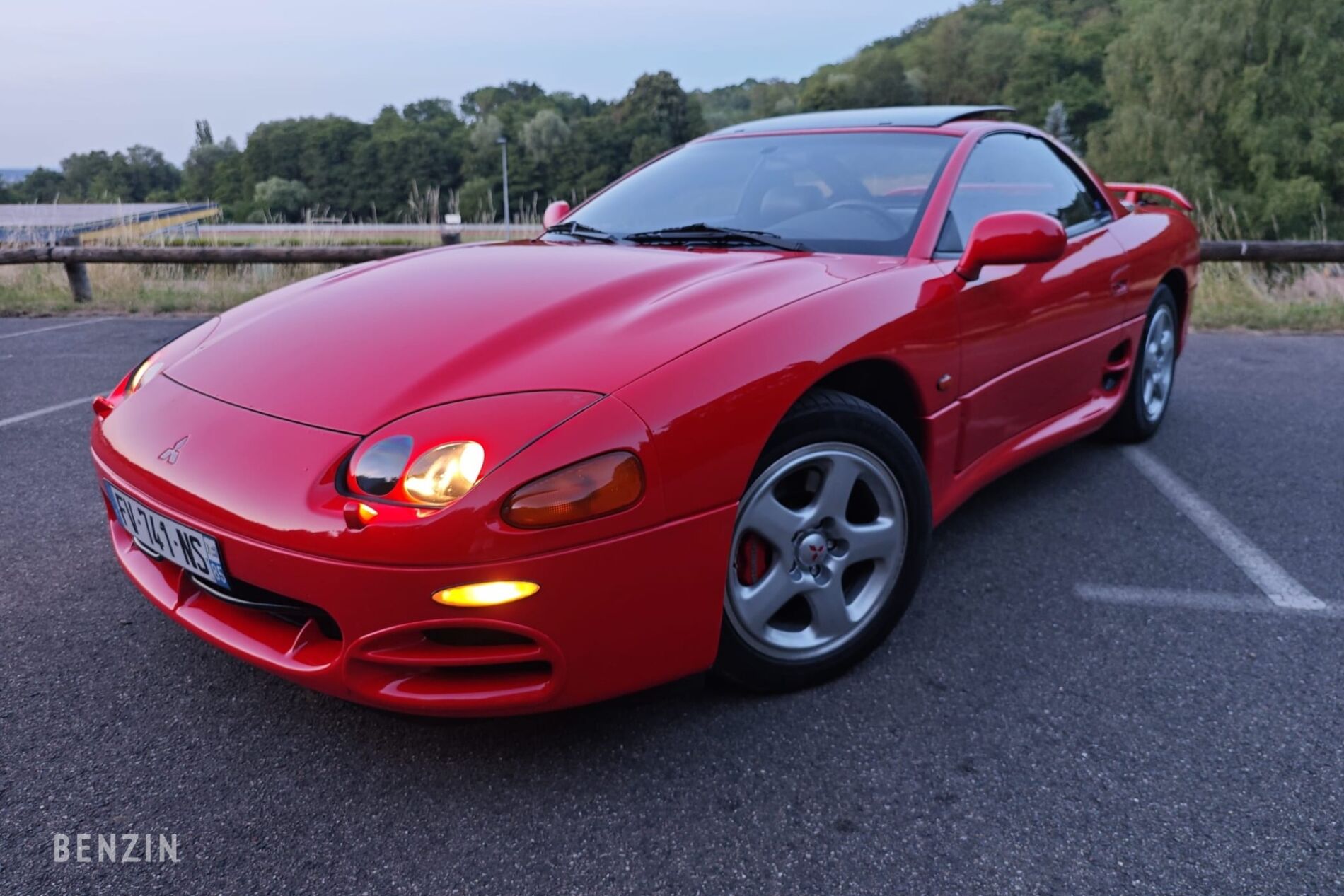
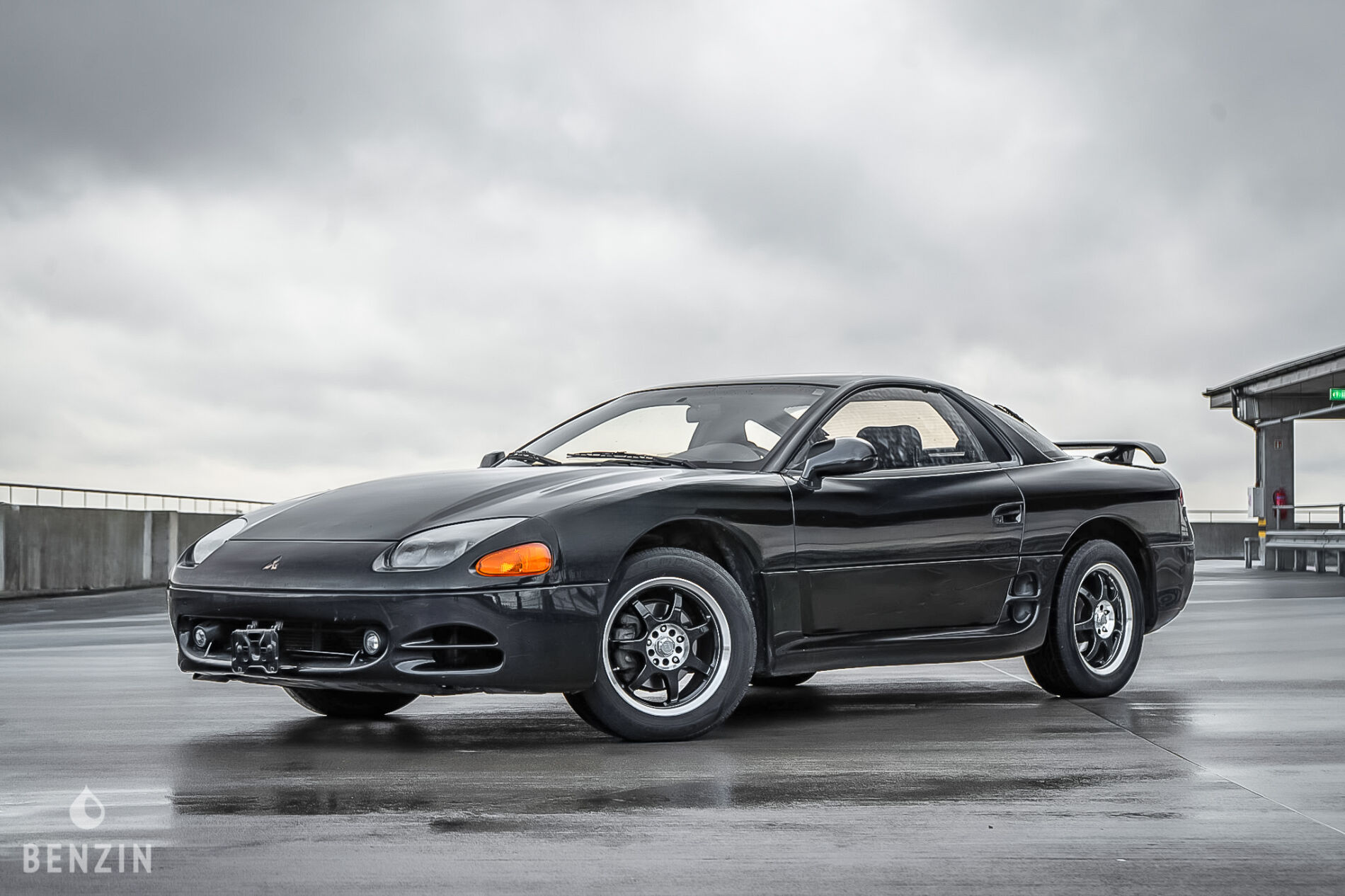
Introduced in Japan in 1990 under the name GTO, then sold in Europe and North America as the Mitsubishi 3000 GT, Mitsubishi’s large sports car was born at the height of Japan’s technological bubble. Developed alongside the Dodge Stealth as part of the alliance with Chrysler, it aimed at the high-performance Grand Touring coupe segment then dominated by the Nissan 300ZX, Toyota Supra, and Mazda RX-7. Its very smooth styling, wide stance, and richly equipped cabin clearly herald the 1990s, with an unusual level of electronics for the time. From launch, the range centered on a naturally aspirated 3.0-liter 24-valve V6 and, at the top, the VR-4 Twin Turbo with all-wheel drive, four-wheel steering, active suspension, and active aerodynamics. Early examples can be recognized by their pop-up headlights, replaced during the mid-cycle facelift by more modern fixed headlights that were simpler to maintain.
Depending on the market, there are front-wheel-drive versions, better-equipped naturally aspirated SLs, and the very sophisticated twin-turbo VR-4s, generally producing around 280 to 320 hp depending on the years and local regulations. Changes mainly concern styling, wheels, gearboxes, equipment, and a few reliability improvements, notably the hydraulic lifters on the V6s. In North America, Mitsubishi also offered the rare 3000 GT Spyder with an electrically retractable hardtop, now very uncommon. Although the 3000 GT did not build its image on a major endurance or rally program like some rivals, it left its mark on its era through its abundance of technology and its recurring presence in 1990s car culture. It is also associated with the image of Japanese “GT” sports cars from the era of consoles, tuners, and specialist magazines.
Today, the 3000 GT appeals to enthusiasts of modern Japanese cars looking for a true fast grand tourer, different from more common coupes. Original VR-4s, lightly modified and with all systems functioning, are the most sought after, while the naturally aspirated versions attract buyers thanks to their generally more reasonable running costs. Heavily modified cars, long common, are viewed with caution by experts because of the strain imposed on the drivetrain and cooling system.
Technical specifications
| 3000 GT 3.0 24V | 3000 GT SL | 3000 GT VR-4 Twin Turbo |
| Production years | 1990-1999 depending on market | 1990-1999 depending on market | 1990-1999 depending on market |
| Body style | 2+2 coupe | 2+2 coupe | 2+2 coupe |
| Engine | 60° V6, 2,972 cc, 24 valves | 60° V6, 2,972 cc, 24 valves | 60° V6, 2,972 cc, 24 valves, twin turbo |
| Power | approx. 220-225 hp | approx. 220-225 hp | approx. 280-320 hp |
| Transmission | Front-wheel drive, 5-speed manual or automatic depending on version | Front-wheel drive, 5-speed manual or automatic depending on version | All-wheel drive, 5/6-speed manual depending on year |
| Weight | approx. 1,600 kg | approx. 1,650 kg | approx. 1,720 to 1,780 kg |
| 0-100 km/h | approx. 7.0 s | approx. 7.0 s | approx. 5.5 to 6.0 s |
| Top speed | approx. 235-240 km/h | approx. 235-240 km/h | approx. 250 km/h |
| Features | Well-equipped grand tourer | High-end naturally aspirated version | Four-wheel steering, ECS suspension, active aero depending on year/market |
Buyer’s guide
The VR-4 is the iconic version, to be preferred if it is strictly original or very lightly modified, with a healthy drivetrain and all electronic systems operational. For more peace of mind, a naturally aspirated SL in good condition often offers the best compromise between performance, comfort, and mechanical complexity. Heavily modified examples, those boosted beyond stock, or those with improvised electronic accessories are the ones that require the most caution.
Points to watch
- Getrag manual gearbox and AWD drivetrain : worn 2nd and 3rd gear synchros, bearing whine, or crunching when shifting on VR-4s, especially if the car has been modified or used with repeated standing starts; check shifting both cold and hot and ask whether the gearbox or transfer case has ever been rebuilt.
- Transfer case : on all-wheel-drive versions, leaks and failures have been the subject of campaigns in some markets; check for any seepage, play, or noise from the front drivetrain side, and ask for proof of an intervention or replacement if applicable.
- Hydraulic lifters : top-end ticking at idle is common on early model years; this is not rare on the 3.0 V6s, but it is important to know whether the improved-generation lifters have been fitted.
- Timing belt : the 6G72 V6 does not tolerate a neglected timing belt, and the water pump is often done at the same time; on all versions, ask for a dated invoice for the belt, idlers, and water pump, not just a verbal mention.
- ECS electronically controlled suspension : on cars equipped with Tour/Sport mode, electronically controlled dampers, sensors, and the ECS warning light can cause problems, with expensive or hard-to-find parts; check the operation of the selector and the absence of a persistent warning.
- Four-wheel steering : on versions equipped with it, a hydraulic leak, vague rear-end behavior, or a disabled system are not uncommon; inspect the lines, the boots, and ask whether the system is still active.
- Active aerodynamics : the motorized front spoiler and movable rear wing can seize up or be disconnected on some VR-4s; visually check their deployment and ask whether the motors, sensors, or wiring looms have already been repaired.
- Corrosion of sills and lifting points : despite often flattering presentation, the sills, jacking points, and rear wheel arch edges deserve a targeted inspection, especially on cars from humid climates or imported from salty regions.
When buying
On a VR-4, a compression test, a diagnostic scan of the ECS/AWS systems if the car is equipped with them, and a check of the active aero operation are particularly relevant. Full timing belt, clutch, gearbox, or transfer case invoices are worth more here than a simple stamped service book. For imported examples, the mileage consistency between miles and kilometers should also be checked, as well as the history of transmission campaigns or repairs.
On Benzin a Mitsubishi 3000 GT has sold for 9 117 € on average, with a median price of 11 000 €. Based on the 3 sales completed on the platform.
The 3 Mitsubishi 3000 GT sold on Benzin changed hands for between 1 350 € and 15 000 €, depending on condition, mileage and version.
3 of the 8 Mitsubishi 3000 GT listed on Benzin found a buyer — 38 % of completed sales.
No Mitsubishi 3000 GT is for sale at the moment. Follow the model to be notified as soon as a new one is listed.
Every vehicle comes with a detailed photo report, its history and the public exchanges between seller and community. You bid online; if you win, Benzin secures the payment and supports you through to delivery.
Follow the model from this page and you will get an e-mail as soon as a Mitsubishi 3000 GT is listed on Benzin.
 English
 Français
 Español
 Italiano
 Deutsch
 Polski
 Magyar
