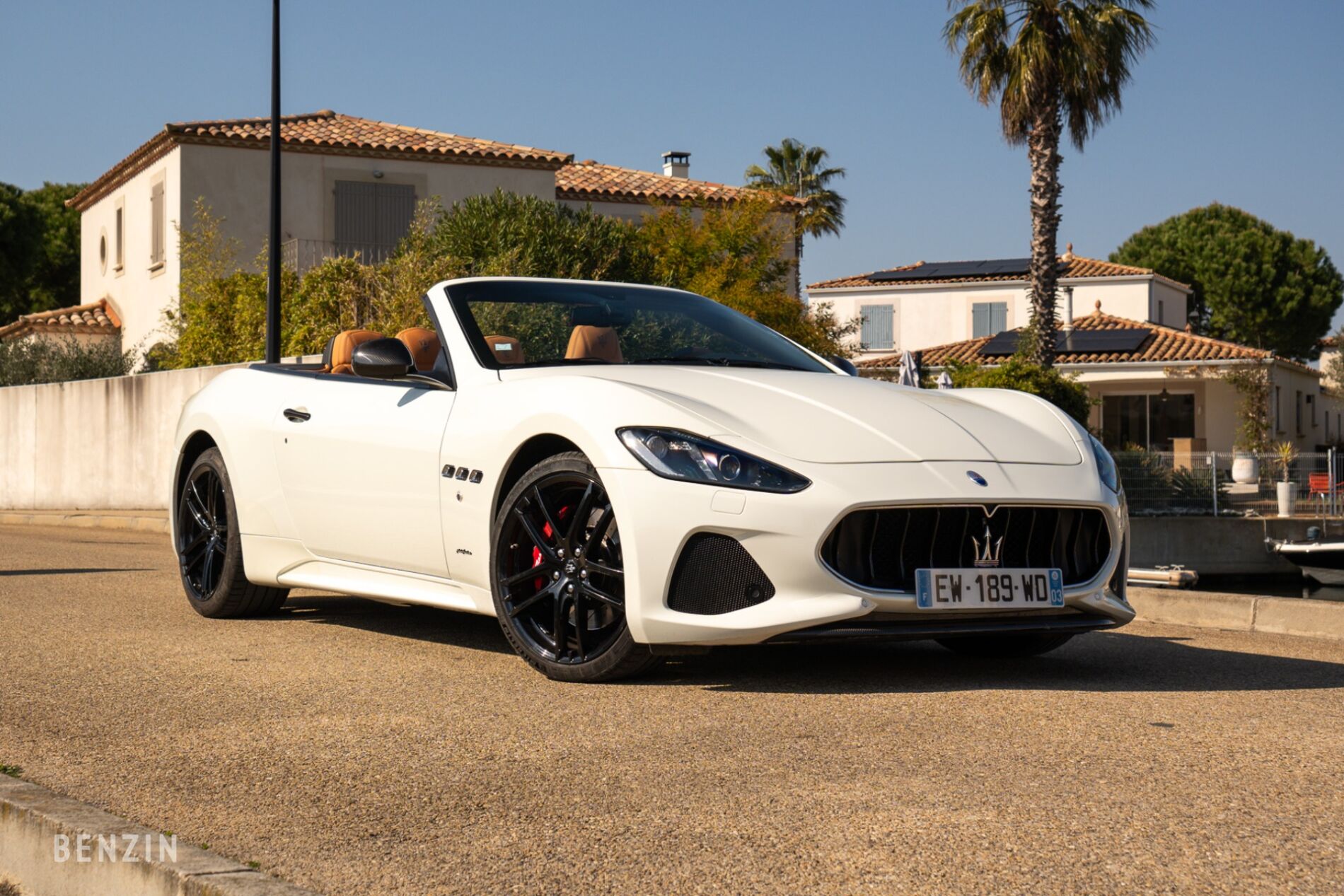
Introduced in 2009 and sold from 2010, the Maserati GranCabrio is the convertible version of the GranTurismo, on the same front-engine, rear-wheel-drive V8 platform. Its design is by Pininfarina, with a multi-layer fabric soft top rather than a hardtop, a coherent choice for a long-distance 2+2 grand convertible. By its dimensions, wheelbase, and four real seats, it established itself as one of the few Italian open GTs of this size in the early 2010s. Launch came with the 4.7-liter naturally aspirated V8 from the F136 family, derived from engines developed by Ferrari and Maserati, paired with a 6-speed ZF automatic gearbox. From the outset, the model favored comfort and sound over outright aggression, with a more touring than pure sports-car character. The GranCabrio Sport version then appeared with power increased to 450 hp, revised suspension and exhaust settings, and a quicker shift mode. In some markets, the range was later expanded with a GranCabrio MC featuring a more assertive look, inspired by the Maserati Corse world, without changing the model’s GT mission.
In 2017, the range received a styling and aerodynamic update similar to that of the facelifted GranTurismo, with a new front end, infotainment improvements, and a modernized interior presentation. The last GranCabrio Sport models sold in 2018 belong to this late phase, generally regarded as the most accomplished for regular use thanks to sharper tuning and less dated multimedia equipment. The first-generation model’s career ended in the late 2010s, well before the return of the GranCabrio name on a new electrified or Nettuno generation, which belongs to a different model. Total production of this first series runs to a few thousand units, in volumes far lower than those of contemporary German convertibles. Among enthusiasts, the GranCabrio is sought after for its now rare combination of an Italian naturally aspirated V8, a true four-seat layout, and a very cohesive Pininfarina line both with the roof up and down. The most desirable examples are often late-production Sports, provided engine, roof, and running-gear maintenance has been carried out by specialists familiar with Maseratis powered by the F136 engine.
Technical data
| Version | GranCabrio 4.7 | GranCabrio Sport 4.7 | GranCabrio MC 4.7 |
| Production years | 2010-2017 | 2011-2019 | from 2013 depending on market |
| Body | 2+2 convertible, fabric soft top | 2+2 convertible, fabric soft top | 2+2 convertible, fabric soft top |
| Engine | 4.7-liter naturally aspirated V8 | 4.7-liter naturally aspirated V8 | 4.7-liter naturally aspirated V8 |
| Power | 440 hp | 450 hp | 460 hp |
| Torque | approx. 490 Nm | approx. 510 Nm | approx. 520 Nm |
| Transmission | Rear-wheel drive, 6-speed ZF automatic | Rear-wheel drive, 6-speed ZF automatic | Rear-wheel drive, 6-speed ZF automatic |
| Curb weight | approx. 1,980 kg | approx. 1,980 kg | approx. 1,980 kg |
| 0-100 km/h | approx. 5.4 s | approx. 5.2 s | approx. 4.9 s |
| Top speed | approx. 283 km/h | approx. 285 km/h | approx. 289 km/h |
| Production | total production of the series in the low thousands | total production of the series in the low thousands | total production of the series in the low thousands |
Buyer’s guide
Late-production GranCabrio Sport models are generally the most recommendable: they combine the 4.7-liter engine in its most appealing form, a better-finished interior, and a worthwhile multimedia update. Early 4.7s remain attractive if their history is clear, but cars that have been driven little and poorly maintained can accumulate more minor electrical and hydraulic issues. The MC stands out for its looks and power, but it does not necessarily deliver a proportionate increase in enjoyment on open roads.
Things to watch
- Roof and mechanism : slow operation, jerks, an error message, or a trunk lid that refuses to lock; this applies throughout the model’s life. Check full opening and closing several times, roof alignment, the condition of the struts, and the absence of oil traces in the trunk and behind the trim panels.
- Microswitches and frameless windows : windows that do not drop properly when the door is opened, poor sealing against the seals, or pronounced wind noise; common on convertibles used irregularly. Check that the windows index correctly, the roof locks properly, and the window regulators are calibrated.
- Water drainage and electrical modules : moisture in the trunk, persistent fogging, central locking or roof malfunctions; a known issue if the drains clog. Inspect the drain wells, trunk carpets, and connectors located low in the car.
- 4.7 F136 engine : unstable idle, engine warning light, ticking on cold start, or excessive oil consumption on a neglected example. Ask whether the spark plugs, coils, sensors, and cooling-system work were done on time, and absolutely listen to a cold start.
- ZF 6-speed gearbox : harsh shifts when cold, hesitation on downshifts, or jerks in manual mode; the gearbox is robust but sensitive to fluid that has never been changed. Check shift quality, ask for proof of a fluid change despite the period talk of “lifetime” oil, and check for any faults in diagnostics.
- Skyhook suspension and running gear : knocking over rough surfaces, leaking shock absorbers, worn control-arm bushings or unstable alignment; more common on heavy cars used in the city. Inspect tire wear, the condition of the adaptive dampers, and the amount already spent on the front suspension arms.
- Braking : scored discs, braking vibrations and rapid wear on cars that have been driven hard; consumables are expensive on a car of this size. Measure disc and pad thickness, especially on Sport and MC versions, which are often fitted with wider wheels and driven more dynamically.
- Interior and trim : sticky buttons, dashboard leather shrinking in the heat, degraded soft-touch controls; this is a classic issue on Maseratis from this period. Check whether specialist refurbishment has already been done, as the cosmetic condition can quickly affect perceived quality.
When buying
On this model, a diagnostic scan is particularly useful to read stored faults for the roof, gearbox, and adaptive suspension. You should also ask for invoices proving any major or costly work already carried out: ZF gearbox fluid change, soft-top system maintenance, replacement of control arms or shock absorbers, and work on the V8 cooling system. Finally, a test drive with a cold start followed by an on-site check of the roof operation is far more revealing than a simple static inspection.
0 of the 3 Maserati GranCabrio listed on Benzin found a buyer — 0 % of completed sales.
No Maserati GranCabrio is for sale at the moment. Follow the model to be notified as soon as a new one is listed.
Every vehicle comes with a detailed photo report, its history and the public exchanges between seller and community. You bid online; if you win, Benzin secures the payment and supports you through to delivery.
Follow the model from this page and you will get an e-mail as soon as a Maserati GranCabrio is listed on Benzin.

 English
 Français
 Español
 Italiano
 Deutsch
 Polski
 Magyar
