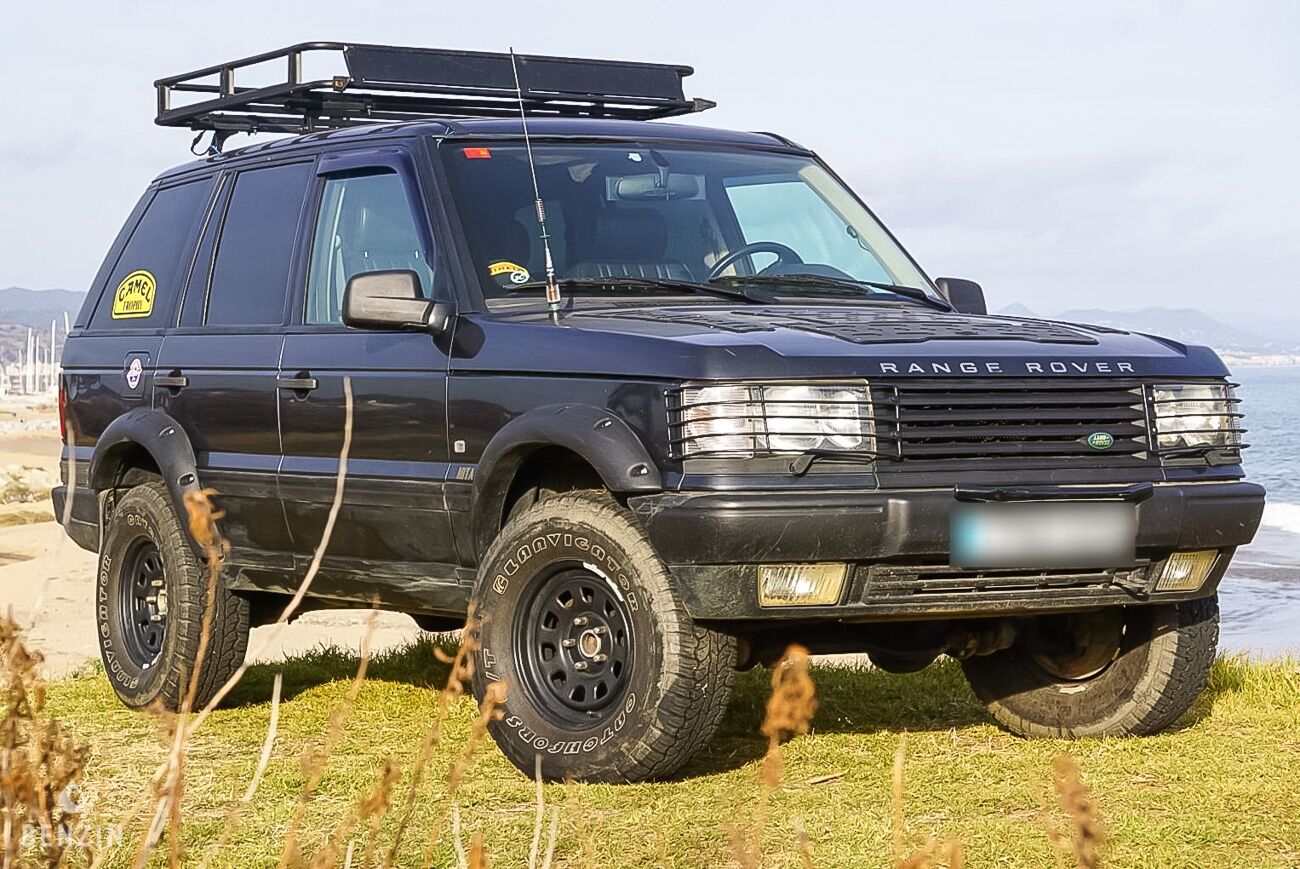
The Range Rover P38, often called P38A by specialists, is the second generation of Range Rover after the “Classic” and was assembled in Solihull from 1994 to 2002. Its code refers to building 38 at the Land Rover technical centre, a sign of a programme intended as a complete redesign rather than a simple facelift. The silhouette remains instantly recognisable, with its high waistline, floating roof and split tailgate, but the body is smoother and the cabin much more luxurious. The model was launched with standard electronic air suspension, a very ambitious feature for the time, and a centralised electronic architecture that contributes greatly to both its appeal and its reputation for complexity. Under the bonnet, it uses the Rover V8 in 4.0- and 4.6-litre form, while Europe also received the BMW 2.5-litre turbo Diesel six-cylinder. Depending on the market and engine, ZF automatic gearboxes were offered and, on some Diesels, a manual gearbox.
The range is built around trims such as SE, HSE, DSE and Vogue depending on the years and markets, with a clear improvement in interior presentation compared with the Range Rover Classic. In 1999, a major update brought, among other things, an evolution of engine electronics on the V8s, equipment revisions and, in some markets, improvements intended to make everyday use more reliable. The 4.6 is the flagship P38 version, sought after for its torque, refinement and ability to retain the very “wafting” character of the traditional Range Rover. The 4.0, a little less impressive but often considered easier to maintain, is now a well-liked compromise. The P38 did not have a true sporting career, but it strongly marked 1990s luxury SUV culture by combining genuine off-road ability with a level of comfort and refinement that was rare at the time. Produced in just over 160,000 examples, it now occupies a special place among enthusiasts: too modern to be rustic, still old enough to retain the spirit of the first Range Rovers, and very dependent on actual condition rather than mileage alone.
Technical data
| Feature | Range Rover P38 4.0 SE | Range Rover P38 4.6 HSE / Vogue | Range Rover P38 2.5 DSE |
| Production years | 1994-2002 | 1994-2002 | 1994-2002 |
| Body style | 5-door 4x4 | 5-door 4x4 | 5-door 4x4 |
| Engine | Rover petrol V8, 3,946 cc | Rover petrol V8, 4,554 cc | BMW M51 turbocharged inline 6-cylinder Diesel, 2,497 cc |
| Power | 190 hp | 225 hp | 136 hp |
| Torque | approx. 320 Nm | approx. 380 Nm | approx. 270 Nm |
| Transmission | Permanent four-wheel drive, 4-speed automatic gearbox | Permanent four-wheel drive, 4-speed automatic gearbox | Permanent four-wheel drive, manual or automatic gearbox depending on version |
| Suspension | Electronic air suspension EAS | Electronic air suspension EAS | Electronic air suspension EAS |
| Kerb weight | approx. 2,100 kg | approx. 2,150 kg | approx. 2,150 kg |
| 0 to 100 km/h | approx. 11 s | approx. 9.5 s | approx. 15 s |
| Top speed | approx. 177 km/h | approx. 196 km/h | approx. 165 km/h |
| Total model production | Just over 160,000 examples |
Buyer’s guide
For a collector-pleasure use, the late 4.0 SE and 4.6 Vogue/HSE models, especially after the 1999 update, are generally the most interesting: the 4.0 for its balance, the 4.6 for its very Range Rover-like character. Neglected 4.6s in terms of cooling are, however, the riskiest, and many enthusiasts are wary of examples converted to coil springs, a frequent sign of air suspension that was not properly repaired. The 2.5 DSE remains a sensible choice for those who drive regularly, but it offers neither the smoothness nor the mechanical prestige of the V8s.
Points to watch
- EAS air suspension : sagging after parking, slow rise, compressor running too long or dashboard error message; all years are affected; you must check the five ride heights, the air spring seals, the valve block condition and ask the date of replacement of the compressor or air springs.
- Rover V8 4.0/4.6 : overheating, pressurised cooling system, no mayonnaise but coolant consumption, misfires when hot; especially critical on the 4.6, known for head gasket issues but also for porous blocks or slipped liners; ask specifically whether the repair was a simple top-end rebuild or the fitting of reinforced top-hat liners.
- Cooling : tired radiator, weak viscous fan coupling, water pump, cracked expansion tank and lazy thermostat; on a P38 V8, a small cooling weakness can precede major engine damage; check temperature stability and invoices for a complete cooling-system refresh.
- BeCM and electrical supply : temperamental locking, battery drain, random immobilisation, erratic electric windows or seats; the central electronic box under the driver’s seat is sensitive to voltage drops and water ingress; check the condition of the sunroof drains and ask whether the remote radio receiver was replaced with the later version on early cars.
- HEVAC heating and air conditioning : warning symbol on the display, hot air on one side and cold on the other, erratic fan; blend flap motors and certain heater unit components are classic P38 issues; all functions must be tested, including recirculation, air conditioning and distribution.
- ZF automatic gearbox : harsh shifts, slipping, “gearbox fault” message or degraded behaviour, especially on cars that have towed; all V8s are affected; ask about any fluid changes, check for smooth shifts when hot and the absence of vibrations under acceleration.
- Water ingress and localised corrosion : damp carpets, corrosion on the lower tailgate, the boot floor or around the body mounting points; the P38 rusts less dramatically than its predecessor, but water in the cabin then creates costly electrical problems; inspect especially the lower tailgate, seals and drains.
- Front axle and steering : vague steering, vibrations, uneven tyre wear or knocking; ball joints, bushes, steering box and sometimes the front propshaft develop play on heavy cars with wide tyres; check front tyre wear and steering precision in a straight line.
At the time of purchase
On a P38, a visit to a Land Rover specialist diagnostic computer or a tool such as TestBook, Hawkeye or Nanocom is worth far more than a simple road test: it allows you to read EAS, HEVAC, gearbox and BeCM faults. On V8s, you should ask for detailed invoices for any work on the cylinder heads and cooling system, clearly distinguishing a simple top-end rebuild from a proper block solution if the vehicle has already overheated. A full check of the suspension’s operation both at rest and while driving, as well as verification that there is no moisture under the carpets and around the BeCM, are particularly important on this model.
2 of the 3 Land Rover Range Rover P38 listed on Benzin found a buyer — 67 % of completed sales.
No Land Rover Range Rover P38 is for sale at the moment. Follow the model to be notified as soon as a new one is listed.
Every vehicle comes with a detailed photo report, its history and the public exchanges between seller and community. You bid online; if you win, Benzin secures the payment and supports you through to delivery.
Follow the model from this page and you will get an e-mail as soon as a Land Rover Range Rover P38 is listed on Benzin.


 English
 Français
 Español
 Italiano
 Deutsch
 Polski
 Magyar
