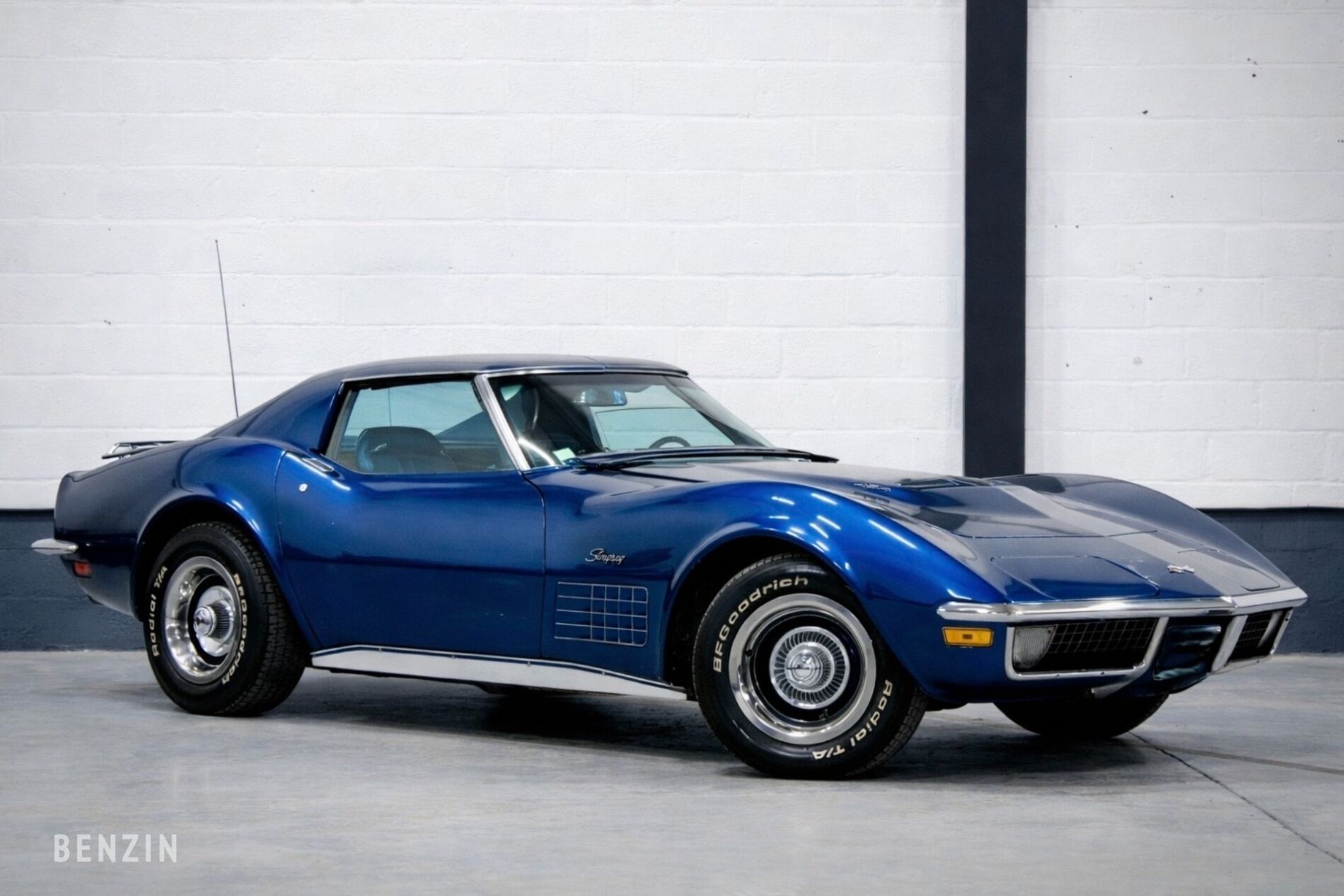
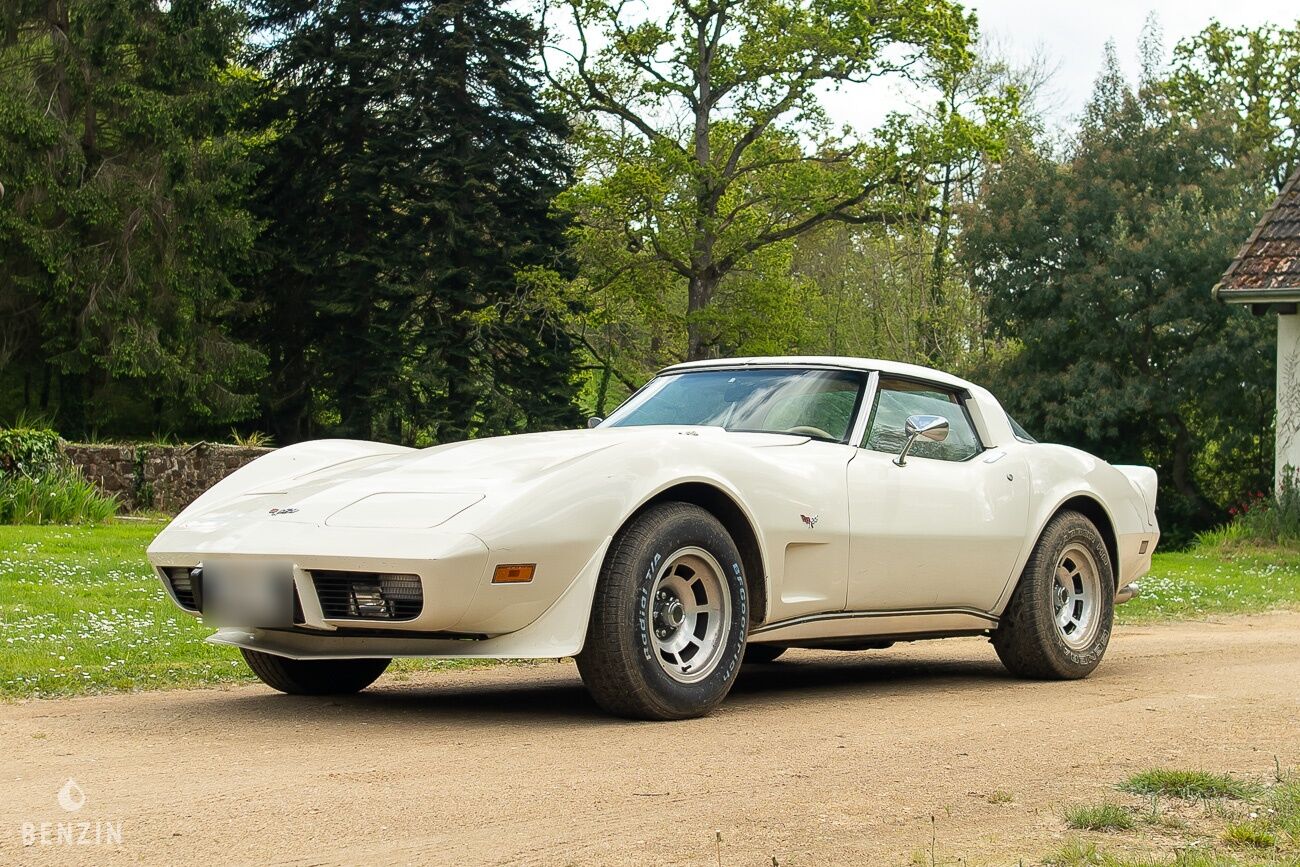
The Chevrolet Corvette C3, the third generation of Corvette, was launched for the 1968 model year and remained in production until 1982. Its spectacular styling derives directly from the Mako Shark II prototype, under the direction of Bill Mitchell, with body development overseen by Larry Shinoda, even though the detailed authorship of the design remains collective within GM. Lower, longer and more aggressive than the C2, it retained the separate steel chassis and fiberglass body, with pop-up headlights and a very enveloping cockpit. The early 1968-1972 years are now the most sought after for their pure lines, their big-block engine availability up to 454 ci and their power still measured under SAE gross ratings. In 1969, the “Stingray” name appeared as one word, then was dropped after 1976, whereas 1968 still used “Sting Ray” as two words. The 1973 model year marked an important transition with a shock-absorbing urethane front bumper, while the chrome rear remained for one more year. In 1974, both ends switched to urethane and the car entered its so-called “late C3” phase, more civilized but also progressively less powerful under the effect of emissions regulations and insurance constraints.
The mechanical range is vast, from the 350 ci small-block in multiple states of tune to the 427 and then 454 ci big-block, with highlights such as the early L71/L89, then especially the LS5, LS6 and the announced but never mass-produced LS7. After 1972, the advertised power drops sharply with the switch to SAE net ratings and the real decline in performance, with the 350-based L48 and L82 versions becoming the most common in the mid- and late 1970s. The 1978 model year, recognizable by its glass fastback rear window and the 25th Anniversary edition, revived commercial interest, while the Indy 500 Pace Car became one of the emblematic special series. In 1980 and 1981, the C3 received aerodynamic and weight-saving changes, then the final 1982 model year adopted Cross-Fire injection on the Collector Edition. In total, a little over 540,000 C3s were produced, making it by far the most widely built Corvette of its era. Today, it holds a central place in American car culture: the 1970-1972 big-blocks are the most coveted, the 1973-1974 cars still offer a good style/mechanics compromise, and the 1977-1982 models appeal through easier usability and availability. Names seen on the market such as “Targa” generally describe removable roof panels, while “Notchback” most often refers to a later conversion or kit, not a Chevrolet factory version.
Technical sheet
| Version | Corvette C3 454 LS5 | Corvette C3 350 L82 | Corvette C3 25th Anniversary |
| Production years | 1970-1974 | 1973-1980 | 1978 |
| Body | T-top coupe or convertible, 2 seats | T-top coupe or convertible, 2 seats | Fastback coupe with glass rear window or convertible, 2 seats |
| Engine(s) | 454 ci (7.4 l) big-block V8 | 350 ci (5.7 l) small-block V8 | 350 ci (5.7 l) small-block V8 L48 or L82 depending on option |
| Power | up to 365 hp SAE net depending on model year | up to 250 hp SAE net depending on model year | 185 hp SAE net in L48, 220 hp SAE net in L82 |
| Transmission | Rear-wheel drive, 4-speed manual or 3-speed automatic | Rear-wheel drive, 4-speed manual or 3-speed automatic | Rear-wheel drive, 4-speed manual or 3-speed automatic |
| Weight | about 1,550-1,650 kg | about 1,500-1,600 kg | about 1,500-1,600 kg |
| 0-100 km/h | about 6 to 7 s | about 7.5 to 9 s | about 8 to 9.5 s depending on engine and gearbox |
| Top speed | about 210 to 240 km/h | about 200 to 220 km/h | about 195 to 220 km/h depending on engine |
| Production | included in total C3 production, a little over 540,000 units | included in total C3 production, a little over 540,000 units | commemorative series for the 1978 model year, integrated into annual production |
Buyer’s guide
For pure collecting, the 1969-1972 cars with high-performance small-blocks or big-blocks remain the most desirable, and a properly documented 1971 454 is one of the major versions. For the best balance of style, enjoyment and usability, the 1973-1979 small-block cars, especially authenticated L82s, are often the most coherent choice. However, caution is needed with cars whose designation is vague or reconstructed, especially poorly documented “L82”s and “Notchback” cars, which generally do not correspond to a factory configuration.
Points to watch
- Birdcage : hidden corrosion of the steel structure embedded under the fiberglass, especially at the windshield base, cowl, pillars, floors and front mounts; a known issue on all C3s, particularly cars stored outside; ask for photos under the carpets, at the base of the A-pillars and around the door hinges.
- Chassis and body mounts : rust in the frame, rear crossmembers and body mounting points; common on cars from the northern United States or poorly repaired cars; check the condition of the body bushings and for perforation hidden by a simple underseal coating.
- Rear trailing arms : wear in the trailing arm bearings, play in the pivots and leaks around the integrated parking brake; a classic weakness of C2/C3s; check for bearing noise, abnormal camber and invoices for rear arm refurbishment.
- Headlight and wiper vacuum : slow pop-up headlights or ones that drop back down, temperamental wiper doors on early model years; typical of aging vacuum hoses, actuators and reservoirs; check operation with the engine off a few minutes after pressurizing.
- Small-block L48/L82 : frequent confusion between versions, especially on 1977-1980 cars where the power gap is significant; a simple badge or air cleaner is not enough; check the engine suffix, build sheet, option label and VIN/date-code consistency.
- Big-block 454 : overheating, cracked manifolds and heat-worn peripherals on 1970-1974 cars; on a 1971 454, check the radiator, shroud, water pump, signs of overheating and whether the engine matches its original code.
- TH350/TH400 automatic and manual gearbox : soft shifts, leaks and poorly adjusted kick-down on automatics, worn 2nd/3rd synchros on Muncie manuals; a recurring issue on cars that have been driven little or left standing; ask whether the gearbox has been rebuilt and check for jerks when hot.
- Instrumentation and accessories : gauges, clock, air conditioning and power windows can work intermittently because of grounds, wiring and the dashboard circuit board; common on late C3s; test all instruments one by one, not just the lighting.
When buying
On a C3, the decisive inspection is the birdcage and the chassis on a lift, with photos of hidden areas if the carpets cannot be removed. For a version advertised as L82, 454, 25th Anniversary or any other specific variant, the VIN, engine/transmission codes, casting dates and, if possible, the build sheet or original option label must be checked. A compression test and verification of the vacuum-operated equipment are particularly useful on this model, as is consistency between the miles-only odometer, registration history and import documents or French registration papers.
On Benzin a Chevrolet Corvette C3 has sold for 19 210 € on average, with a median price of 16 800 €. Based on the 5 sales completed on the platform.
The 5 Chevrolet Corvette C3 sold on Benzin changed hands for between 14 000 € and 28 800 €, depending on condition, mileage and version.
5 of the 9 Chevrolet Corvette C3 listed on Benzin found a buyer — 56 % of completed sales.
No Chevrolet Corvette C3 is for sale at the moment. Follow the model to be notified as soon as a new one is listed.
Every vehicle comes with a detailed photo report, its history and the public exchanges between seller and community. You bid online; if you win, Benzin secures the payment and supports you through to delivery.
Follow the model from this page and you will get an e-mail as soon as a Chevrolet Corvette C3 is listed on Benzin.

 English
 Français
 Español
 Italiano
 Deutsch
 Polski
 Magyar