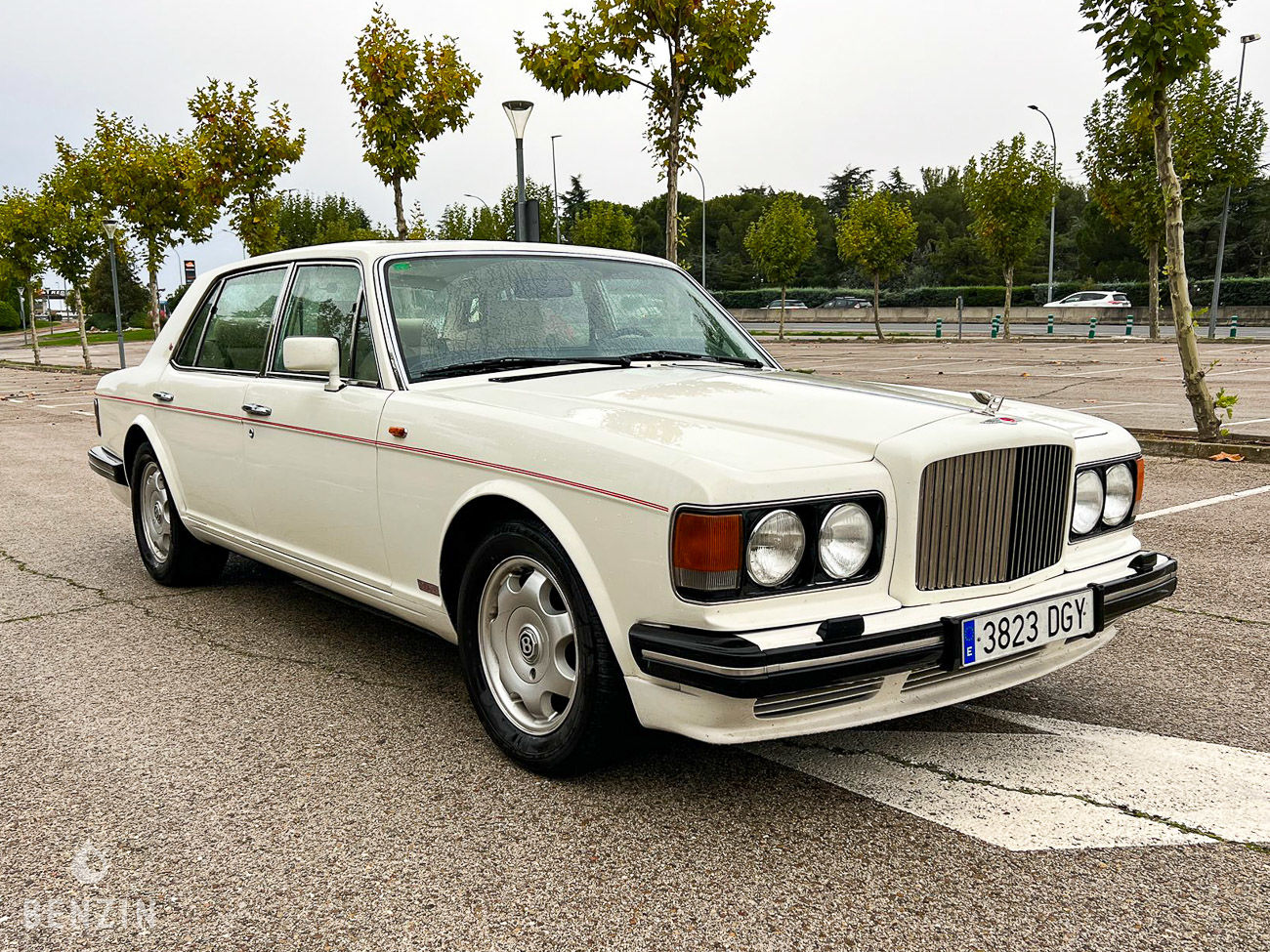
Introduced in 1985, the Bentley Turbo R is the model that truly revived Bentley’s sporting image during the Rolls-Royce Motors era, using the SZ family derived from the Mulsanne as its base. The “R” stands for “Roadholding”, because the idea was not simply to add a turbocharger to the in-house 6.75-liter V8, but to transform road manners through suspension, steering and tire settings that were far more ambitious than those of the Mulsanne Turbo. Its styling remains that of the classic Crewe three-box saloon, very close to contemporary Rolls-Royce Silver Spirit and Bentley Mulsanne models, but with a more muscular presentation and a less subdued personality. Very quickly, the Turbo R established itself as the Bentley of the 1980s and 1990s, capable of remarkable acceleration for a limousine weighing more than two tons.
Throughout its career, the Turbo R retained the alloy pushrod Bentley/Rolls-Royce V8, fuel-injected and turbocharged, while the automatic transmission evolved from the robust three-speed GM Turbo-Hydramatic to a four-speed GM unit on later cars. The car evolved in small steps rather than through major changes, with improvements to engine management, equipment, braking, suspension and trim, as well as the arrival of catalytic versions depending on market. In the 1990s, long-wheelbase variants also appeared, followed by the Turbo S, Turbo RL and especially the rarer and more powerful Turbo RT, which pushed the concept of a high-performance, ultra-luxury saloon even further. The Turbo R thus remained the template for Bentley’s modern revival, well before the Continental R, Arnage and other models of the Volkswagen era.
Its cultural reputation owes as much to its image as a powerful British luxury saloon as to its constant presence in the specialist press of the time, where it symbolized a less formal kind of luxury than that of a Rolls-Royce. Total Turbo R production, across all closely related variants depending on counting methods, exceeds 7,000 cars, making it one of the most significant postwar Crewe Bentleys. Today, enthusiasts mainly seek out cars that have been well maintained by marque specialists, because their appeal remains exceptional but their maintenance complexity is very real. A fine Turbo R is now seen as a true driver’s Bentley, more engaging and more dynamic than a simple large prestige saloon.
Technical data
| Turbo R | Turbo RL | Turbo RT |
| Production years | 1985-1997 | 1997-1998 | 1997-1998 |
| Body style | 4-door saloon | 4-door saloon, long wheelbase | 4-door saloon |
| Engine(s) | Turbo 6.75-liter V8 | Turbo 6.75-liter V8 | Turbo 6.75-liter V8 |
| Power | Not officially stated for most years; generally quoted at around 300 hp depending on version | Not officially stated; broadly comparable to the late Turbo R | More powerful version, commonly quoted at around 400 bhp |
| Transmission | Rear-wheel drive, 3-speed then 4-speed automatic gearbox | Rear-wheel drive, 4-speed automatic gearbox | Rear-wheel drive, 4-speed automatic gearbox |
| Weight | Around 2,350 to 2,450 kg | Around 2,500 kg | Around 2,450 kg |
| 0-100 km/h | Around 6.5 to 7.5 s depending on year | Around 7 s | Around 6 s |
| Top speed | Around 230 to 240 km/h | Around 230 km/h | Around 250 km/h |
| Production | The majority of the just over 7,000 examples of the Turbo R family | Rarer series | Very rare version |
Buyer’s guide
Examples from the first half of the 1990s are often the most appealing in use, with a more polished setup and, on the later cars, the desirable 4-speed gearbox. The Turbo RL and RT are more exclusive, but their rarity and specific features can complicate maintenance. It is better to avoid a car that has been laid up or maintained on the cheap: on a Turbo R, the right example is worth far more than a theoretically more desirable but neglected version.
Points to watch
- High-pressure hydraulic system : brake or pressure warning lights coming on, pump cycling too often, abnormal pedal feel; all Turbo R cars are affected because they use the Rolls-Royce-derived hydraulic system. Check the invoices for accumulators, hoses, spheres and the dates of replacement of the correct fluid.
- Self-leveling rear suspension : rear end sagging when parked, degraded road holding or leaks in the hydraulic components; this is a classic issue on SZ cars, especially when conversions or deactivations have been carried out. Ask specifically whether the system is still original and by which specialist it was restored.
- GM automatic gearbox : delayed engagement, jerks, slipping when hot or inconsistent shifts on later 4-speed cars. On both the three-speed and the 4L80-E, the fluid changes, oil condition and quality of work must be checked, because a heavy, very torquey car puts the transmission under significant strain.
- V8 cooling system : rising temperature, tired viscous fan, clogged radiator, old hoses or signs of overheating. The 6.75-liter engine does not tolerate a neglected cooling circuit well, and specialists recommend checking any history of overheating closely before considering a purchase.
- Turbocharger and intake : smoke after prolonged idling, loss of power, abnormal whistling or tired intake hoses, especially on high-mileage cars. Look for invoices for turbo rebuilds or, at the very least, the absence of excessive play and abnormal oil consumption.
- Body corrosion : door bottoms, rear wings, sills, windshield and rear window surrounds, as well as the trunk around the battery and water drains. Even if these Bentleys rust less quickly than older British cars, hidden corrosion under seals or under thick paint remains a well-known issue among owners.
- Air conditioning and comfort electronics : climate control that does not respond properly, temperamental distribution flaps, slow electric seats or intermittent accessories. The control modules and wiring loom age, and a full refurbishment can become lengthy on cars from the 1980s and 1990s.
- Front axle and steering : vague steering, knocking over poor road surfaces, uneven wear on the front tires. The weight of the car and the firmer Turbo R setup wear out ball joints, bushings and steering components, which should have been maintained more seriously than on a Bentley used for relaxed driving.
When buying
On this model, invoices detailing maintenance of the hydraulic system, cooling system and gearbox are more important than a simple run of stamps. An inspection by a Crewe specialist, with checks of hydraulic operation, self-leveling suspension, any fault codes on later versions and boost pressure, is particularly relevant. It is also necessary to note the chassis and engine numbers, and to make sure the car retains its correct configuration, as some Turbo R cars received suspension modifications or simplified repairs that detract from their original character.
0 of the 1 Bentley Turbo R listed on Benzin found a buyer — 0 % of completed sales.
No Bentley Turbo R is for sale at the moment. Follow the model to be notified as soon as a new one is listed.
Every vehicle comes with a detailed photo report, its history and the public exchanges between seller and community. You bid online; if you win, Benzin secures the payment and supports you through to delivery.
Follow the model from this page and you will get an e-mail as soon as a Bentley Turbo R is listed on Benzin.
 English
 Français
 Español
 Italiano
 Deutsch
 Polski
 Magyar
