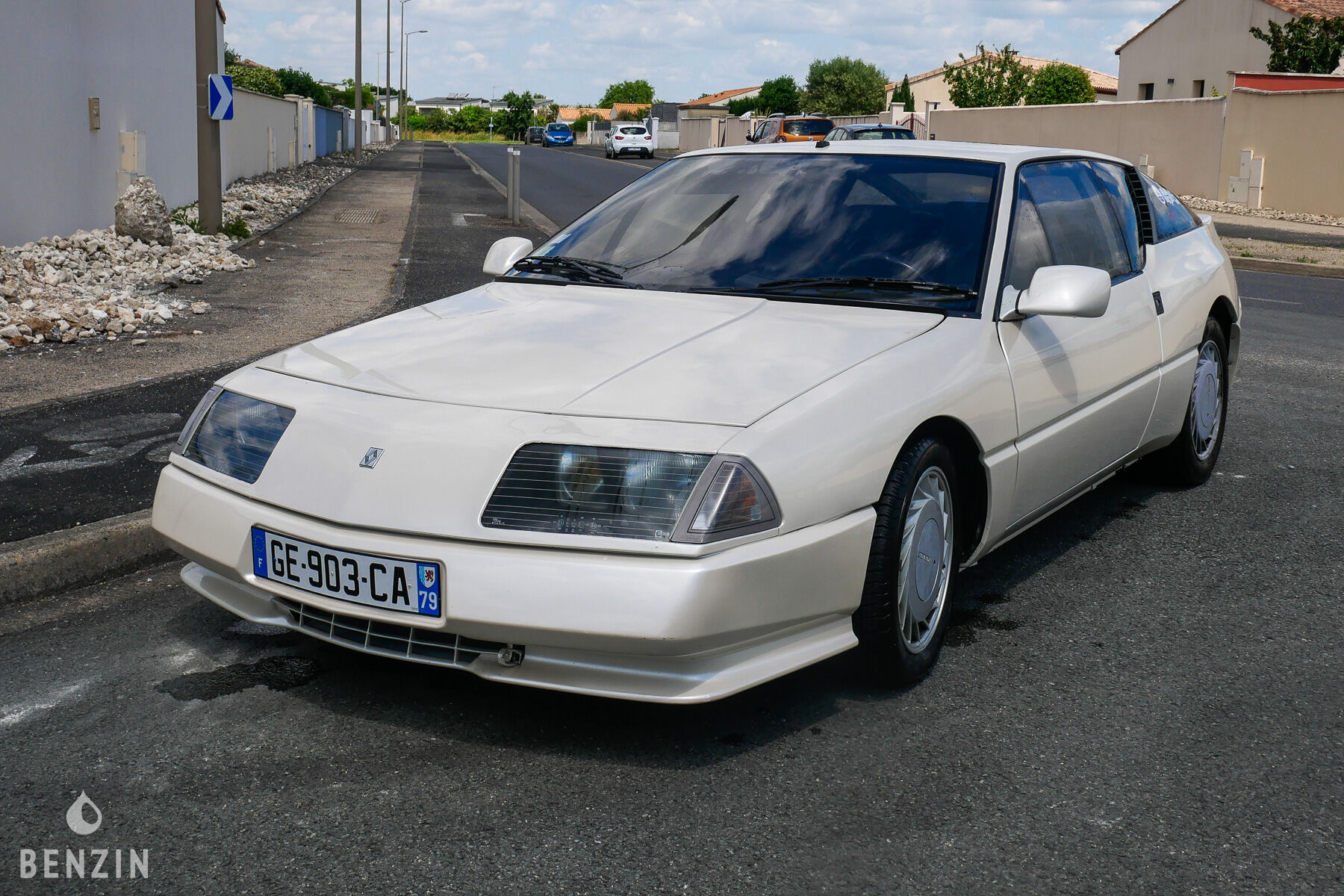
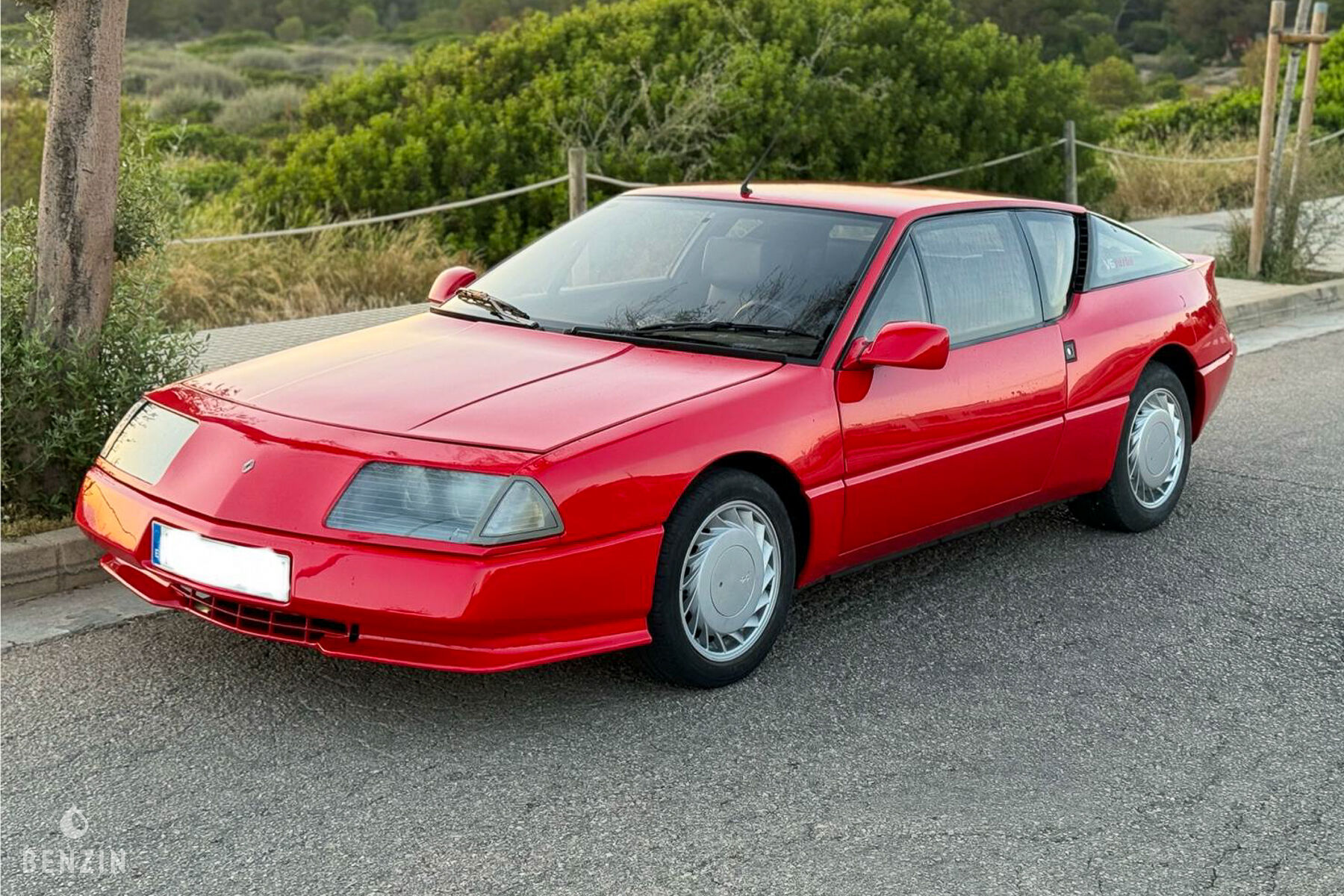
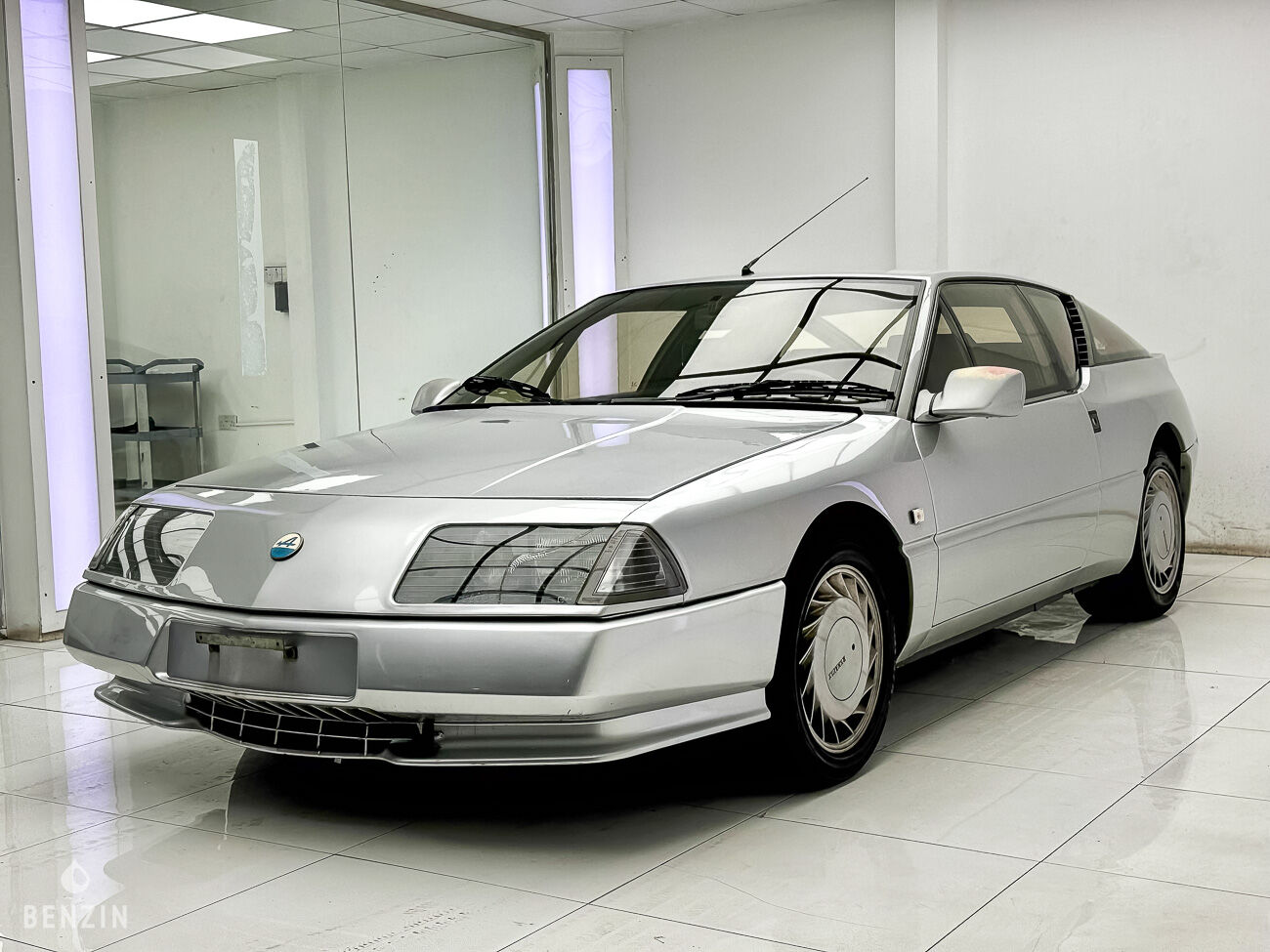
The Alpine GTA appeared in autumn 1984 as the direct successor to the A310, with the aim of modernizing Dieppe’s GT without abandoning the Alpine formula: rear mid-engine layout, polyester bodywork and restrained weight. The project, often referred to internally as GTA for “Grand Tourisme Alpine,” was developed under Renault with strong attention paid to aerodynamics, one of its signatures, with a particularly low drag coefficient for the time. The very smooth lines, flush glazing and more spacious cabin marked a real break from the A310, while the steel backbone chassis remained faithful to the Alpine tradition. At launch, the range centered on the naturally aspirated V6 GT, powered by the 2.8-liter injected PRV, quickly joined by the V6 Turbo, which was more powerful and became the model’s emblematic version. With around 200 hp in its best-known European specification, the Turbo then placed Alpine among the fastest French GT cars of its era.
The GTA’s career ran until 1991, before the A610 took over, and it evolved in small steps rather than through a complete redesign: equipment details, updates for regulations, revised trim and special editions. The best-known is the GTA Le Mans, recognizable by its wide body kit and specific presentation, produced in small numbers late in the model’s life. Some cars also received market- or dealer-specific configurations, which explains the varying names and equipment from one example to another today. The GTA also served as the basis for the Alpine GTA Europa Cup one-make racing series, which helped maintain its sporting image despite a commercial career that was more discreet than its qualities suggested. Total GTA production, across all versions, stands at just over 6,000 examples, with the V6 Turbo being the most sought-after by many enthusiasts.
Long overshadowed by the A110 and A610, the GTA is now viewed much more favorably, especially thanks to its very 1980s styling, still-relevant performance and genuine technical distinctiveness. Collectors appreciate cars that remain true to their original configuration, with their wheels, steering wheel, upholstery and specific features preserved, because many have been modified or recommissioned after long periods of inactivity. The best examples are those whose chassis corrosion has been properly addressed, whose PRV and gearbox have been maintained by model specialists, and whose history makes it possible to distinguish a proper restoration from a simple return to the road.
Technical sheet
| Alpine GTA V6 GT | Alpine GTA V6 Turbo | Alpine GTA Le Mans |
| Production years | 1984-1990 | 1985-1990 | 1990-1991 |
| Body | 2+2 coupé in polyester on steel backbone chassis | 2+2 coupé in polyester on steel backbone chassis | 2+2 coupé in polyester on steel backbone chassis, wide body kit |
| Engine(s) | 2,849 cc naturally aspirated fuel-injected PRV V6 | 2,458 cc turbocharged PRV V6 | 2,458 cc turbocharged PRV V6 |
| Power | 160 hp | 200 hp | 200 hp |
| Transmission | rear-wheel drive, 5-speed manual gearbox | rear-wheel drive, 5-speed manual gearbox | rear-wheel drive, 5-speed manual gearbox |
| Curb weight | around 1,050 kg | around 1,100 kg | around 1,150 kg |
| 0 to 100 km/h | around 8 s | around 6.3 s | around 6.5 s |
| Top speed | around 235 km/h | around 250 km/h | around 245-250 km/h |
| Production | included in a total GTA production of just over 6,000 examples | included in a total GTA production of just over 6,000 examples | late-production limited series |
Buyer’s guide
The V6 Turbo is the most sought-after version, especially when it has remained close to original and has not been “optimized” in boost pressure or presentation. For more relaxed use and often better-controlled running costs, the naturally aspirated V6 GT is a very coherent choice. Cars that have been off the road for a long time or recommissioned without a proper mechanical refresh are, however, the ones that concentrate the most unpleasant surprises.
Points to watch
- Backbone chassis and suspension mountings : the polyester body does not rust, but the steel chassis, crossmembers, front subframe and suspension arm mounting points can corrode, sometimes without obvious visual warning; this applies to all years, especially cars stored for a long time or poorly repaired, and the underside must absolutely be inspected on a lift.
- Wishbones and front suspension : signs of distortion, perforating corrosion or rough repairs on the lower arms and their mountings should raise concern; on a GTA, a superficially sound appearance can hide an old impact or structural weakness, hence the importance of checking alignment and the symmetry of the mountings.
- PRV timing : the chain-driven V6 is robust, but cold-start chain noise, worn tensioners or persistent rattles should be taken seriously; on a car without a clear history, ask what has been done to the timing system and listen to the engine at first start-up.
- Cooling system : the front radiator, long pipes, hoses and complex bleeding circuit can cause overheating or unstable operation, especially after a long period off the road; on both V6 GT and Turbo, check temperature stability, the absence of mayonnaise and signs of abnormal pressure in the system.
- Turbo and exhaust : on the V6 Turbo, smoke on overrun, excessive whistling, irregular boost build-up or cracked manifolds are not uncommon; check for any improvised modifications to the turbo system and ask whether the turbo has ever been overhauled or replaced.
- UN1 gearbox : the manual gearbox does not tolerate abuse well, especially on Turbo; worn 2nd or 3rd gear synchros, imprecise engagement and noises under load should be checked, as should maintenance or rebuild invoices.
- Electrical system and specific accessories : slow windows, temperamental instruments, ventilation, dashboard controls and aging wiring loom often recur on GTA models; parts are available, but some specific interior or equipment references are harder to source.
- Conformity of presentation items : wheels, steering wheel, radio/stereo, upholstery, Le Mans kit or body add-ons are often changed; on a model that has become collectible, the authenticity of these parts matters and some are difficult to find in good condition.
When buying
On a GTA, invoices for work on the chassis, cooling system, turbo and gearbox count for more than a simple clean MOT. An inspection on a lift by a model specialist, with checks of the mountings, structural corrosion and powertrain leaks, is strongly recommended. If the history is patchy, a cold start test, a compression test and verification that the type, engine and original specification match are particularly useful.
On Benzin a Alpine GTA has sold for 16 225 € on average, with a median price of 16 975 €. Based on the 6 sales completed on the platform.
The 6 Alpine GTA sold on Benzin changed hands for between 12 500 € and 18 000 €, depending on condition, mileage and version.
6 of the 12 Alpine GTA listed on Benzin found a buyer — 50 % of completed sales.
No Alpine GTA is for sale at the moment. Follow the model to be notified as soon as a new one is listed.
Every vehicle comes with a detailed photo report, its history and the public exchanges between seller and community. You bid online; if you win, Benzin secures the payment and supports you through to delivery.
Follow the model from this page and you will get an e-mail as soon as a Alpine GTA is listed on Benzin.
 English
 Français
 Español
 Italiano
 Deutsch
 Polski
 Magyar