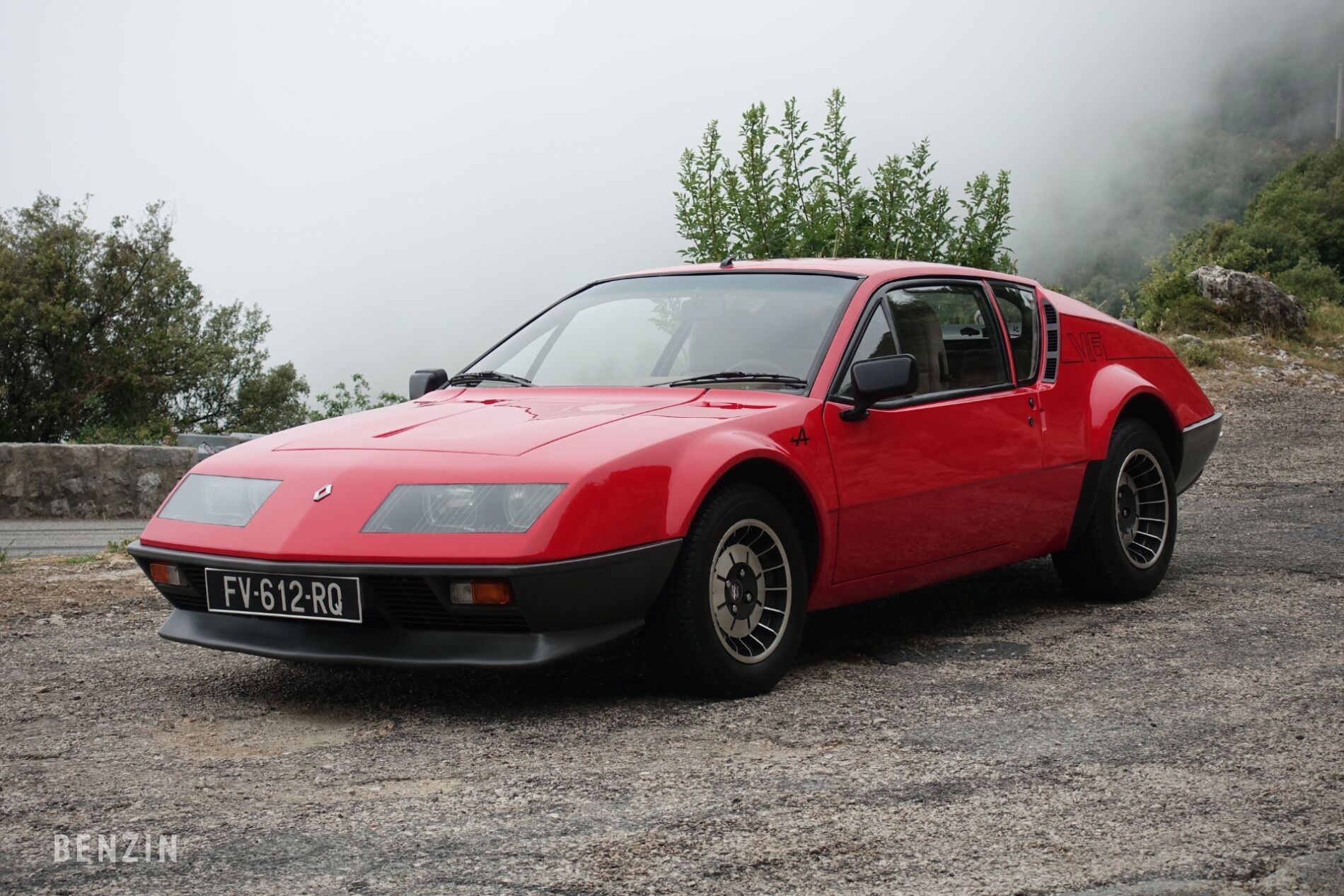
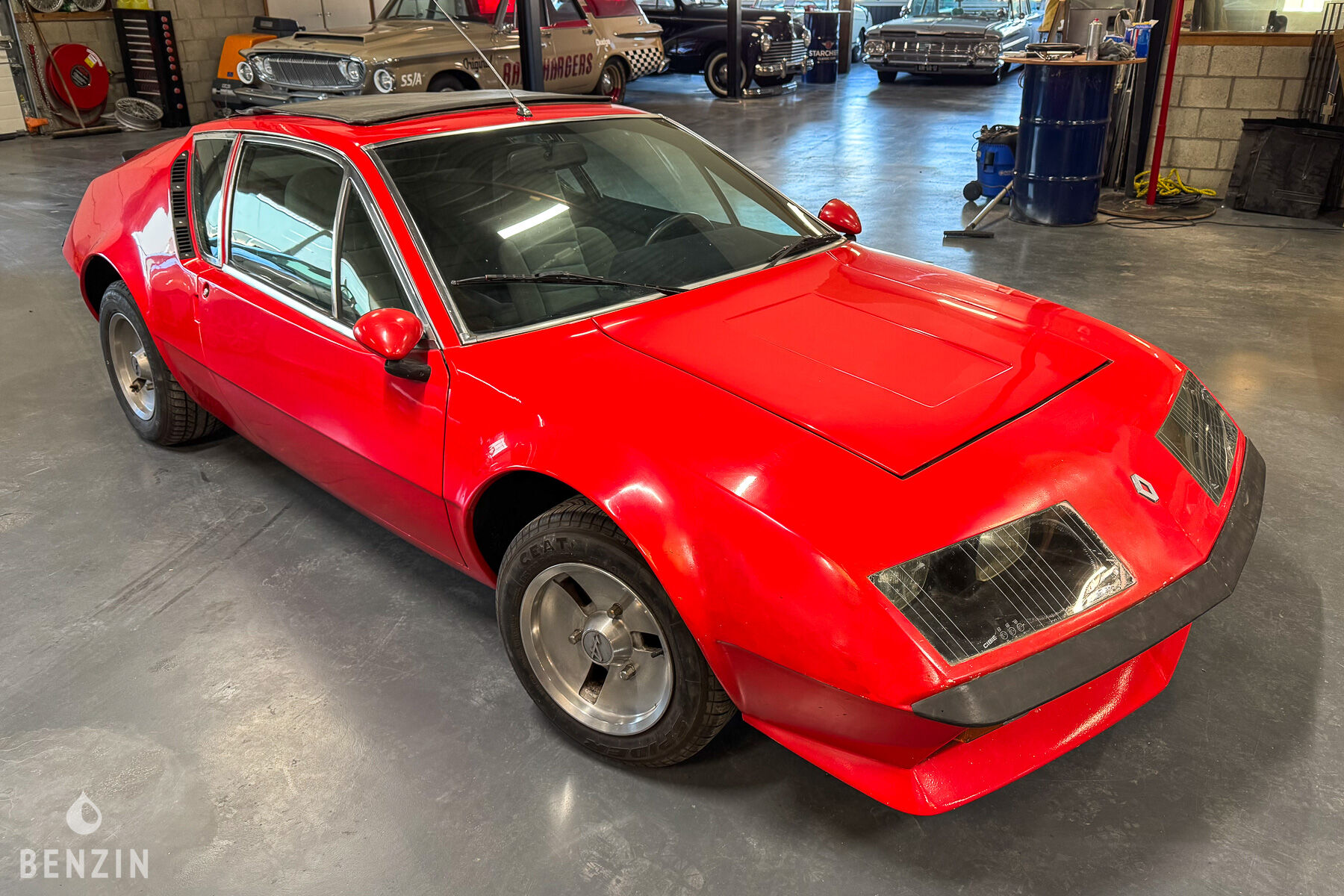
Launched at the 1971 Geneva Motor Show, the Alpine A310 was designed as the GT capable of succeeding the A110 without abandoning the brand’s formula: rear mid-engine layout, steel backbone chassis and polyester bodywork. Its very angular styling, generally attributed to Michel Beligond’s work at Alpine, contrasts with the Berlinette’s curves and targets a more road-oriented clientele. The first A310s received a 1600 four-cylinder engine, initially derived from the Renault 16 TS and then, on the best-known versions, the more powerful 1600 from the 1600 VE. These early series are recognized by their six-headlight front end, which became one of the model’s signatures. Roomier than an A110, better soundproofed and more stable at high speed, the A310 is nevertheless a true lightweight sports car, with a weight distribution and handling that require solid driving skills.
The major turning point came in 1976 with the A310 V6, powered by the 2.7-liter PRV mounted at the rear. The nose was redesigned with four headlights, the track was widened and the car gained torque, top-end performance and versatility, at the cost of noticeable extra weight. The first V6s were paired with a 4-speed manual gearbox, then a 5-speed gearbox became available at the end of the 1970s and is now the most sought-after choice. In the early 1980s, the A310 received several detail changes to styling, equipment and trim, while some cars adopted the so-called Pack GT presentation, inspired by competition versions with widened fenders. Without having the A110’s record, the A310 competed in Group 4 and later in rally and circuit versions, and it also served as the basis for the “factory” A310 V6, which helped keep Alpine visible in French motorsport.
The model’s career ended in 1984, when the GTA took over in the Alpine-Renault range. Total A310 production was just over 11,000 examples, with the V6s making up most of the surviving sought-after cars. Long in the shadow of the A110, it is now appreciated for its very seventies styling, its unusual layout and its appeal as a fast French GT. Enthusiasts clearly distinguish the four-cylinder cars, rarer and lighter, from the V6s, which are more balanced and more usable. Beautiful, matching, well-restored examples at chassis level and correctly tuned in terms of carburation and cooling are now the ones collectors seek first.
Technical data
| Version | A310 1600 VE | A310 V6 | A310 V6 Pack GT |
| Production years | 1973-1976 | 1976-1984 | Early 1980s |
| Body | 2+2 coupé, polyester on backbone chassis | 2+2 coupé, polyester on backbone chassis | 2+2 coupé, polyester on backbone chassis |
| Engine | 1,605 cc inline 4 | 2,664 cc PRV V6 | 2,664 cc PRV V6 |
| Fuel system | Fuel injection | Carburetors | Carburetors |
| Power | around 125-127 hp DIN | 150 hp DIN | 150 hp DIN |
| Transmission | Rear-wheel drive, 5-speed manual gearbox | Rear-wheel drive, 4- then 5-speed manual gearbox | Rear-wheel drive, 5-speed manual gearbox |
| Weight | around 800-850 kg | around 980-1,050 kg | around 1,000-1,070 kg |
| 0-100 km/h | around 8 s | around 7.5-8 s | around 7.5-8 s |
| Top speed | around 205-210 km/h | around 220-225 km/h | around 220-225 km/h |
| Production | Just over 11,000 A310s in all versions combined |
Buyer’s guide
For road use, A310 V6s with the 5-speed gearbox are generally the most recommendable: they make better use of the PRV and make the car more pleasant on fast roads. The early V6s with the 4-speed gearbox have their appeal for authenticity, but they are less desirable to drive. The four-cylinder cars appeal to purists for their lightness and rarity, provided you accept a more demanding car that can sometimes be trickier to tune perfectly.
Points to watch
- Backbone chassis : structural corrosion is the number one issue, even if the polyester bodywork can be deceptive; all years are affected, especially at the suspension mountings, front crossmembers, windshield base and areas near the battery. Ask for underside photos, body-off restoration photos, or an inspection on a lift by a specialist who knows A310s.
- PRV cooling system : an A310 V6 that runs hot, vents late or expels coolant may suffer from a tired radiator, corroded pipes or poor bleeding, a classic issue linked to the rear-mounted engine and front radiator. Check temperature stability in slow traffic and the history of the radiator, water pump, hoses and thermostat.
- V6 carburation : unstable idle, difficult hot starts, flat spots on acceleration or a smell of fuel often indicate carburetors that are poorly synchronized or badly adjusted after overhaul. On carbureted V6s, ask who carried out the rebuild and whether a final on-car adjustment was done after reassembly.
- Gearbox : the gearboxes on V6s can have worn synchros, especially on cars that have been little used or poorly serviced, with crunching into 2nd or imprecise shifting. The early 4-speed gearboxes are less pleasant to use; on all of them, check for leaks, bearing noise and evidence of service invoices or at least regular oil changes.
- Wiring loom and Jaeger instruments : erratic tachometer, fanciful gauges, inconsistent charge indicator, temperamental headlights or fans often come from poor grounds, oxidized connectors or wiring looms hardened by heat, especially in the engine bay. The condition of the wiring, terminals and fuse box must be inspected, not just the fact that “it works on the day of the viewing”.
- Suspension and shock absorbers : an A310 that floats, dives or pulls under braking may simply have period shocks, but also worn bushes and ball joints, which greatly degrades the handling of this rear-engine layout. On a V6, checking the mounting points of the suspension on the chassis is just as important as the condition of the suspension components themselves.
- Specific interior : sagging headliner, roughly reupholstered seats, cracked dashboard or missing interior trim pieces are common and costly to correct because some parts are specific to the A310. You need to check the completeness of the cabin and the authenticity of the trim, especially on cars restored a long time ago.
When buying
On an A310, the ideal file includes proof of work on the chassis even more than on the paint: photos of body-off restoration, invoices for anchor-point repairs and anti-corrosion treatment are decisive. On a V6, a prolonged test drive should be supplemented by a compression test and a check of the cooling system, because a PRV that runs well when cold can reveal its faults once fully hot. Also check that the chassis numbers match and, if the car is presented as very original, the presence of its version-specific features, notably the 4- or 5-speed gearbox, interior presentation and, where applicable, an authentic Pack GT rather than just a cosmetic dress-up.
On Benzin a Alpine A310 has sold for 26 017 € on average, with a median price of 26 050 €. Based on the 3 sales completed on the platform.
The 3 Alpine A310 sold on Benzin changed hands for between 15 500 € and 36 500 €, depending on condition, mileage and version.
3 of the 11 Alpine A310 listed on Benzin found a buyer — 27 % of completed sales.
No Alpine A310 is for sale at the moment. Follow the model to be notified as soon as a new one is listed.
Every vehicle comes with a detailed photo report, its history and the public exchanges between seller and community. You bid online; if you win, Benzin secures the payment and supports you through to delivery.
Follow the model from this page and you will get an e-mail as soon as a Alpine A310 is listed on Benzin.
 English
 Français
 Español
 Italiano
 Deutsch
 Polski
 Magyar