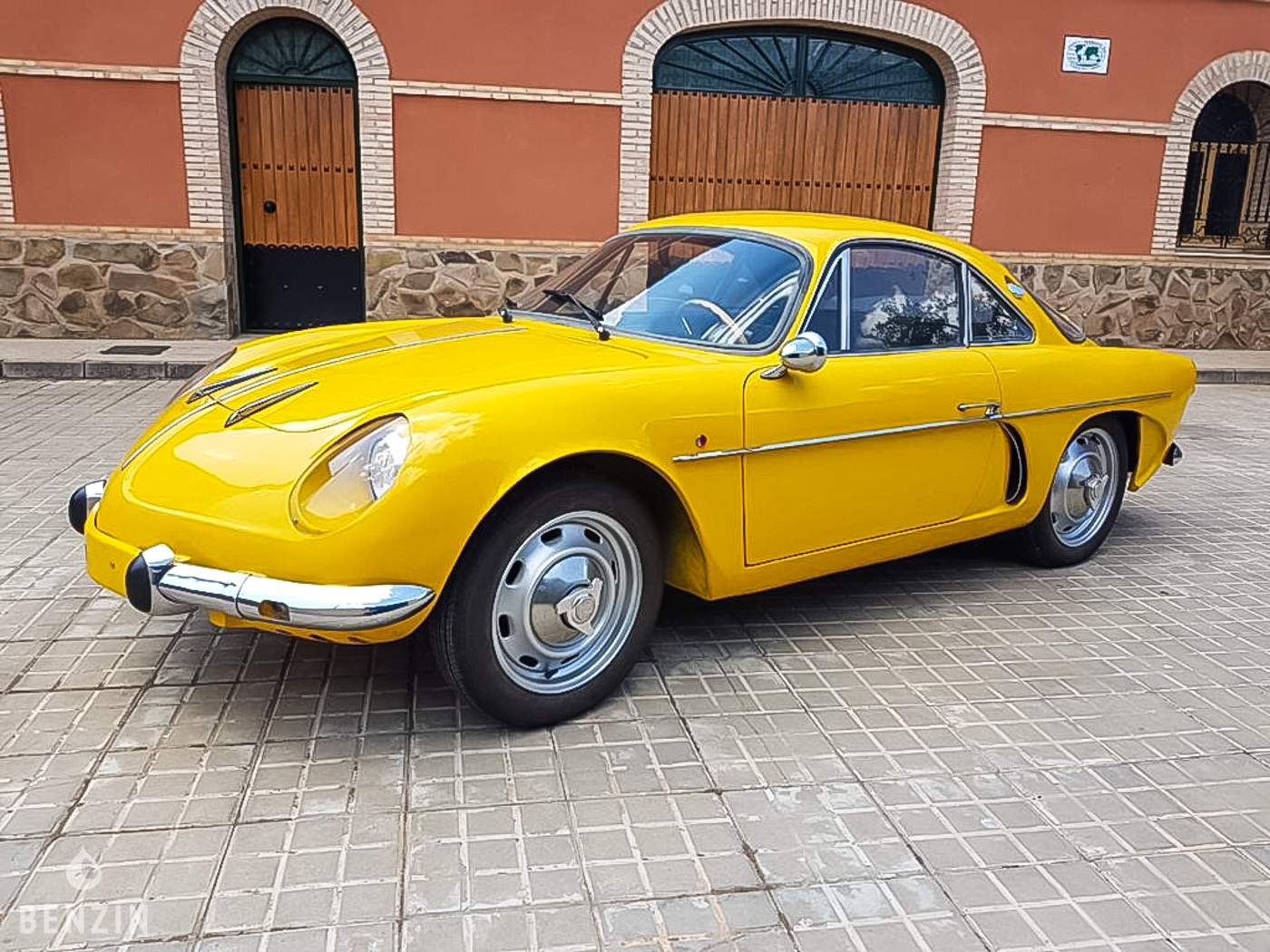
The Alpine A108 is the model that truly brings Jean Rédélé’s small brand into the era of the rear-engined berlinette. Introduced in the late 1950s to replace the A106, it follows the recipe dear to Dieppe: a lightweight backbone chassis, a polyester body and Renault mechanicals derived from the 4CV and then the Dauphine. Its styling varies according to body style, with lines shaped both by the work of the Chappe et Gessalin coachbuilder and by the influence of Giovanni Michelotti’s studies on certain versions. The A108 was offered as a convertible, a 2+2 coupe and, above all, as the so-called “Tour de France” berlinette, the one that most directly foreshadows the A110. Very light, low and simple, it relies more on agility and the efficiency of well-prepared small engines than on outright power.
Over the course of its career, the A108 received several Renault Ventoux and Dauphine-derived engines, with displacements ranging around 850, 900 and up to 1.1 liters depending on year and market. The latest examples benefit from a presentation and tuning closer to the emerging A110, which explains why some cars are now difficult to place without a precise examination of the numbers, running gear and body shell. French production remained limited, as was often the case with Alpine at the time, and a significant part of the model’s history also took place in Spain, where FASA built A108s under license. This Spanish production is well known to enthusiasts, with its specific trim, identification and sometimes mechanical details. The A108 does not have the track record or worldwide fame of the A110, but it occupies an essential place in Alpine genealogy, as the direct link between the first Alpine cars based on the 4CV and the most famous berlinette from Dieppe.
Today, the A108 is sought after by collectors for its rarity, lightness and very pure character. Enthusiasts particularly appreciate well-identified original berlinettes, not transformed into pseudo-A110s and retaining their specific body shell, dashboard and chassis elements. Convertibles and coupes also have their fans, but the berlinette remains the most emblematic variant and the one best documented by clubs and specialists. As is often the case with small Alpine models from the 1950s and 1960s, authenticity, the chassis’ structural quality and the consistency of the parts matter far more than presentation alone.
Technical data
| Version | A108 Berlinette / Coupe | Late A108 1100 | A108 FASA (Spain) |
| Production years | Late 1950s to mid-1960s | Mid-1960s | 1960s |
| Body | Berlinette, 2+2 coupe or convertible, polyester | Berlinette, polyester | Berlinette and derivatives, polyester |
| Layout | Rear engine, rear-wheel drive | Rear engine, rear-wheel drive | Rear engine, rear-wheel drive |
| Chassis | Alpine central backbone | Alpine central backbone | Alpine-type central backbone |
| Engine(s) | 4-cylinder Renault 845 to approx. 904 cc | 4-cylinder Renault approx. 1.1 liters | 4-cylinder Renault depending on version and market |
| Power | Around 40 to 60 hp depending on engine | Around 60 hp | Variable depending on version |
| Gearbox | 4-speed manual | 4-speed manual | 4-speed manual |
| Weight | Around 550 to 650 kg | Around 600 kg | Depending on body style and engine |
| Top speed | Around 140 to 160 km/h | Around 155 to 165 km/h | Depending on engine |
| Production | Limited series | Limited series | Licensed production, also limited |
Buyer’s guide
The most desirable examples are late berlinettes, especially when they retain a chassis, body shell and mechanicals consistent with their period. A well-identified French A108 or a clearly documented FASA is worth more than a car hybridized with A110 parts, which is very common on this model. Cars that have been heavily modified for competition or rebuilt from disparate parts should be examined with great caution.
Points to watch
- Backbone chassis: perforating corrosion or major repairs around the front and rear suspension mounting points, a classic issue on cars that have been stored for a long time or restored long ago; check the underside, welds and the car’s alignment.
- Polyester body shell: star cracks, blisters, distortions or thick fiberglass repairs, often after an impact or approximate restoration; inspect the body shell mountings on the chassis and the quality of the resin used.
- A108 / A110 authenticity: many examples have received A110 front ends, dashboards, headlights or running gear to “modernize” the car; check the conformity of the body shell, openings, vents and numbers.
- French or FASA identification: frequent confusion over the origin of Spanish cars, with vague paperwork or descriptions; ask for the manufacturer’s plates, the logic of the chassis numbers and old import or registration documents.
- Ventoux/Dauphine engine: leaks, overheating and weakness of the head gasket or liners on engines that have been pushed hard or poorly cooled; check compression, temperature stability and rebuild invoices.
- Renault transaxle gearbox: tired synchromesh, crunching on downshifts and increased wear if the engine has been tuned; test the car when hot and ask whether the gearbox has been rebuilt with suitable parts.
- Swing axle rear suspension: handling altered by poor adjustment, worn bushes or a mixed installation of Dauphine, Gordini or A110 parts; check the ride height, rear camber and consistency of the fitted components.
- Braking system and electrical circuit: significant differences depending on year, version and restorations, with conversions from 6 to 12 volts or non-compliant installations; check whether the wiring loom, drum type or master cylinder really match the stated configuration.
When buying
On an A108, the car’s identity papers are almost as important as its mechanical condition: the registration document, manufacturer’s plate, chassis number and body specifications must be cross-checked to avoid a poorly documented reconstruction. A chassis inspection on a lift, supplemented if possible by a compression test and a hot gearbox test drive, is far more useful than a merely attractive presentation. On a FASA or an imported car, the consistency of the paperwork and registration history should be examined with the same care as the car itself.
0 of the 1 Alpine A108 listed on Benzin found a buyer — 0 % of completed sales.
No Alpine A108 is for sale at the moment. Follow the model to be notified as soon as a new one is listed.
Every vehicle comes with a detailed photo report, its history and the public exchanges between seller and community. You bid online; if you win, Benzin secures the payment and supports you through to delivery.
Follow the model from this page and you will get an e-mail as soon as a Alpine A108 is listed on Benzin.
 English
 Français
 Español
 Italiano
 Deutsch
 Polski
 Magyar
