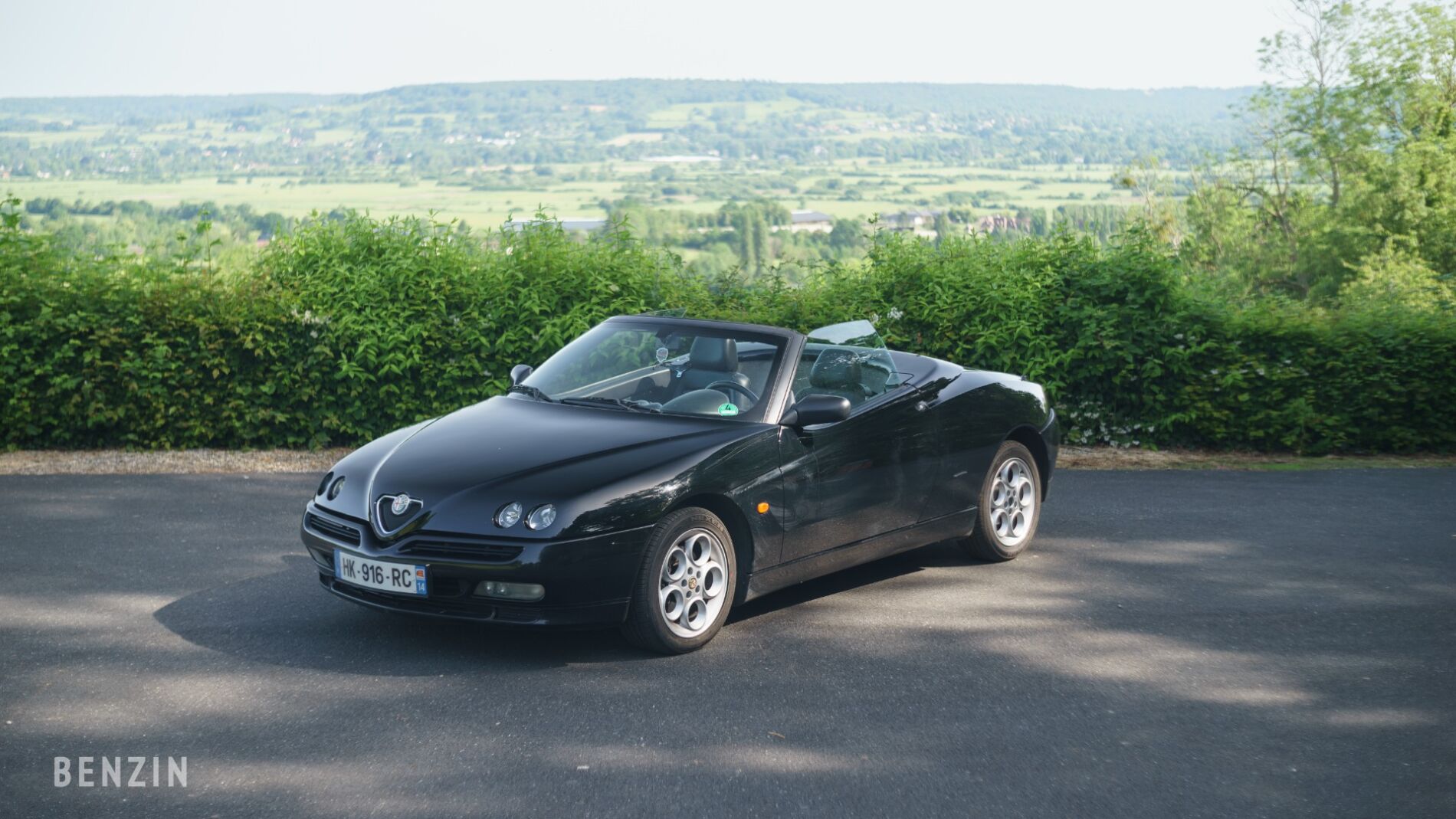
Unveiled at the 1994 Geneva Motor Show and sold from 1995, the Alfa Romeo GTV type 916 marked Alfa’s return to a large front-wheel-drive sports coupé after the Alfetta GTV and Sprint. It is based on a heavily reworked evolution of the Fiat Group “Tipo Due” platform, with a specific front suspension and, above all, a spectacular multi-link rear suspension, rare in the segment at the time. Its styling, penned at Pininfarina by Enrico Fumia, stands apart from 1980s coupés with its very low nose, wedge-shaped profile and truncated rear, while the driver-focused cabin asserts a true Alfa personality. The Spider 916, technically very close, was launched at the same time and shares most of the mechanical range, which is why the two models are often considered together by enthusiasts and specialists.
The first phase mainly received the 2.0 Twin Spark 16V, 3.0 V6 12-valve “Busso” and, for certain markets including Italy, the 2.0 V6 Turbo or V6 TB, which was more tax-friendly. In 1998, the 3.0 V6 moved to 24 valves, becoming more powerful and more eager to rev, while the range then evolved in small steps with new trims and equipment updates. The 2003 facelift, often called phase 3, brought the front end inspired by the restyled 156 with a more pronounced grille, as well as the arrival of the 2.0 JTS with direct injection and, depending on the market, the 3.2 V6 at the top of the range. In between, phase 2 is recognized by minor interior and exterior styling changes, without altering the original lines. Among the most sought-after versions today are the V6 Busso, the rare V6 Turbo and the Cup series, inspired by one-make racing and identifiable by its specific body kit.
The GTV 916 did not build its reputation on a major international racing record, but it strongly reinforced Alfa Romeo’s sporty image in the late 1990s thanks to its precise chassis, incisive front end and, in V6 form, a now-legendary soundtrack. Production remained limited for a mass-produced model, over roughly a decade until 2005, which contributes today to its status as a desirable youngtimer. Enthusiasts clearly distinguish well-preserved, original cars from modified or neglected examples, because maintenance quality radically changes both enjoyment and reliability. The 916 is now considered one of Alfa’s most significant cars of its era, at the crossroads of Pininfarina design and the final golden age of the Busso V6.
Technical data
| Feature | GTV 2.0 Twin Spark 16V | GTV 3.0 V6 24V | GTV 2.0 JTS |
| Production years | 1995-2003 | 1998-2003 | 2003-2005 |
| Body | 2+2 coupé | 2+2 coupé | 2+2 coupé |
| Engine | Inline 4-cylinder, 1970 cc, 16 valves | 60° V6, 2959 cc, 24 valves | Inline 4-cylinder, 1970 cc, direct injection |
| Power | 150 hp | 220 hp | 165 hp |
| Transmission | Front-wheel drive, 5-speed manual gearbox | Front-wheel drive, 6-speed manual gearbox | Front-wheel drive, 5-speed manual gearbox |
| Curb weight | approx. 1,320 kg | approx. 1,410 kg | approx. 1,350 kg |
| 0-100 km/h | approx. 8.4 s | approx. 6.7 s | approx. 8.0 s |
| Top speed | approx. 215 km/h | approx. 242 km/h | approx. 220 km/h |
| Notable versions | 1.8 TS, 2.0 TS | 3.0 V6 12V, 3.0 V6 24V, 3.2 V6, 2.0 V6 Turbo depending on market | Phase 3 |
Buyer’s guide
The most desirable remain the V6 Busso engines, especially the 3.0 24V for its balance of character, performance and parts availability, while the 3.0 12V appeals with its rougher sound and personality. For more reasonable use, the 2.0 Twin Spark is often the best chassis balance, provided it has an impeccable timing and lubrication history; the 2.0 JTS should be reserved for very well-maintained cars, as it does not tolerate approximate servicing. The Cup and the V6 Turbo/V6 TB are sought after by enthusiasts, but their rarity means you must be even more attentive to authenticity and specific parts.
Points to watch
- Twin Spark and JTS timing service : an interval often considered too optimistic at the time, with a real risk of failure if the belt, tensioners, water pump and balance shaft belt are not replaced on time; on 2.0 TS and 2.0 JTS, ask for a dated and detailed invoice, not just a statement.
- Twin Spark variator : diesel-like noise at startup or an engine that feels less strong at low revs, especially on the 2.0 TS; check whether it was replaced at the same time as the timing service, as this is the job recommended by almost all specialists.
- Oil consumption on 2.0 TS/JTS : some engines do not tolerate a low oil level well and can end up with worn bearings or clogged piston rings; ask about observed consumption, check for the absence of knocking when hot and inspect the breather system on cars that have been driven little.
- Front suspension : knocking, imprecision or uneven tire wear often come from the upper wishbones, bushes and anti-roll bar links; this is a classic 916 issue, especially noticeable on rough roads and on cars fitted with large wheels.
- Multi-link rear suspension : rear end that feels loose, unstable alignment or a dull thump over bumps due to worn bushes and joints; many examples still run with worn components, which greatly degrades the model’s otherwise renowned handling.
- Gearbox and clutch on the V6s : firm action, lazy 2nd or 3rd gear synchros when cold, heavy clutch or worn slave cylinder; on the 3.0 and V6 TB, check for quick gear changes once the engine is warm, as repairs can quickly become expensive.
- Cabin electronics and airbag warning light : under-seat connectors, sensors or an intermittent fault in the instrument cluster often result in a warning light staying on; on the 916, a diagnostic scan is essential if an airbag, ABS or injection warning light is present, even if the car drives normally.
- Soft top and window adjustment on Spider 916 : on the convertible versions associated with the GTV in the 916 range, the electro-hydraulic mechanisms can be temperamental and poorly adjusted windows cause leaks and wind noise; check the sealing, the full mechanism operation and the glass alignment when closed.
When buying
On a GTV 916, the most important documents are the timing service invoices detailing the belt, tensioners, water pump and, on Twin Spark/JTS, the balance shaft belt as well as the variator if replaced. An electronic diagnostic is particularly useful to confirm the absence of airbag, ABS and injection faults, as intermittent warning lights are common on the model. On the 2.0 JTS and cars with an unclear history, a compression test and a check of oil consumption are relevant; on the V6s, also inspect the underbody, jacking points and the front end, which is very exposed to minor impacts or rough repairs.
On Benzin a Alfa Romeo GTV 916 has sold for 7 358 € on average, with a median price of 6 950 €. Based on the 16 sales completed on the platform.
The 16 Alfa Romeo GTV 916 sold on Benzin changed hands for between 4 200 € and 12 800 €, depending on condition, mileage and version.
16 of the 26 Alfa Romeo GTV 916 listed on Benzin found a buyer — 62 % of completed sales.
No Alfa Romeo GTV 916 is for sale at the moment. Follow the model to be notified as soon as a new one is listed.
Every vehicle comes with a detailed photo report, its history and the public exchanges between seller and community. You bid online; if you win, Benzin secures the payment and supports you through to delivery.
Follow the model from this page and you will get an e-mail as soon as a Alfa Romeo GTV 916 is listed on Benzin.

 English
 Français
 Español
 Italiano
 Deutsch
 Polski
 Magyar
