Launched in autumn 1997 to replace the 155, the Alfa Romeo 156 marked a real turning point for the brand, both in styling and driving pleasure. Its design, by Walter de Silva at the Centro Stile Alfa Romeo, modernized the codes of the Italian sedan with concealed rear door handles, a very fluid profile and an immediately recognizable front end. The 156 was voted European Car of the Year 1998, an important success for Alfa Romeo during a period of commercial recovery. The range began with Twin Spark four-cylinder gasoline engines and the first JTD common-rail diesels, then quickly expanded with the 2.5-liter 190 hp “Busso” V6, a version that became emblematic. The transmission was initially manual, then Alfa also offered the Selespeed robotized gearbox on certain engines.
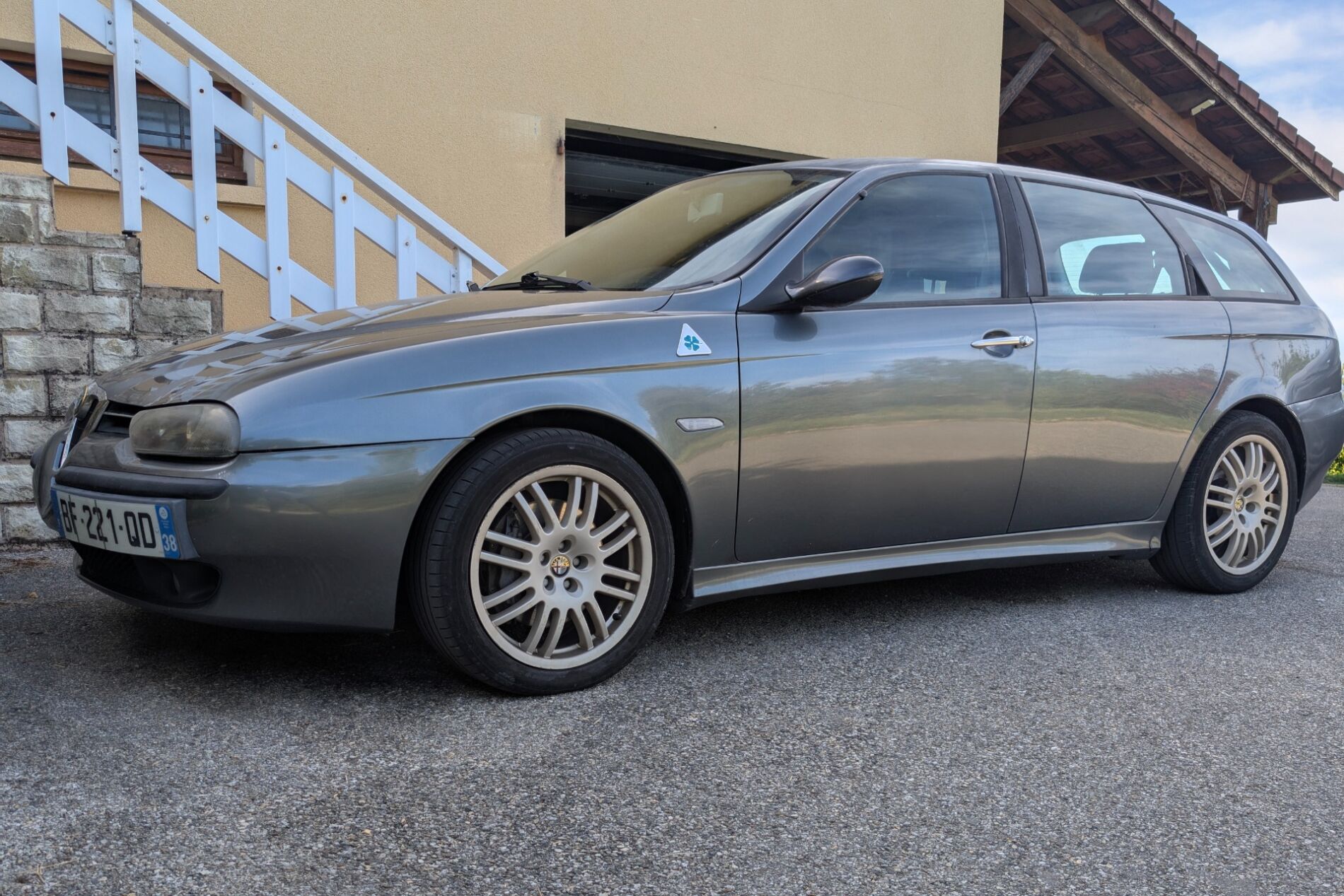
In 2000 came the 156 Sportwagon, more shooting brake than boxy family estate, which retained the sedan’s road-going character without sacrificing the lines. In 2002, Alfa launched the 156 GTA, powered by the 250 hp 3.2-liter V6, the range’s pinnacle and now the most sought-after version. The model’s career was marked by several technical updates, including the arrival of JTS direct-injection gasoline engines, as well as a more significant facelift in 2003 with a redesigned front end by Giorgetto Giugiaro and a revised interior presentation. Depending on the market, the 156 also existed in special editions and distinctive sporty trims, but it is above all the Twin Spark, JTD and 2.5 V6 versions that make up the core of the current fleet.
The 156 also built its reputation in competition, notably in Superturismo and then in ETCC, where it collected titles and gave the sedan silhouette a real sporting aura. Its precise steering, incisive front end and the character of its engines, especially the Busso V6, explain why it remains so highly regarded by alfisti. Total production exceeds 600,000 units, making it a major model in the brand’s recent history. Today, enthusiasts mainly seek cars that remain original, properly maintained and structurally sound, with particular interest in the 2.5 V6, well-specified Sportwagon models and, of course, the GTA.
Technical specifications
| Feature | 156 2.0 Twin Spark | 156 2.5 V6 24V | 156 GTA 3.2 V6 |
| Production years | 1997-2005 | 1997-2005 | 2002-2005 |
| Body style | Sedan, Sportwagon | Sedan, Sportwagon | Sedan, Sportwagon |
| Engine(s) | Inline 4-cylinder 2.0-liter 16-valve Twin Spark | 60° V6 2.5-liter 24-valve | 60° V6 3.2-liter 24-valve |
| Power | 155 hp | 190 hp | 250 hp |
| Transmission | Front-wheel drive, 5-speed manual gearbox or Selespeed | Front-wheel drive, 6-speed manual gearbox | Front-wheel drive, 6-speed manual gearbox |
| Curb weight | approx. 1,270 kg | approx. 1,350 kg | approx. 1,410 kg |
| 0-100 km/h | approx. 8.6 s | approx. 7.3 s | approx. 6.3 s |
| Top speed | approx. 216 km/h | approx. 230 km/h | 250 km/h |
| Production | More than 600,000 examples for the entire 156 range |
Buyer’s guide
For driving pleasure and emotional value, the 2.5 V6 24V, in both sedan and Sportwagon form, are the most appealing versions thanks to the Busso engine and their still usable layout. The 2.0 Twin Spark is a good compromise provided it has a clear history for the timing belt, oil consumption and phase variator. Selespeed versions and cars neglected on the engine maintenance side should be approached with more caution than well-maintained manuals.
Points to watch
- Timing belt : replacement left too long, especially on Twin Spark and V6 engines, with a risk of engine failure; on many cars, specialists recommend shorter intervals than those stated at the time; check the date and mileage of the belt, tensioners and water pump.
- Twin Spark phase variator : diesel-like noise at cold start, especially on 1.8 and 2.0 TS; the part often ages and is ideally replaced at the same time as the timing belt; ask whether the variator has been replaced and listen to the engine when cold.
- Oil consumption of Twin Spark engines : level dropping quickly, smoke or knocking if used with the level too low; this is a known issue on the 2.0 TS; check how often top-ups are needed and for any bottom-end noise.
- Selespeed : slow gear changes, limp mode, noisy hydraulic pump or refusal to engage a gear; this concerns 156s equipped with this robotized gearbox; ask for invoices for the accumulator, actuator and a diagnostic scan with recent calibration.
- Front suspension : knocking, less precise steering and uneven tire wear due to the upper and lower wishbones; wear is common across the range, and even more so on V6 and Sportwagon models; check for play and behavior on rough roads.
- V6 cooling : worn thermostat, aging radiator or unstable temperature; on the 2.5 V6, an abnormally high or, conversely, too low operating temperature is not uncommon; check temperature stability in use and invoices for the radiator, thermostat or hoses.
- Airbag, ABS or VDC warning lights : intermittent or permanent warning light related to the connectors under the seats, wheel sensors, brake pedal switch or a voltage fault; this is a recurring issue on the 156; a dedicated diagnostic check is preferable before purchase to avoid masking a simple or more costly fault.
- Corrosion of the sills and jacking points : distortion of the door apertures, localized corrosion at the front jacking points, sometimes also early signs on the sills or tailgate of the Sportwagon; this is not systematic but it is a real point of vigilance on cars that have been poorly lifted or stored outdoors; inspect the underbody and jacking points carefully.
When buying
On a 156, the most important invoices are those for a complete timing belt service with water pump, and on Twin Spark models, those for the phase variator. A diagnostic scan is particularly useful to check airbag, ABS/VDC faults and, where applicable, the operation of the Selespeed system. On a Twin Spark, a cold start and an oil level check are essential; on a V6, pay particular attention to operating temperature, the clutch and the smoothness of the manual gearbox.
On Benzin a Alfa Romeo 156 has sold for 2 925 € on average, with a median price of 2 850 €. Based on the 4 sales completed on the platform.
The 4 Alfa Romeo 156 sold on Benzin changed hands for between 1 000 € and 5 000 €, depending on condition, mileage and version.
4 of the 5 Alfa Romeo 156 listed on Benzin found a buyer — 80 % of completed sales.
No Alfa Romeo 156 is for sale at the moment. Follow the model to be notified as soon as a new one is listed.
Every vehicle comes with a detailed photo report, its history and the public exchanges between seller and community. You bid online; if you win, Benzin secures the payment and supports you through to delivery.
Follow the model from this page and you will get an e-mail as soon as a Alfa Romeo 156 is listed on Benzin.


 English
 Français
 Español
 Italiano
 Deutsch
 Polski
 Magyar
