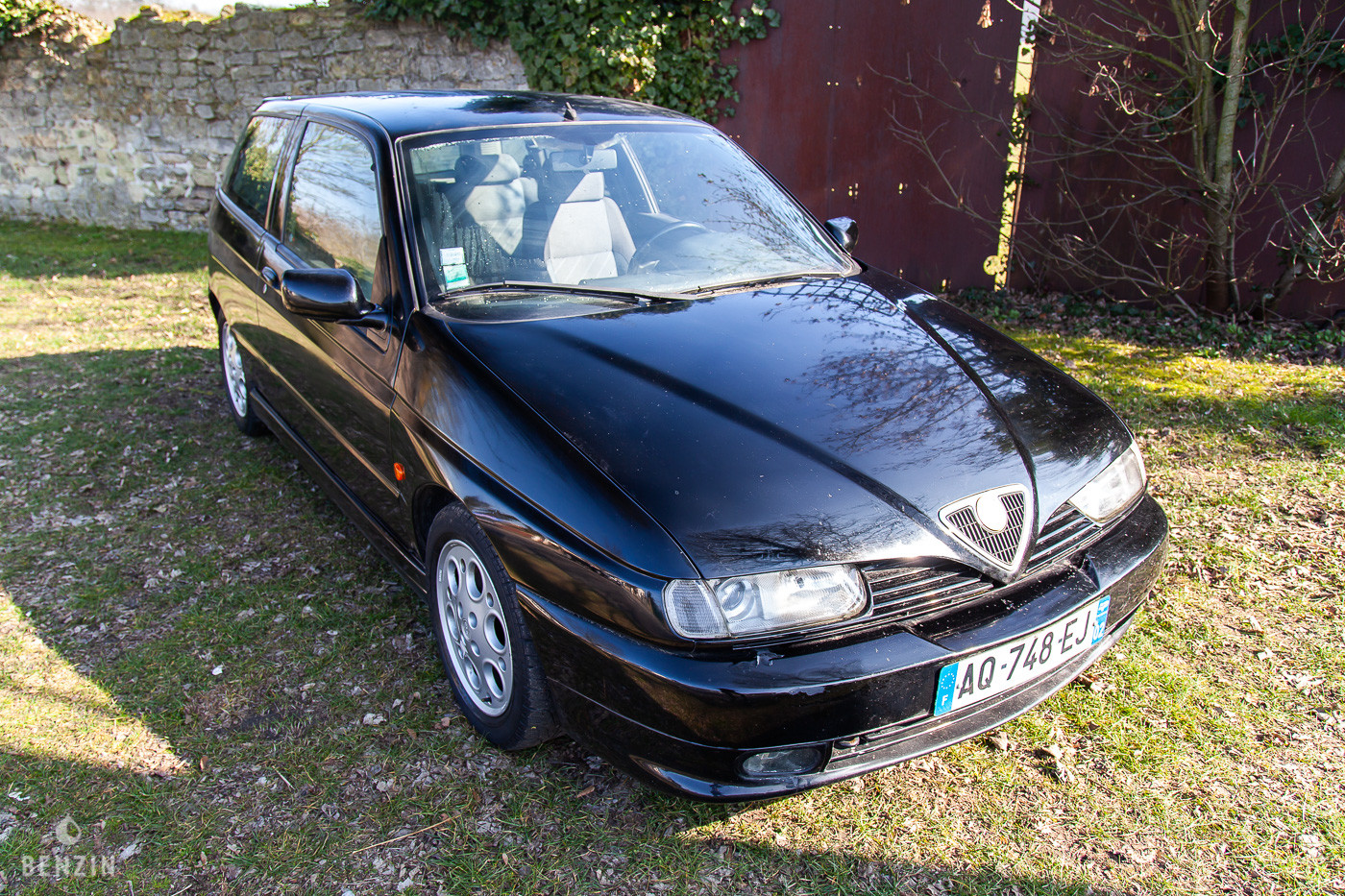
The Alfa Romeo 145 appeared in spring 1994 to replace the aging 33 and give the brand a more modern hatchback compact, built on the “Tipo 2” platform shared with the Fiat group. Its angular three-door body, designed by the Alfa Romeo Centro Stile under Chris Bangle, stands out for its very high truncated rear end and for a driver-focused cockpit, in the brand’s tradition. At launch, the 145 still retained the boxer engines inherited from the Alfasud and the 33, in 1.3, 1.6 and 1.7-liter 16-valve form, making it a true transition between the old Alfa school and the new front-wheel-drive generation. A 1.9 turbodiesel version quickly completed the range for some markets. From the outset, the 145 positioned itself as a characterful compact, less consensual than German or French rivals, but more expressive to drive and to look at.
The major evolution came in 1996-1997 with the gradual replacement of the boxers by transverse Twin Spark 16V engines with twin ignition: 1.4, 1.6, 1.8 and especially 2.0 liters. It is this 150 hp engine that gave birth to the 145 Quadrifoglio Verde, often abbreviated QV, now the most sought-after version and the one most readily associated with the model. The facelift remained discreet, with a revised interior presentation, improved perceived quality and equipment updates, but the philosophy did not change: a compact three-door, light, sharp at the front end and very Italian in character. Toward the end of its life, the range also expanded to include the 1.9 JTD, more economical and more modern, before production ended in 2000 in favor of the 147. In total, the 145 was produced in a little over 220,000 examples, far from the segment’s best-sellers, which explains its relative rarity today.
The 145 did not have a major official motorsport program, but it fostered a small brand culture made up of clubs, amateur builds and a genuine attachment from Alfisti to its boxer engines and then Twin Spark units. The 1995-1996 QV, with its 2.0 Twin Spark and specific presentation, now concentrates most of the collector interest, while the early boxer cars appeal for their sound and their direct technical link with the Alfasud. Long considered an affordable youngtimer, the 145 is now appreciated for its unique style, lively steering and special place in Alfa Romeo history, straddling two mechanical eras. Nice original examples are becoming hard to find, especially those that have escaped modifications, body corrosion or neglected maintenance that have removed a significant part of the surviving fleet.
Technical specifications
| 145 1.7 16V Boxer | 145 Quadrifoglio / QV 2.0 Twin Spark | 145 1.9 JTD |
| Production years | 1994-1996 | 1995-2000 | 1999-2000 |
| Body style | 3-door hatchback | 3-door hatchback | 3-door hatchback |
| Engine(s) | flat 4-cylinder, petrol, 16-valve | inline 4-cylinder, petrol, Twin Spark 16V | inline 4-cylinder, direct-injection turbo diesel |
| Displacement | 1,712 cc | 1,970 cc | 1,910 cc |
| Power | 129 hp | 150 hp | 105 hp |
| Transmission | front-wheel drive, 5-speed manual gearbox | front-wheel drive, 5-speed manual gearbox | front-wheel drive, 5-speed manual gearbox |
| Curb weight | around 1,100 kg | around 1,180 kg | around 1,200 kg |
| 0-100 km/h | around 9 s | around 8.4 s | around 10.5 s |
| Top speed | around 200 km/h | around 210 km/h | around 190 km/h |
| Production | a little over 220,000 units across all versions |
Buyer’s guide
The versions to favor are the 2.0 Twin Spark Quadrifoglio Verde/QV, for its performance and status as an iconic version, and the 1.6 Twin Spark for a better balance between enjoyment, running costs and parts availability. The early boxer cars have real mechanical charm and strong appeal among purists, but they require more meticulous maintenance and bodywork that is often more exposed to past repairs. It is better to avoid an attractive-looking example without recent proof of timing belt and engine maintenance, especially on Twin Spark cars.
Points to watch
- Twin Spark phase variator : diesel-like noise at startup or uneven idle on the 1.8 and 2.0 TS, sometimes also on other TS engines; ask whether the variator was replaced at the same time as the timing belt, as that is the logical job to do.
- Twin Spark timing belt : interval to be strictly respected on phase 2 145s, with idlers and water pump; check dated invoices, as a neglected belt is enough to condemn the top end.
- Twin Spark oil consumption : several owners report normal but sometimes high consumption; check the level, smoke when hot, bottom-end knocking and signs of top-ups spaced too far apart, especially on 2.0 QV cars driven hard.
- Manual gearbox and synchros : heavy shifting or crunching in 2nd and 3rd has been reported on high-mileage cars, boxer as well as Twin Spark; during the test drive, check it cold and then hot, as well as the absence of bearing hum.
- Front suspension : wishbones, bushings, tie rods and top mounts wear out and cause knocking on rough roads; this is common on the 145/146 and quickly degrades the steering precision that is nevertheless part of the model’s appeal.
- Body corrosion : watch the rear wheel arches, sills, floorpan at the jacking points, lower edge of the tailgate and windscreen surround; several cars have had approximate body repairs, sometimes hidden by fresh paint.
- Interior electrics : power windows, central locking, dashboard warning lights and poor earth contacts can cause intermittent faults on 1990s cars; check that everything works reliably, including ventilation and instrumentation.
- Cooling on boxer versions : irregular warm-up, radiator leaks or seepage around the cooling system can appear on the early 145s; check gauge stability, fan activation and the absence of mayonnaise.
When buying
On a 145 Twin Spark, the distribution, water pump and phase variator invoices matter more than anything, ideally with consistent dates and mileage. On a QV, it is useful to check that the 2.0 TS engine is indeed the original version and not just an aesthetic conversion. An inspection on a lift is particularly important to assess structural corrosion, the condition of the front suspension and the quality of any body repairs, while a compression test or at least a cold start test remains very revealing on tired engines.
1 of the 2 Alfa Romeo 145 listed on Benzin found a buyer — 50 % of completed sales.
No Alfa Romeo 145 is for sale at the moment. Follow the model to be notified as soon as a new one is listed.
Every vehicle comes with a detailed photo report, its history and the public exchanges between seller and community. You bid online; if you win, Benzin secures the payment and supports you through to delivery.
Follow the model from this page and you will get an e-mail as soon as a Alfa Romeo 145 is listed on Benzin.

 English
 Français
 Español
 Italiano
 Deutsch
 Polski
 Magyar