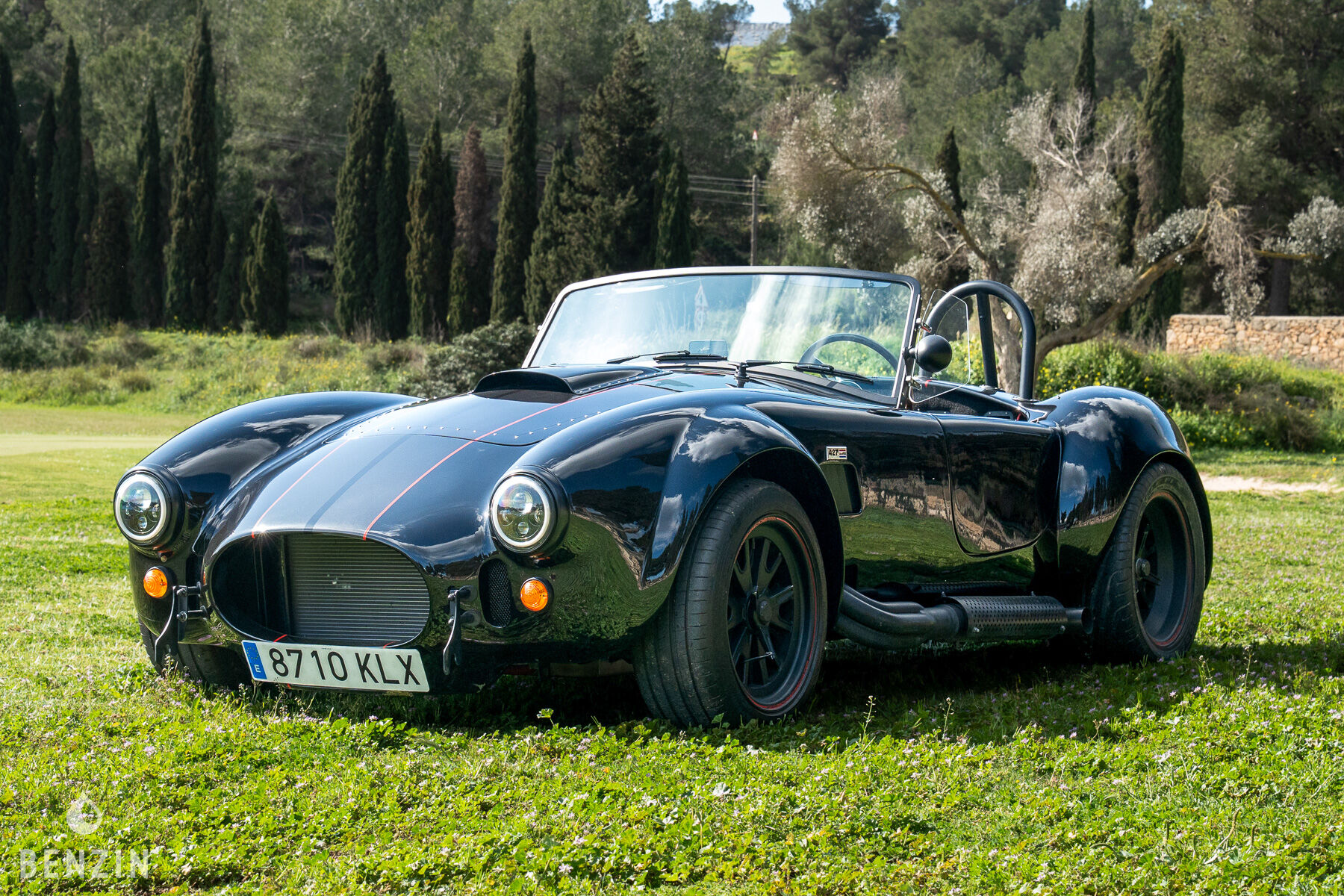
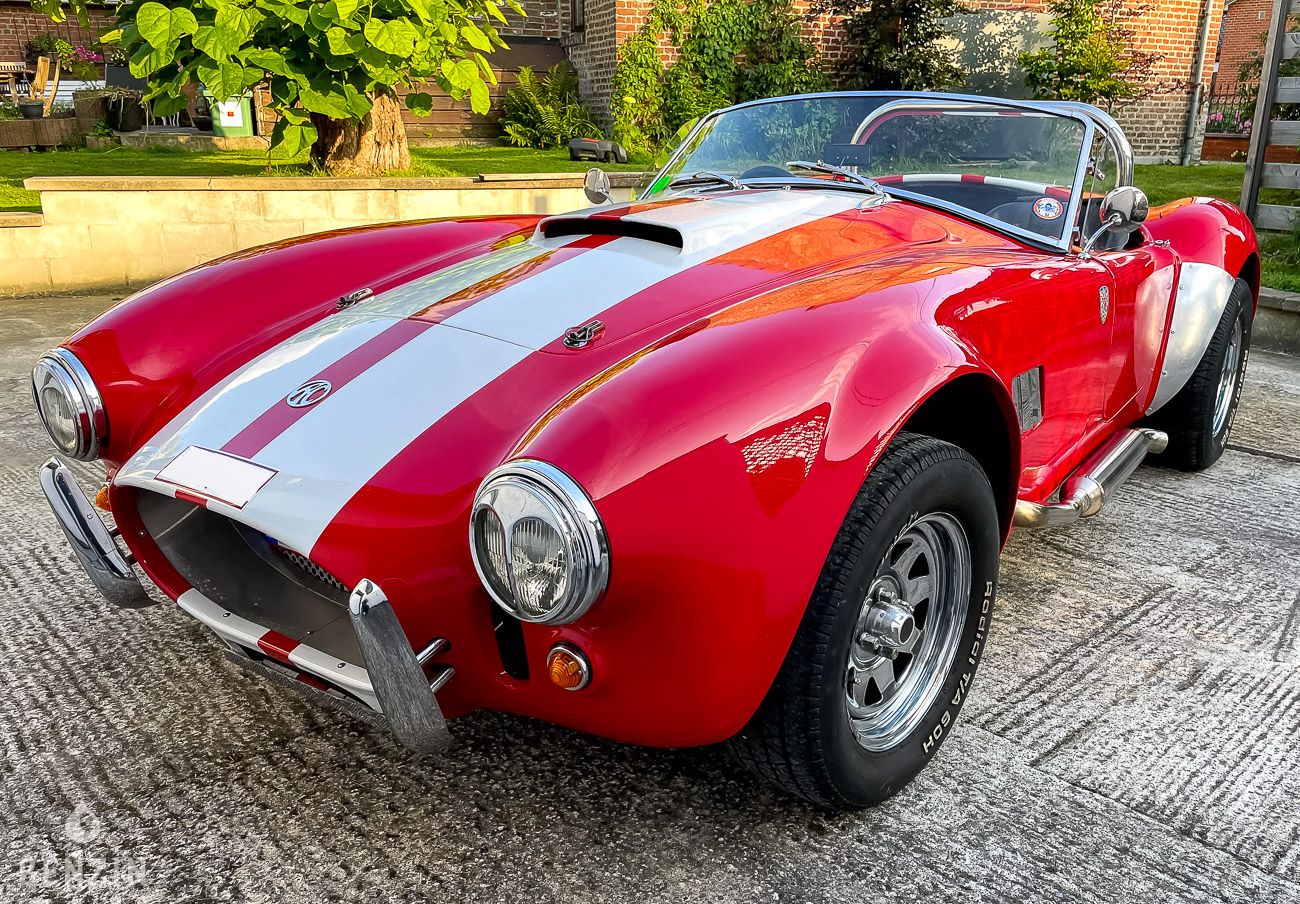
Born from the meeting between the small English AC Ace roadster and Carroll Shelby’s idea of fitting it with a Ford V8, the AC Cobra appeared in 1962 as one of the most explosive combinations of the 1960s. AC Cars supplied the tubular chassis and aluminum body, Shelby American handled the mechanical adaptation and the commercial and sporting program, while Ford first supplied the 260 ci small block V8 and then, above all, the 289 ci. The first Cobras, often called Mark I then Mark II depending on steering and suspension developments, remained relatively compact and light, with transverse leaf springs and very lively handling. In 1965 came the 427 Cobra, extensively reworked with a widened chassis and coil springs to accept the 427 ci FE big block V8, soon joined on some road cars by the smoother and less expensive 428 ci. This generation gave the Cobra its definitive image: swollen fenders, widened tracks, side exhausts and then outrageous performance. Competition played a central role in its legend, from FIA homologation of the 289s to the derived Daytona Coupé versions that beat Ferrari in GT racing, even if the 427 roadster became above all a road-going monster. Period production remained limited to fewer than a thousand examples across all versions, which explains the special place of the genuine Shelby/AC cars in the collector world.
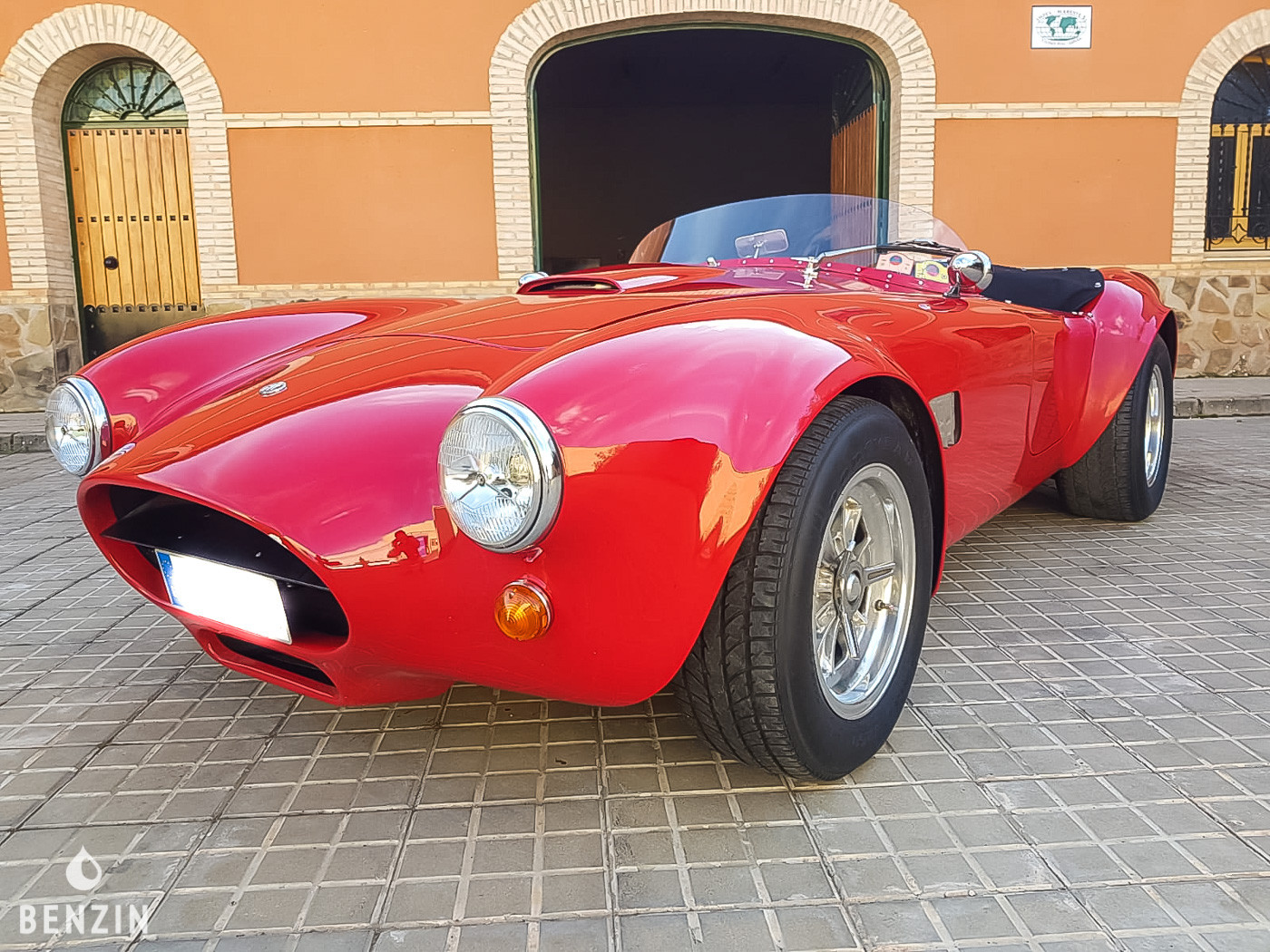
Yet the story does not end in 1967. In the 1980s, AC revived the formula with the Autokraft AC MkIV, assembled in England with an aluminum body, a much more careful finish and a 5.0-liter Ford Windsor engine, sometimes with fuel injection depending on the market and the year. The MkIV does not claim to be a sixties Shelby, but an official AC continuation, more civilized, better built and generally easier to use, which has earned it a specific audience today. At the same time, the Cobra silhouette became one of the most copied in the world: very diverse replicas, in kit form or assembled, appeared, including British Pilgrims, technically far removed from the original but visually close. For enthusiasts, it is therefore essential to distinguish between a period Cobra, an AC MkIV and a replica such as a Pilgrim, both for construction, registration and driving enjoyment. All of them, however, benefit from an intact cultural aura, fueled by racing, cinema, the unmistakable sound of the V8 and an image of a brutal roadster that few cars have matched.
Technical sheet
| Version | AC/Shelby Cobra 289 | AC/Shelby Cobra 427 | AC MkIV |
| Production years | 1962-1965 | 1965-1967 | from 1982, especially the 1980s-1990s |
| Body | 2-seat roadster, aluminum on tubular chassis | 2-seat roadster, aluminum on tubular chassis | 2-seat roadster, aluminum on tubular chassis |
| Engine(s) | Ford 260 then 289 ci V8 | Ford FE 427 ci V8, sometimes 428 ci on road cars | 5.0-liter Ford Windsor V8 |
| Power | around 260 to 271 hp depending on engine and specification | around 425 hp in 427 competition trim, less on some road-going 428s | around 225 to 250 hp depending on year and fuel system |
| Transmission | Rear-wheel drive, 4-speed manual gearbox | Rear-wheel drive, 4-speed manual gearbox | Rear-wheel drive, 5-speed manual gearbox |
| Weight | around 900 to 950 kg | around 1,050 to 1,100 kg | around 1,100 kg |
| 0-100 km/h | around 5.5 s | around 4.5 s | around 5.5 to 6.0 s |
| Top speed | around 240 km/h | around 260 km/h | around 225 to 240 km/h |
| Production | a few hundred examples | a few hundred examples | a few hundred examples |
Buyer’s guide
For a usable and clearly identified Cobra, the AC MkIV is often the most coherent choice: official AC construction, serious finish and a well-known Ford Windsor engine. The genuine 289s appeal through their purity and balance, while the 427s are the most iconic but also the most physical and the most sensitive to authenticity. Among replicas, a Pilgrim only makes sense if its build, mechanical base and registration are perfectly documented; this is where you need to be most selective.
Points to watch
- Tubular chassis : internal corrosion, old repairs or deformed tubes around the suspension mounting points; a crucial issue on period cars, on some MkIVs stored for a long time and on replicas built on chassis of varying quality; ask for clear underside photos and look for non-compliant repairs.
- Aluminum/steel interface : galvanic corrosion, paint blisters or tired mounting between the aluminum body and the structure; mainly concerns originals and MkIVs; inspect the sills, windshield posts, wheel arches and panel mounting areas.
- V8 cooling : tendency to overheat in slow traffic, unsuitable fans, undersized radiator or poorly bled cooling circuit; particularly common on 427s and on poorly sorted replicas; check temperature stability, radiator quality and fan installation.
- Carburetion : running too rich, unstable idle, fuel smell and failure to pass emissions testing; common on carbureted cars, whether originals or replicas, and sometimes on converted MkIVs; check the exact fuel system, synchronization and tuning invoices.
- Differential and rear mounts : drivetrain noises, leaks or cracks at the mountings under torque load; a known issue on very powerful cars or those driven hard, especially big block cars and some replicas; inspect the mountings, the condition of the silentblocs and any repair marks around the rear axle.
- Front suspension and steering : wandering, excessive torque steer or uneven tire wear due to poorly set geometry or mismatched components; common on Cobra replicas assembled from kits and on modified cars; check the consistency of the fitted parts and the geometry settings actually suited to the car.
- Windshield, side-screens and fittings : missing or non-interchangeable parts depending on the manufacturer; a frequent issue on MkIVs and especially on Pilgrim-type replicas, whose glass, frames and soft tops do not match AC or Shelby parts; confirm the presence of the specific items supplied with the car.
- Administrative identity : inconsistent make and type designation, no clear approval or a chassis number that does not match the stated manufacturer; a major issue on replicas and certain imported cars; check whether the car is registered as AC, Autokraft, Pilgrim or another, as this determines its status and the steps required.
At the time of purchase
On a genuine 1960s Cobra, authenticity comes first: chassis and engine numbers, original configuration, ownership history and, if possible, an opinion from a specialist recognized for the model. On an AC MkIV, you also need to confirm the exact Ford engine specification, the presence of the correct Autokraft components and the absence of major modifications. On a Pilgrim or any other replica, the key documents are the build file, identification of the donor base, consistency of the numbers and the exact nature of the registration; you should not rely on a modern certificate of conformity as you would for a recent car.
0 of the 4 AC Cobra listed on Benzin found a buyer — 0 % of completed sales.
No AC Cobra is for sale at the moment. Follow the model to be notified as soon as a new one is listed.
Every vehicle comes with a detailed photo report, its history and the public exchanges between seller and community. You bid online; if you win, Benzin secures the payment and supports you through to delivery.
Follow the model from this page and you will get an e-mail as soon as a AC Cobra is listed on Benzin.
 English
 Français
 Español
 Italiano
 Deutsch
 Polski
 Magyar