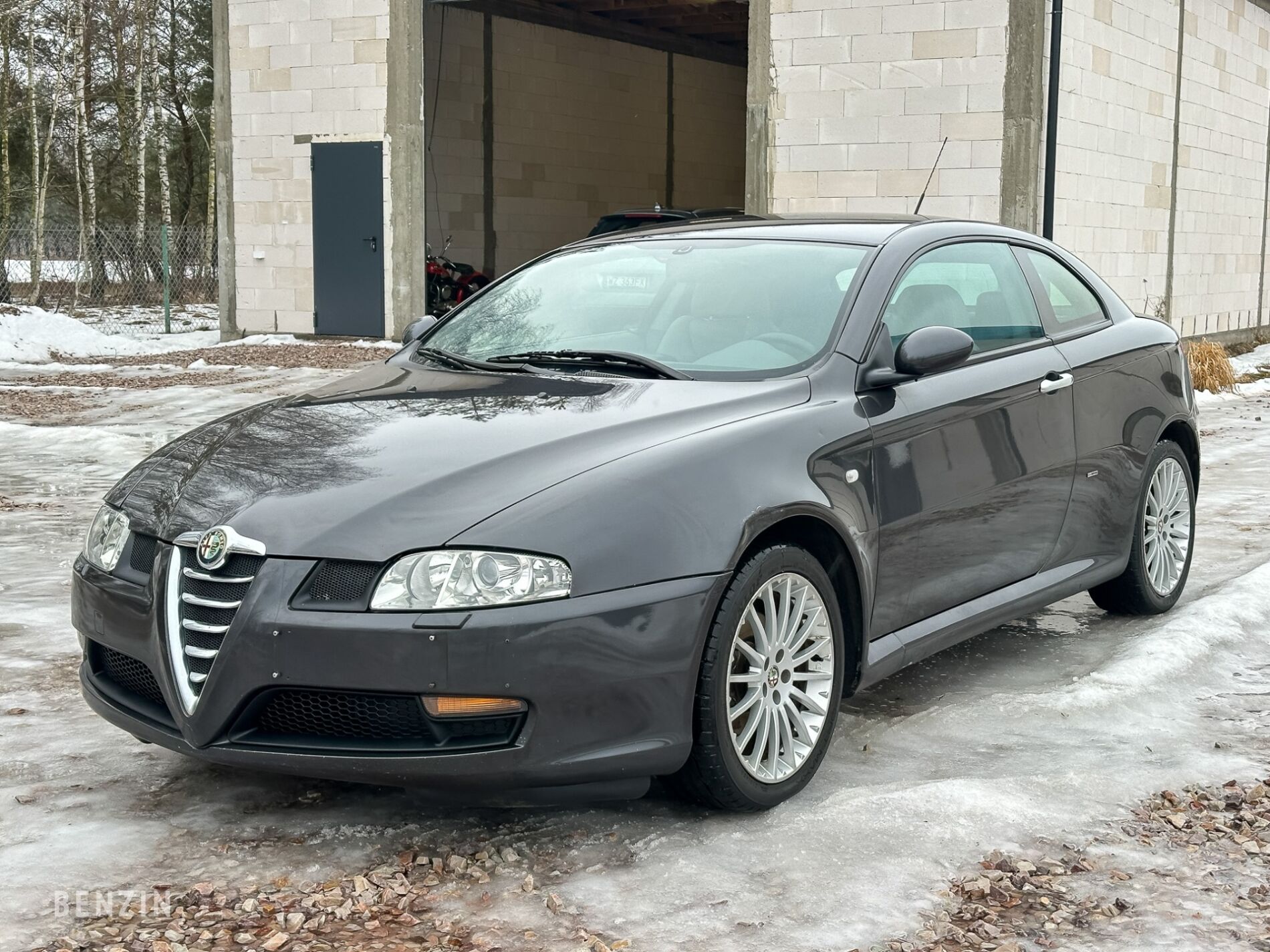
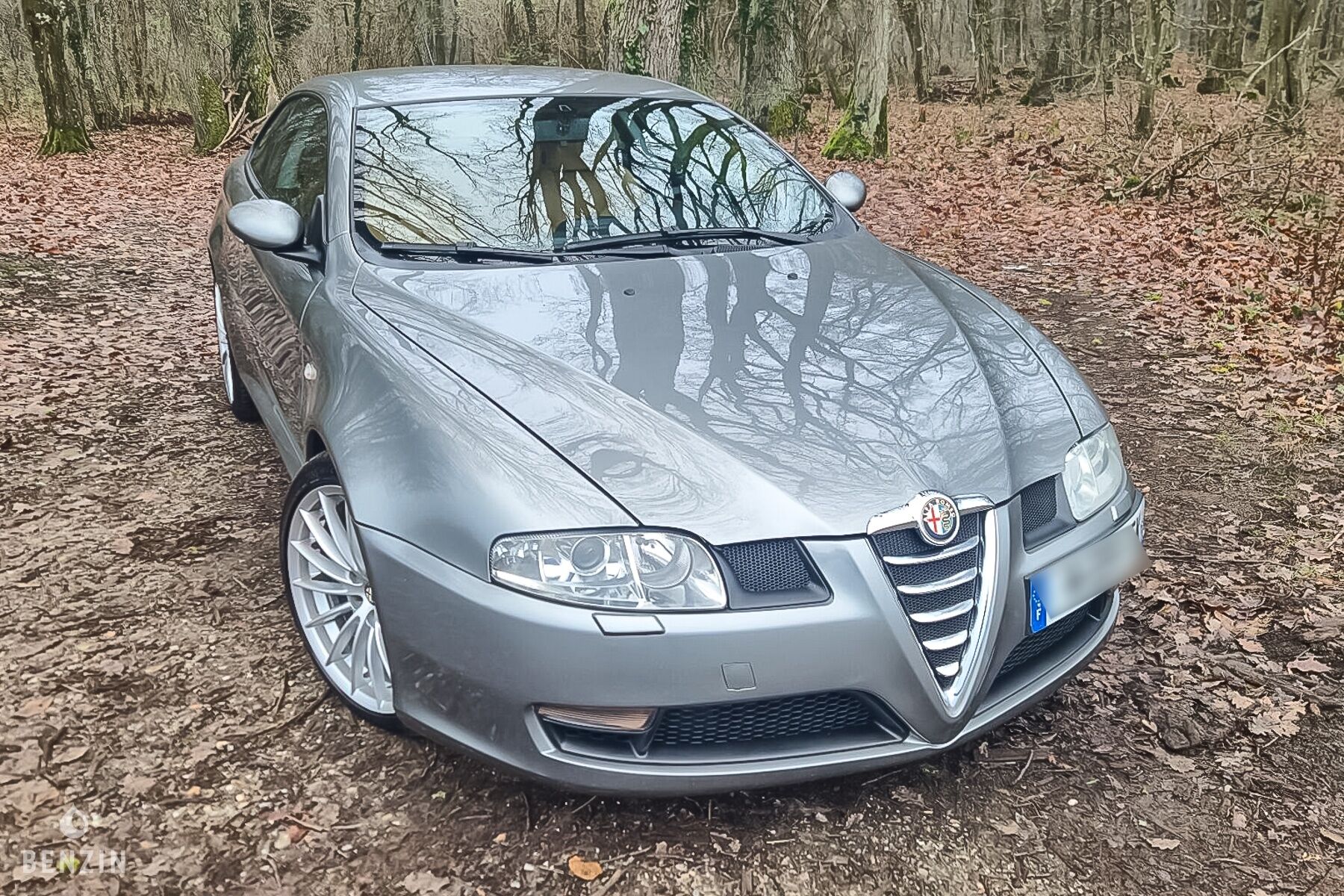
The Alfa Romeo GT type 937 is the compact coupé derived from the 147, unveiled at the 2003 Geneva Motor Show and sold from 2004. Its lines were penned by Bertone, which also handled assembly in Grugliasco, with a very pure style combining a contemporary Alfa front end and a particularly successful fastback roofline. Technically, the GT uses the “Tipo 937” platform from the 147 and 156, with a front-wheel-drive layout, double wishbone front suspension and an evolved McPherson rear axle. The model takes over the spiritual role of the accessible Alfa coupés, more practical than a GTV and more spacious than a strictly 2+2 coupé. From launch, the petrol range centered on the 1.8 Twin Spark, 2.0 JTS with direct injection and especially the 3.2 V6 24-valve “Busso”, while the 1.9 JTD/JTDM engines accounted for most of the volume in many European markets.
Over the course of its career, the GT evolved mainly through small changes in equipment, upholstery and special editions depending on the country, rather than through a true mid-cycle facelift. The versions that most appeal to enthusiasts today are the 3.2 V6s, for their sound, mechanical nobility and the fact that they are among the last high-volume Alfa models with a Busso engine. The 2.0 JTSs appeal thanks to their performance/usability balance, but require careful maintenance, while the 1.8 Twin Sparks are more accessible without being the most sought after. Like many powerful front-wheel-drive Alfas of this era, the differential issue often comes up on V6s, with many specialists recommending a Q2 or Quaife replacement for the original unit. Produced until 2010 in just over 80,000 examples, the GT carved out a truly unique place in the Alfa Romeo range, positioned in image between the sporty 147 and the more prestigious Brera.
Today, it is appreciated for its timeless design, excellent driving position, lively chassis and genuine practicality for a coupé of this size. Preserved examples, unmodified and properly maintained by knowledgeable specialists, are becoming harder to find, especially original, healthy V6s. The GT nevertheless remains a modern Alfa that is still usable every day, which explains its lasting success with clubs and brand enthusiasts.
Technical data
| Version | 1.8 Twin Spark | 2.0 JTS | 3.2 V6 24V |
| Production years | 2004-2010 | 2004-2010 | 2004-2007 |
| Body | 3-door coupé, 4 seats | 3-door coupé, 4 seats | 3-door coupé, 4 seats |
| Engine | Naturally aspirated inline 4-cylinder, 1747 cm³ | Naturally aspirated inline 4-cylinder with direct injection, 1970 cm³ | Naturally aspirated V6, 3179 cm³ |
| Power | 140 hp | 165 hp | 240 hp |
| Torque | 163 Nm | 206 Nm | 289 Nm |
| Transmission | Front-wheel drive, 5-speed manual gearbox | Front-wheel drive, 5- or 6-speed manual gearbox depending on market | Front-wheel drive, 6-speed manual gearbox |
| Curb weight | approx. 1,290 kg | approx. 1,365 kg | approx. 1,500 kg |
| 0-100 km/h | approx. 9.6 s | approx. 8.7 s | approx. 6.7 s |
| Top speed | approx. 208 km/h | approx. 216 km/h | approx. 243 km/h |
| Production | Just over 80,000 units across all versions |
Buyer’s guide
The 3.2 V6 is the most desirable version for the fan of modern classic Alfa Romeos, provided it is mechanically sound and the differential issue has been addressed or at least closely monitored. The 2.0 JTS is often the best compromise between usability and enjoyment, but only with a clear history for the timing belt, ignition and engine warning lights. The 1.8 TS is simpler and often less expensive to run, but it appeals less to collectors.
Points to watch
- Gearbox differential on 3.2 V6 : clunking under load, irregular traction, metal shavings or noisy gearbox on cars left with the original differential; V6s are the most affected, and it is necessary to check whether a Q2 or a Quaife has been fitted, with invoice to back it up.
- Timing belt : a deadline not to be neglected on all petrol engines, with possible engine failure if the job is overdue or poorly done; ask for the date, mileage, and whether the water pump, pulleys and accessories were replaced at the same time.
- Twin Spark/JTS phase variator : diesel-like noise on cold start, less smooth idle and reduced refinement; especially on 1.8 TS and 2.0 JTS, to be checked if the variator was changed during a timing belt service.
- 2.0 JTS, intake and engine management : recurring engine warning light, hesitation on acceleration, unstable idle or abnormal consumption; on this engine, owners report intake clogging, airflow meter, lambda sensors, coils and sometimes the ECU, hence the value of a diagnostic scan before purchase.
- Cooling system : cracked expansion tank, leaking hoses, worn thermostat or abnormal temperature rise; especially to watch on cars that are driven little, and even more so on V6s where any overheating must be taken seriously.
- Running gear : knocking on rough roads, less precise steering and uneven tire wear; the front wishbones, tie rods and rear suspension bushes are classic weak points on the 147/GT platform, to be checked on a lift.
- Sills and lifting points : deformation under the sills, chipped paint or localized corrosion due to poorly placed lifting points; this is a frequently noted issue on GTs, and you need to look underneath rather than just the visible sides.
- Comfort electronics : inoperative parking sensors, intermittent airbag warning light, minor locking or accessory faults; on a GT, these issues are often minor but annoying, and deserve a full functional check.
At the time of purchase
On a petrol GT, timing belt invoices are the key document, ideally with details of the parts replaced and the name of an Alfa specialist. A full electronic diagnostic is very useful, especially on the 2.0 JTS, to check stored faults for the engine, ABS and airbag, even if no warning light is on on the day of the inspection. On a 3.2 V6, the car should also be tested under load and during maneuvering to detect any transmission noise, then it should be checked in writing whether the differential is still original. Finally, the presence of duplicate keys and a properly maintained service book matters more than elsewhere, because some electronic or immobilizer repairs can quickly become expensive.
On Benzin a Alfa Romeo GT type 937 has sold for 10 119 € on average, with a median price of 8 933 €. Based on the 6 sales completed on the platform.
The 6 Alfa Romeo GT type 937 sold on Benzin changed hands for between 3 750 € and 17 400 €, depending on condition, mileage and version.
6 of the 11 Alfa Romeo GT type 937 listed on Benzin found a buyer — 55 % of completed sales.
No Alfa Romeo GT type 937 is for sale at the moment. Follow the model to be notified as soon as a new one is listed.
Every vehicle comes with a detailed photo report, its history and the public exchanges between seller and community. You bid online; if you win, Benzin secures the payment and supports you through to delivery.
Follow the model from this page and you will get an e-mail as soon as a Alfa Romeo GT type 937 is listed on Benzin.
 English
 Français
 Español
 Italiano
 Deutsch
 Polski
 Magyar