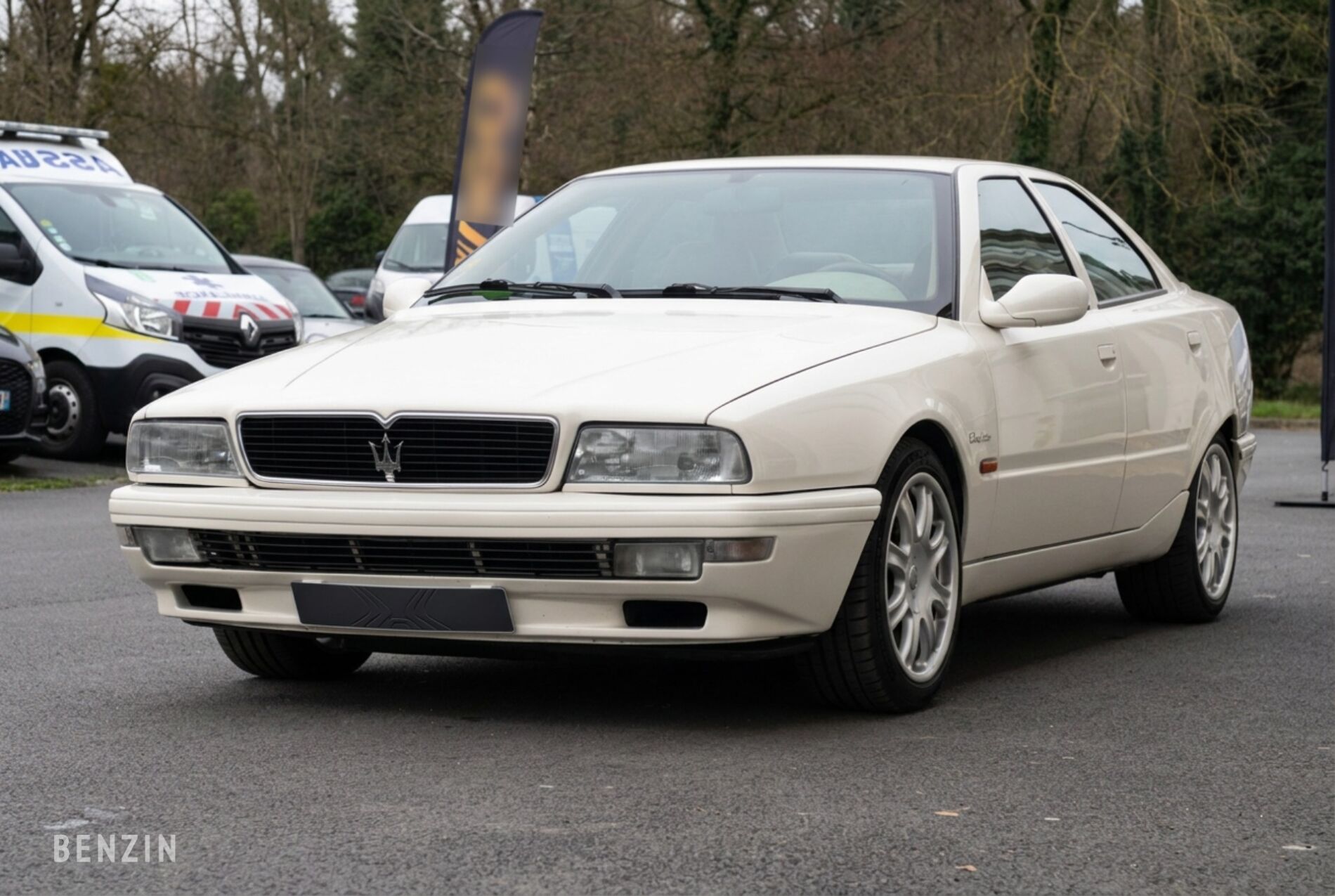
Launched in 1963, the Maserati Quattroporte pioneered the idea of the very high-performance Italian sedan, with a body designed by Pietro Frua and a competition-derived V8 mounted at the front. The first series, then the front-wheel-drive Quattroporte II developed under the Citroën era, and the Quattroporte III styled by Giugiaro, each reflected the brand’s industrial shifts more than strict technical continuity. The Quattroporte IV, introduced in 1994 on a platform close to the Ghibli and Shamal, returned to a more compact and sporty format, with twin-turbo V6s and then a 3.2-liter twin-turbo V8, before the 1998-2001 Evoluzione series, which benefited from a thoroughly revised build after Ferrari took control. It is this Quattroporte IV Evoluzione V8, rare and more carefully assembled, that now attracts the interest of Maserati Biturbo-era youngtimer enthusiasts.
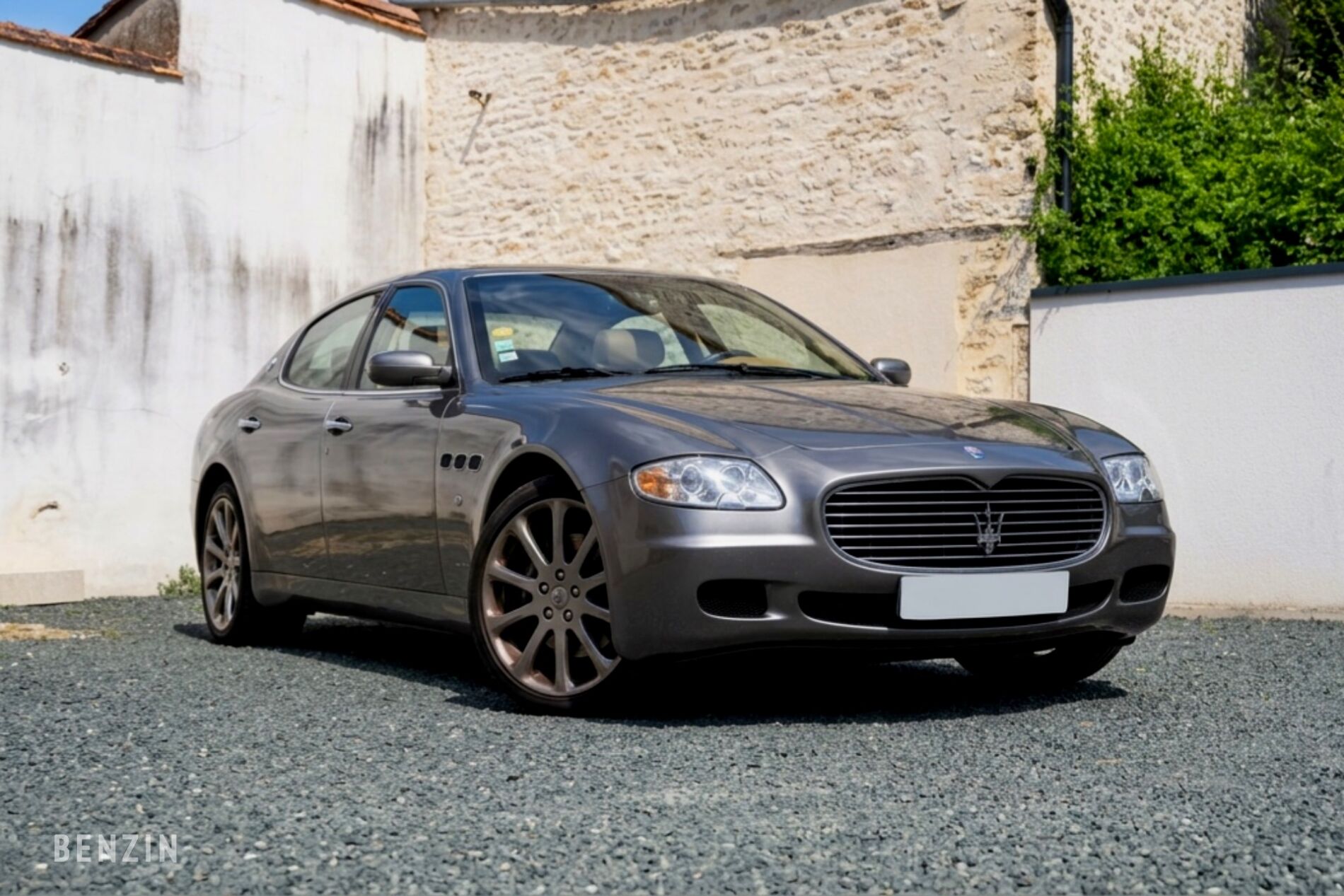
The major modern turning point came in 2003 with the Quattroporte V, code M139, designed by Pininfarina under the direction of Ken Okuyama and powered by a Ferrari-Maserati F136 naturally aspirated V8 of 4.2 liters. The first examples received the DuoSelect transaxle robotized gearbox, much appreciated for chassis balance and mechanical character, but far more demanding in use and maintenance than the ZF torque-converter automatic adopted from 2007 on the Quattroporte Automatica. The range then expanded with the Executive GT trim, more focused on comfort and rear-seat space, then with the Quattroporte S and Sport GTS with a 4.7-liter engine, more powerful, faster and now particularly sought after. Produced until 2012, this generation has become the quintessential modern classic Quattroporte, elegant, sonorous and still relatively analog despite its onboard electronics.
In 2013 came the Quattroporte VI, larger and more international, with V6 and V8 twin-turbo engines developed with Ferrari; the GTS gets a 3.8-liter V8 with 530 hp and marks a clear step up in outright performance. If this sixth generation is better suited to long journeys and daily use, many enthusiasts still prefer the personality of the M139, while connoisseurs of 1990s Maserati seek out the last Evoluzione models for their rarity. The Quattroporte thus remains a model apart in Maserati history: less widespread than its German rivals, but rich in image, sound and presence, with a real hierarchy between versions depending on the gearbox, engine and quality of maintenance.
Technical specifications
| Version | Quattroporte IV Evoluzione V8 | Quattroporte V 4.2 ZF / Executive GT | Quattroporte VI GTS |
| Production years | 1998-2001 | 2007-2012 | 2013-2016 (phase 1) |
| Body style | 4-door sedan | 4-door sedan | 4-door sedan |
| Engine | Twin-turbo V8, 3,217 cc | Naturally aspirated V8, 4,244 cc | Twin-turbo V8, 3,799 cc |
| Power | 335 hp | 400 hp | 530 hp |
| Transmission | Rear-wheel drive, manual or automatic transmission depending on market | Rear-wheel drive, 6-speed ZF automatic transmission | Rear-wheel drive, 8-speed automatic transmission |
| Curb weight | About 1,700 kg | About 1,990 kg | About 1,900 kg |
| 0 to 100 km/h | About 5.8 s | About 5.6 s | About 4.7 s |
| Top speed | About 270 km/h | About 270 km/h | About 307 km/h |
Buyer’s guide
For peace of mind, the Quattroporte V 4.2 with ZF gearbox, including Executive GT, are generally the most recommended: they retain the style and naturally aspirated V8 while avoiding the constraints of the DuoSelect. The Quattroporte S and Sport GTS 4.7 are the most desirable for their engine and driving pleasure, but running costs are often higher; conversely, a 4.2 DuoSelect should only be considered if its clutch, gearbox settings and transmission history are perfectly documented. As for the Quattroporte IV, the Evoluzione models should be favored over the early series for their clearly improved build quality.
Points to watch
- DuoSelect gearbox and clutch : rapid clutch wear and very variable drivability on Quattroporte V from 2003-2006, especially in town; ask for a diagnostic reading of clutch wear, the PIS value and self-learning values rather than relying on a simple road test impression.
- Front suspension arms and ball joints : play in the upper and lower arms, knocks and imprecise steering are common on the M139, sometimes noted during the technical inspection; check invoices for replacement of the control arms and a wheel alignment performed after the work.
- Skyhook adaptive damping : worn dampers, suspension warning lights or inconsistent behavior on Quattroporte V and S/Executive GT; check for the absence of faults in diagnostics and the condition of the four struts, which are expensive to replace.
- Interior “sticky buttons” and headliner : gummy button coating that sticks or wears off, and headliner that peels over time, very common on the Quattroporte V; ask whether the controls have been properly refinished and not simply cleaned.
- Lambda sensors, coils and engine warning lights : misfires, intermittent engine warning light or catalytic converters faulted on the V8 4.2 and 4.7; check for replacement of coils, spark plugs and sensors, as well as the absence of stored fault codes.
- Power windows and comfort electronics : window mechanisms, TPMS sensors, central locking and small body modules can cause recurring issues on the M139; everything should work without any spurious message in the instrument cluster.
- Quattroporte IV timing system : on the 3.2 biturbo Evoluzione, the timing belt and cooling system are critical points if the car is driven little; there should be dated proof of replacement of the belt, tensioners and ideally the water pump.
When buying
On a Quattroporte V, a diagnostic scan is essential: it allows you to read clutch wear on DuoSelect versions, Skyhook suspension faults, and stored engine anomalies even if no warning light is on. For an import, check for the certificate of conformity or its equivalent, as well as consistency between the service book, invoices, and successive registration countries. On a Quattroporte IV Evoluzione, timing and cooling system invoices matter more than mileage alone, and on all versions it is preferable to confirm that both keys, the manuals and, if possible, the stamped service book are present.
On Benzin a Maserati Quattroporte has sold for 20 543 € on average, with a median price of 19 600 €. Based on the 8 sales completed on the platform.
The 8 Maserati Quattroporte sold on Benzin changed hands for between 13 600 € and 29 200 €, depending on condition, mileage and version.
8 of the 26 Maserati Quattroporte listed on Benzin found a buyer — 31 % of completed sales.
No Maserati Quattroporte is for sale at the moment. Follow the model to be notified as soon as a new one is listed.
Every vehicle comes with a detailed photo report, its history and the public exchanges between seller and community. You bid online; if you win, Benzin secures the payment and supports you through to delivery.
Follow the model from this page and you will get an e-mail as soon as a Maserati Quattroporte is listed on Benzin.
 English
 Français
 Español
 Italiano
 Deutsch
 Polski
 Magyar
