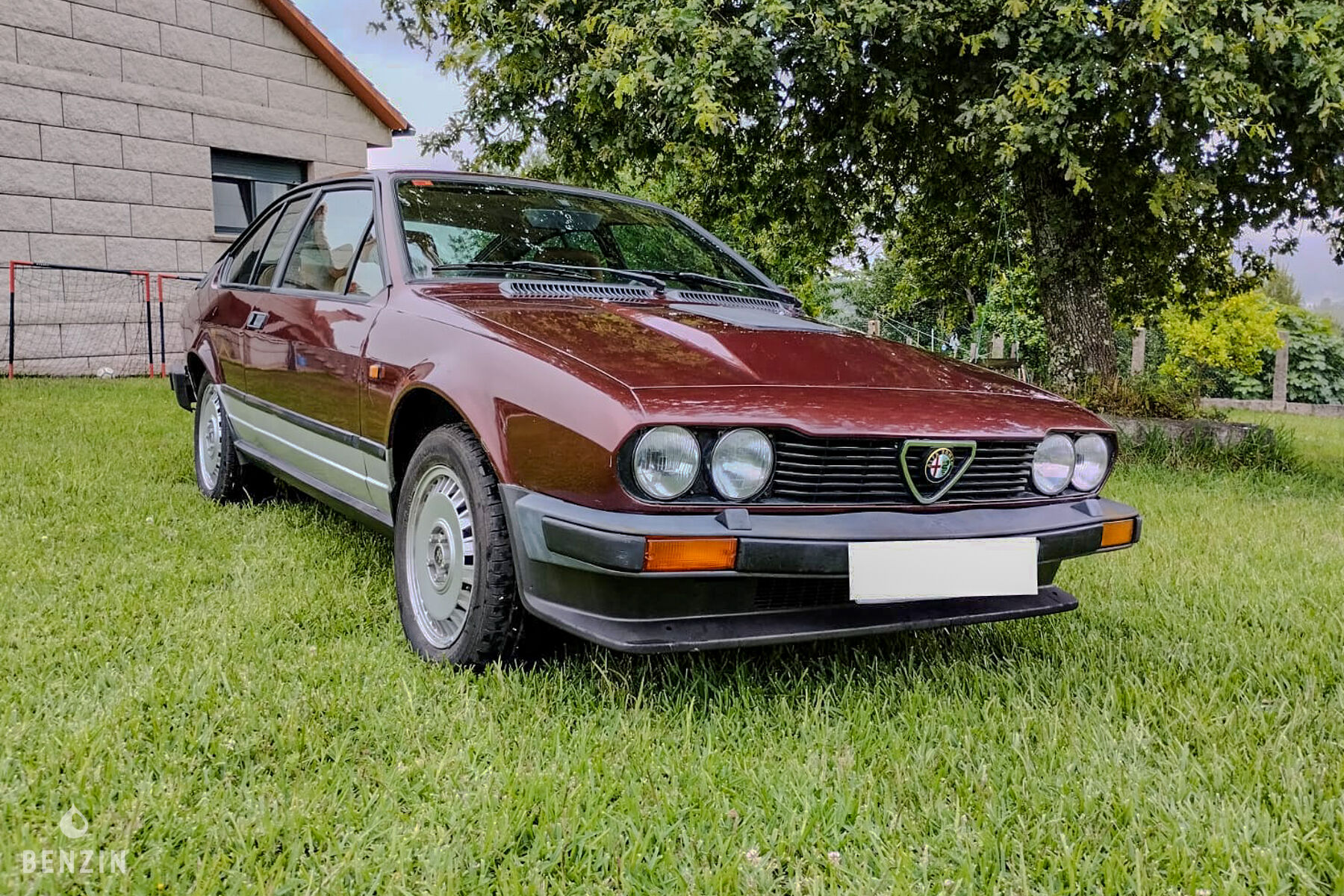
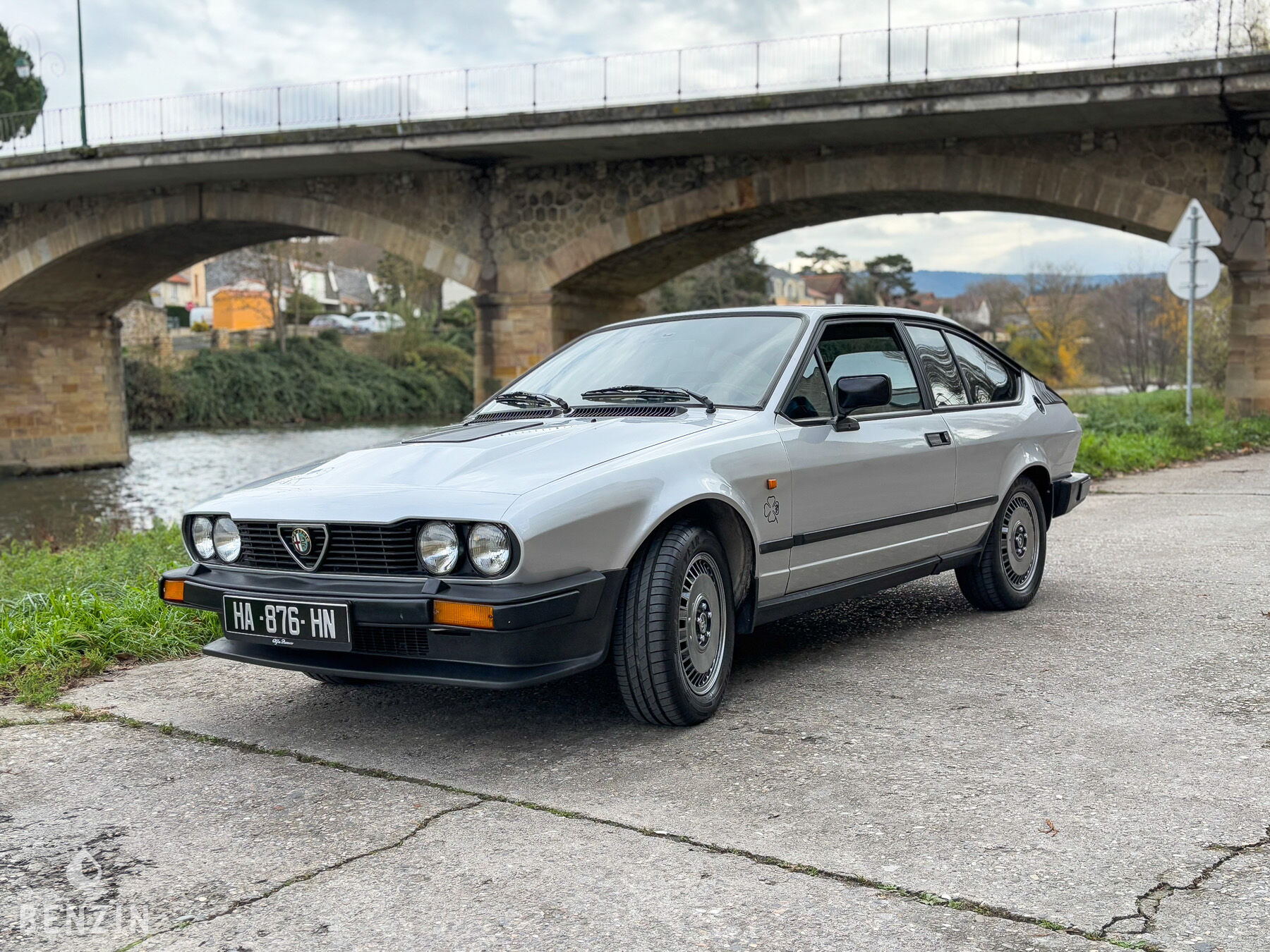
The Alfetta GT appeared in 1974 as the coupé version of the Alfetta sedan, using its 116 technical base with front engine, rear transaxle gearbox, and De Dion rear axle, a very sophisticated layout for the time. Its lines were drawn by Giorgetto Giugiaro at Italdesign, with a very practical hatchback, a long hood, and a visual balance that stood apart from the more classic Alfa Romeo coupés of the 1960s. The first engine was the all-aluminum 1.8-liter twin-cam four-cylinder, soon joined by 1.6- and 2.0-liter units depending on the market, while the name evolved from GT to GTV over the course of its career. In 1976, the Alfetta GTV 2000 became the most complete and most capable four-cylinder version, with its two-liter bialbero, often fed by two carburetors on European versions.
In 1980, the model was extensively revised and lost the Alfetta name in many markets to become simply Alfa Romeo GTV, recognizable by its new front end, modernized interior, and more substantial exterior trim. The major new arrival was the GTV6 2.5, which received the Bosch-injected “Busso” V6 and turned the coupé into a true sporty grand tourer, with a now-iconic soundtrack. The four-cylinder GTV 2.0 remained in the range until the mid-1980s, while the GTV6 continued until 1986 depending on the market, with a few special editions and local variants. The whole family retained the same transaxle principle, much appreciated for traction and balance, but demanding in setup and maintenance.
The GTV6 made its mark in competition, especially in touring cars, where it built a very strong reputation in the early 1980s, while the road versions became driving classics rather than mere static collectibles. Total production of the Alfetta GT, GTV and GTV6 coupés exceeds 220,000 units, making it a fairly widely produced model but one that is now much less common in good structural condition. Enthusiasts mainly seek well-sorted GTV 2.0s and original GTV6s, for their balance of style, technical layout, and mechanical character. Truly sound survivors are now more valued than hastily restored cars, because corrosion and certain transmission repairs can quickly make the difference between a good car and a heavy restoration.
Technical data
| Version | Alfetta GT 1.8 | GTV 2.0 | GTV6 2.5 |
| Production years | 1974-1976 | 1976-1986 | 1980-1986 |
| Body style | 2+2 hatchback coupé | 2+2 hatchback coupé | 2+2 hatchback coupé |
| Engine(s) | Inline 4-cylinder twin-cam, 1,779 cc | Inline 4-cylinder twin-cam, 1,962 cc | 60° V6, 2,492 cc, Bosch injection |
| Fuel system | Two carburetors | Two carburetors depending on versions and markets | Electronic fuel injection |
| Power | Around 122 hp | Around 130 hp | Around 160 hp |
| Transmission | Rear-wheel drive, 5-speed transaxle manual | Rear-wheel drive, 5-speed transaxle manual | Rear-wheel drive, 5-speed transaxle manual |
| Curb weight | Around 1,050 kg | Around 1,100-1,140 kg | Around 1,180-1,210 kg |
| 0-100 km/h | Around 9.5 s | Around 9 s | Around 8 s |
| Top speed | Around 190 km/h | Around 195-200 km/h | Around 210-215 km/h |
| Architecture | Front engine, rear transaxle gearbox, De Dion axle | Front engine, rear transaxle gearbox, De Dion axle | Front engine, rear transaxle gearbox, De Dion axle |
| Production | Alfetta GT / GTV / GTV6 family: more than 220,000 units in total |
Buyer’s guide
For regular use, GTV 2.0s are often the best compromise between performance, maintenance costs, and parts availability, especially when the body is very sound. The GTV6 is the most sought-after for its Busso V6 and its importance in the model's history, but it must be bought on the quality of its structure and recent mechanical work, not just on its engine. The early GT 1.8s appeal through the purity of their lines and their light weight, but they are rarer in good original condition and harder to find properly restored.
Points to watch
- Structural corrosion : the sensitive areas are the chassis rails, sills, jacking points, floors, front wing bottoms, windscreen surround, tailgate surround, and front wheel arch on the engine-bay side; this concerns the entire 116 series and is the first topic on a repainted car. The car should be inspected on a lift, and photos before paint or during restoration should be requested.
- Towers and engine bay : blisters or repairs around the front shock towers, the battery tray, and the right front wing are not uncommon; on these coupés, poorly repaired corrosion in this area can hide major work. Check the alignment of the openings and the appearance of the original welds.
- Transaxle gearbox : a tired 2nd-gear synchro, stiff engagement when cold, whining, or crunching on deceleration are classics, especially on cars used hard. On a test drive, the gearbox should remain precise once warm and should not jump out of gear.
- Driveshaft and flex discs : vibrations between 70 and 110 km/h, jerks on takeoff, or a clunk when getting back on the throttle often betray flex discs, a center bearing, or poor driveshaft alignment. This is typical of Alfa transaxle cars, and a proper overhaul requires care, not just replacing a single part.
- Inboard rear brakes : the rear discs and calipers mounted near the axle heat up, seize, or leak more easily, with a handbrake that is often poor if maintenance has been neglected. You should ask exactly what has been redone, because access makes labor expensive.
- 1.8 and 2.0 bialbero engines : uneven idle, hesitation on acceleration, difficult hot starts, or a strong smell of fuel often come from worn or poorly adjusted carburetors, air leaks, or approximate ignition timing. On these versions, you need to know whether the carburetors have been rebushed/rebuilt and by whom.
- GTV6: timing and cooling : the Busso V6 is robust, but an old timing belt, a tired water pump, or a clogged cooling system can be expensive. On a GTV6, you need dated proof of replacement of the belt, tensioners, and ideally the water pump.
- De Dion rear axle and bushings : vague cornering, a car that sits oddly over bumps, or abnormal tire wear can come from the wishbone bushings, the Watt's linkage, or the De Dion axle. This is crucial on a GTV, because road behavior is part of the model's appeal.
When buying
The most important items are detailed proof of bodywork, ideally with photos, and invoices specifically for the transaxle transmission, rear brakes, and rear axle, as these are expensive items on this model. On a GTV6, a recent timing belt invoice is almost indispensable; on a carbureted 2.0, a compression test and an inspection of the carburation/ignition setup are very useful. Also check that the engine type and chassis number match the advertised version, as well as the displayed mileage, since the odometers on many cars in the series have five digits.
On Benzin a Alfa Romeo GTV / Alfetta has sold for 12 450 € on average, with a median price of 12 200 €. Based on the 7 sales completed on the platform.
The 7 Alfa Romeo GTV / Alfetta sold on Benzin changed hands for between 5 700 € and 18 150 €, depending on condition, mileage and version.
7 of the 19 Alfa Romeo GTV / Alfetta listed on Benzin found a buyer — 37 % of completed sales.
No Alfa Romeo GTV / Alfetta is for sale at the moment. Follow the model to be notified as soon as a new one is listed.
Every vehicle comes with a detailed photo report, its history and the public exchanges between seller and community. You bid online; if you win, Benzin secures the payment and supports you through to delivery.
Follow the model from this page and you will get an e-mail as soon as a Alfa Romeo GTV / Alfetta is listed on Benzin.
 English
 Français
 Español
 Italiano
 Deutsch
 Polski
 Magyar