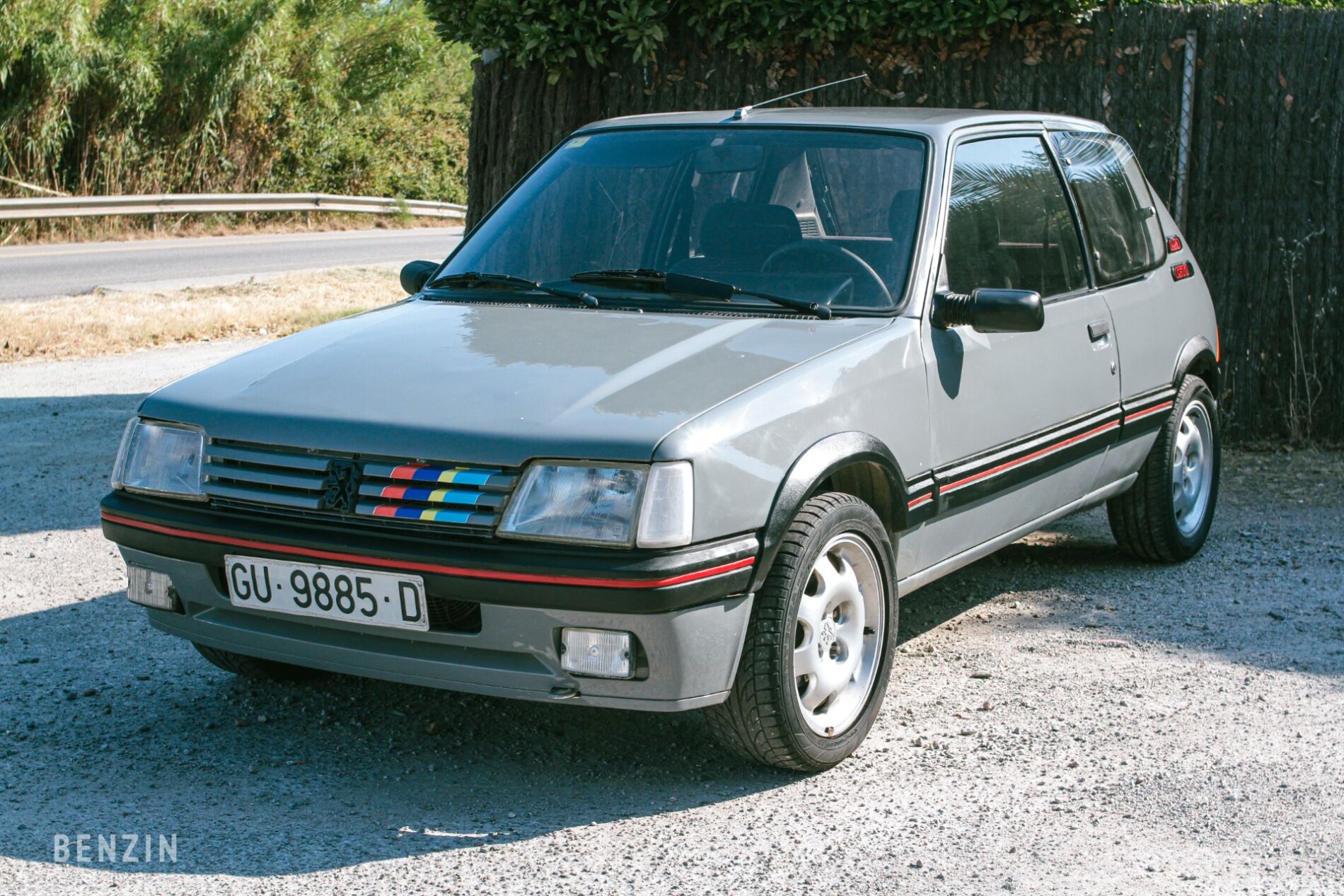
The Peugeot 205 GTI appeared in 1984 in a category then in full swing, that of versatile small sports cars, with the mission of giving the 205 the image-led version missing from an already successful range. Styled in the wake of the design launched by Gérard Welter for the 205, with an interior redesigned by Paul Bracq, it kept the city car’s three-door silhouette while adding black wheel arch extensions, red trim strips, specific wheels and a much sharper chassis. The first version was the 1.6-liter 105 hp, quickly followed by a 115 hp version that became the benchmark of the early years thanks to its very lively character and modest weight. In 1986 came the 1.9 GTI with 130 hp, more torquey, faster and also fitted with rear disc brakes, broadening its range even further without losing its character. Its career continued in stages, with detail changes to the interior trim, fabrics and upholstery, running gear, gearboxes and certain equipment depending on model year and market.
At the end of its commercial life, the 205 GTI had to comply with emissions regulations and some 1.9s were fitted with a catalytic converter, with power reduced to 122 hp depending on the country and year. In France, the best-known special edition is the 1991 Griffe, recognizable by its metallic fluorite green color and specific presentation; other names such as Le Mans, Monte Carlo or Classique Sport mainly refer to limited runs or end-of-series versions depending on export markets. The 205 GTI should not be confused with the more stripped-down 205 Rallye, nor with the competition 205 Turbo 16, but it fully benefits from the sporting aura of the Peugeot range in the 1980s. Although not a rally car in the strict sense, it made its mark in one-make series, slaloms, hill climbs and amateur builds, so sound is its base and so well known is its lively rear-end behavior. Produced in more than 300,000 units across all versions, it has become one of the most sought-after French youngtimers.
Its reputation rests on a balance that has become rare: direct steering, incisive front end, very expressive XU engine and compact dimensions. Enthusiasts still compare the lightness and spontaneity of the 1.6s with the rev range and torque of the 1.9s, without either school really winning out. Original examples, with correct upholstery, wheels and steering wheel, are the hardest to find because many have been modified, crashed, repainted or reconfigured. Today, the 205 GTI occupies a special place among French mainstream sports cars: produced in enough numbers to be known by everyone, but now rare enough in good condition to demand real caution when buying.
Technical data
| 205 GTI 1.6 105 | 205 GTI 1.6 115 | 205 GTI 1.9 |
| Production years | 1984-1987 approx. | 1986-1992 approx. | 1986-1994 approx. |
| Body style | 3-door hatchback | 3-door hatchback | 3-door hatchback |
| Engine | 4-cylinder inline XU5J, injection | 4-cylinder inline XU5JA, injection | 4-cylinder inline XU9JA, injection |
| Displacement | 1,580 cc | 1,580 cc | 1,905 cc |
| Power | 105 hp | 115 hp | 130 hp, then 122 hp on catalyzed versions |
| Transmission | Front-wheel drive, 5-speed manual gearbox | Front-wheel drive, 5-speed manual gearbox | Front-wheel drive, 5-speed manual gearbox |
| Rear brakes | Drums | Drums | Discs |
| Curb weight | approx. 850-875 kg | approx. 875 kg | approx. 900-950 kg |
| 0-100 km/h | approx. 8.9 s | approx. 8.7 s | approx. 7.8 to 8.4 s depending on version |
| Top speed | approx. 190 km/h | approx. 195 km/h | approx. 205 to 208 km/h, around 200 km/h in 122 hp form |
| Production | More than 300,000 examples in total for the entire 205 GTI range |
Buyer’s guide
The 1.9 130 hp versions are the most iconic, especially in a well-documented original configuration, with their correct interior, wheels and mechanicals. For the best compromise between enjoyment, reliability and running costs, many enthusiasts also appreciate the 1.6 115 hp, lighter at the front and often less abused than the 1.9. Converted, swapped, widened cars or those rebuilt from a standard shell, however, require a much more thorough inspection than average.
Points to watch
- Rear axle : very negative rear camber, wheels that “tuck in” at the top, creaks or abnormal ride height; this is the classic 205 GTI issue due to wear in the needle bearings and sometimes the arm shafts. The car’s stance must be checked, and you should ask whether the axle has been rebuilt and with which parts.
- Body and underbody : corrosion at the lower rear wings near the junction with the sill, boot floor, jacking points, front subframe, windscreen surround and sunroof frame when fitted. On this model, a nice paint job can hide repairs; the seals, welds and characteristic folded metal edges must be checked.
- XU 1.6 and 1.9 engines : mayonnaise-like sludge, overpressure in the system, oil consumption or signs of overheating after spirited use, with suspicion of head gasket failure or a tired cylinder head on poorly cooled cars. Temperature stability, the condition of the expansion tank, the cleanliness of the system and invoices for the radiator, thermostat, temperature switch or water pump must be checked.
- BE gearbox and controls : crunching in 2nd, vague engagement, play in the lever or droning under load, especially on hard-driven 1.9s. Worn linkage is common, but a tired gearbox or a noisy differential must also be suspected.
- Injection and ignition : unstable idle, hesitation on acceleration, difficult hot starts or cut-outs, depending on the year with airflow meter, idle actuator, sensors, wiring loom, coil or module. GTIs do not tolerate electrical bodges well; non-original installations, reworked grounds and modified connectors must be identified.
- Authenticity of the version : steering wheel, upholstery, door panels, red or black carpet depending on model year, 15-inch wheels from the 1.9, trim strips, color and badges are often mixed up after restoration or conversion. On a Griffe or an export special edition, it must be verified that the presentation really matches the model year and original market.
- Engine numbers and replacements : many 205 GTIs have received a replacement engine, a 1.9 in a 1.6, or even a reconfigured non-GTI base car. The VIN/registration document match, the plate and stamping, as well as the engine identification, must be checked if the seller claims an original configuration.
When buying
On a 205 GTI, identification items matter almost as much as mechanical condition: serial number, type approval code, consistency of the engine fitted, original color and cabin equipment must all be checked together. Invoices for rear axle rebuilds, timing belt work and cooling system refurbishment are highly valuable, as is a compression test if the engine has been replaced or has covered very few miles recently. For a special edition such as the Griffe, or an imported car, the presentation must also be closely checked against the market and model year claimed.
On Benzin a Peugeot 205 GTI has sold for 10 223 € on average, with a median price of 9 850 €. Based on the 114 sales completed on the platform.
The 114 Peugeot 205 GTI sold on Benzin changed hands for between 1 800 € and 33 592 €, depending on condition, mileage and version.
114 of the 139 Peugeot 205 GTI listed on Benzin found a buyer — 82 % of completed sales.
Yes, 1 Peugeot 205 GTI is currently for sale on Benzin.
Every vehicle comes with a detailed photo report, its history and the public exchanges between seller and community. You bid online; if you win, Benzin secures the payment and supports you through to delivery.
Follow the model from this page and you will get an e-mail as soon as a Peugeot 205 GTI is listed on Benzin.


 English
 Français
 Español
 Italiano
 Deutsch
 Polski
 Magyar
